

Gem shape changes jewelry price through three forces: cut yield (how much rough stone is wasted during cutting), optical performance (how brilliance or step-cut clarity affects perceived beauty), and market demand (how popular a shape is at any given moment). Rounds typically cost more per carat than fancy shapes. Some fancies look larger for less money but may require higher clarity grades to look their best.
- Cut yield: Round brilliants can lose a significant portion of the original rough, driving up cost per polished carat.
- Optical performance: Brilliant cuts hide inclusions; step cuts expose them, sometimes forcing buyers into higher clarity grades.
- Market demand: Shape premiums shift with trends. Oval is currently appreciating while some other fancies trade at meaningful discounts to round.
Authorities including the Gemological Institute of America (GIA), the International Gem Society (IGS), PriceScope, and Merijaan all confirm these three drivers as the foundation of shape-based pricing.
Table of Contents
- How cutting loss (yield) directly raises your price per carat
- How demand, trends, and lab-grown differences shift shape premiums
- Typical price spreads for a 1-carat stone by shape
- How to compare shapes and get the best value
- When shape matters less than setting, budget, or personal style
- Why you can trust this advice
- Key Takeaways
- The shape conversation most buyers skip
- Merijaan makes shape and value easy to see side by side
- Authoritative references and further reading
How cutting loss (yield) directly raises your price per carat
Every gem starts as rough crystal. The cutter’s job is to maximize the finished stone’s beauty, but the shape chosen determines how much rough ends up on the floor. That lost material is a real cost, and it gets passed to you.
Round brilliants are the most wasteful shape to cut. Rounds can lose up to 50–60% of the original rough during the cutting process, which means a cutter needs significantly more raw material to produce a 1-carat round than a 1-carat emerald or radiant. Step cuts and many elongated fancies retain far more of the rough, so their raw-material cost per finished carat is lower.
Shape yield at a glance: A cutter producing a 1-carat round may start with roughly 2 carats of rough. The same 1-carat emerald cut might require only 1.3–1.5 carats of rough. That difference in starting material is baked into the price you see at retail.
The IGS Gem Price Guide shows wide retail price ranges even within a single gem type, partly because yield economics vary so much by shape and cutting style. Leon Diamond’s shape-pricing breakdown confirms that shape-driven price gaps can be substantial between shapes with identical carat weight and quality grades.
- Round: highest rough loss, highest per-carat cost
- Emerald, Asscher: better yield, lower per-carat baseline
- Oval, pear, marquise: moderate yield, but demand can push prices up
- Princess, cushion: variable yield depending on the rough’s crystal structure
How demand, trends, and lab-grown differences shift shape premiums
Shape premiums are not fixed. They move with what buyers want, and 2026 is a clear example. The Diamond Price’s 2026 shape benchmarking shows oval appreciating as a fast-moving fancy shape, driven by celebrity influence and social media visibility. A shape that was a budget alternative five years ago can close the gap with round as demand rises.
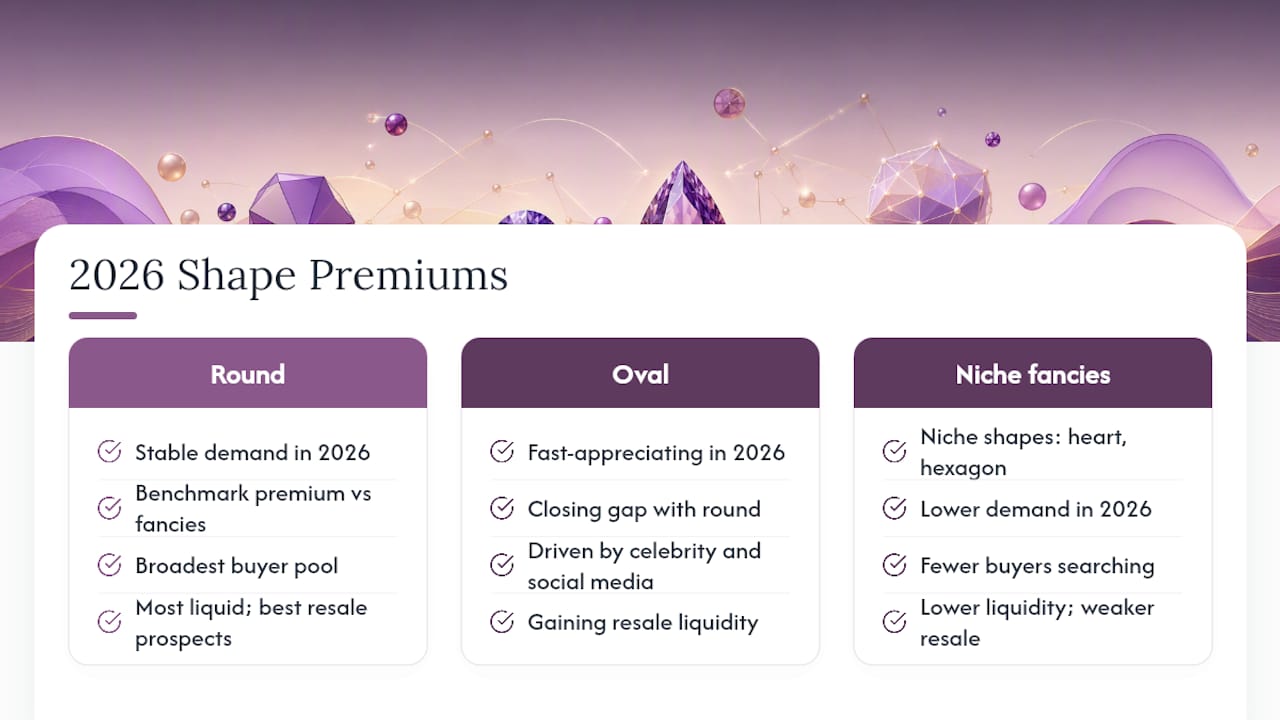
Lab-grown stones add another layer. In lab-grown markets, the round premium narrows because manufacturing costs reduce the penalty for round symmetry. The yield economics still exist, but the raw material (lab-grown rough) costs far less than mined rough, so the gap between rounds and fancies compresses. PriceScope’s live pricing charts let you compare lab-grown versus mined shape premiums in real time, which is worth checking before you commit to a shape.
Resale liquidity follows demand. Rounds remain the most liquid shape because they have the broadest buyer pool. Oval is gaining ground. Niche shapes like heart or hexagon recover less on resale simply because fewer buyers are searching for them. If you might sell or upgrade later, that matters.
Pro Tip: Check sustainable jewelry trend guides alongside shape pricing charts. Ethical sourcing and lab-grown options are reshaping which shapes buyers prioritize, and that shift affects premiums.
Typical price spreads for a 1-carat stone by shape
The table below shows approximate retail price ranges for a 1-carat stone at G color / VS2 clarity, using round as the baseline. These are illustrative ranges drawn from market benchmarking; actual prices vary by certification, fluorescence, cut precision, and supplier.
| Shape | Approx. price range (1 ct, G/VS2) | vs. round baseline |
|---|---|---|
| Round brilliant | — | Baseline |
| Oval | — | lower |
| Cushion | — | lower |
| Princess | — | lower |
| Pear | — | lower |
| Emerald | — | lower |
| Marquise | — | lower |
“Price spreads within a single shape can be just as wide as the gap between shapes. Certification, fluorescence, symmetry, and face-up appearance all create variation inside the same shape category.” — The Diamond Price, price-per-carat guide
The IGS Gem Price Guide reinforces this: large price ranges within a category are normal and expected. Always compare stones at the same certification level (GIA lab report preferred) and the same clarity/color grade before drawing conclusions from price alone.
Disclaimer: ranges above reflect general market conditions and are not guaranteed prices. Verify current figures using live pricing tools like PriceScope before purchasing.
How to compare shapes and get the best value
Comparing two candidate stones across shapes takes about ten minutes if you follow a consistent method.
- Normalize by carat range. Compare stones within 0.05 carats of each other. A 0.95-carat and a 1.05-carat stone are not the same comparison.
- Calculate price per carat. Divide total price by carat weight for each stone. Shape-driven price-per-carat differences are most meaningful when normalized this way.
- Compare face-up measurements. Pull the length × width in mm. Calculate face-up area (length × width × 0.785 for an oval approximation). More face-up area per dollar is real value.
- Check depth% and table%. Flag anything outside the typical ranges for that shape. Deep pavilions hide weight; shallow ones can reduce brilliance.
- Confirm the lab report. GIA certification is the gold standard. No lab report is a red flag, full stop.
- Inspect for shape-specific issues. Ask for video or high-resolution images. Look for bow-tie in ovals/pears, windmill effect in hearts, and off-center culets in rounds.
Red flags in listings:
- No GIA or equivalent lab report
- Depth% above 65% with no explanation
- Heavy blue fluorescence listed without disclosure
- No millimeter measurements provided
- Price significantly below market with vague grading
Pro Tip: Build a quick spreadsheet with columns for price, carat, price-per-carat, length, width, and face-up area. Sort by face-up area per dollar. Affordable luxury alternatives often win on this metric when you run the numbers.
When shape matters less than setting, budget, or personal style
Shape is one variable. Sometimes it is not the most important one.
If the setting will cover the stone’s corners or edges, a fancy shape’s distinctive silhouette disappears. A bezel-set pear looks very different from a prong-set pear. The setting style can dominate the finished jewelry’s cost and visual impact more than the stone shape does.
- When sentimental value drives the choice: Jewelry and personal expression are real. A shape that carries meaning is worth a premium that no spreadsheet captures.
Pointed-corner shapes (marquise, pear, heart) need protective prong settings or bezels to prevent chipping. That adds to the setting cost and total finished price, which can offset the stone’s lower per-carat price. Always factor setting requirements into your total budget, not just the stone price. Finished jewelry cost also includes resizing, warranty, and insurance, none of which appear in the stone listing.
Why you can trust this advice
This article is written by Ammar, a jewelry writer and editorial contributor at Merijaan. You can read more on Ammar’s Merijaan author page.
Merijaan specializes in lab-grown moissanite jewelry with a focus on ethical sourcing, artisan reinvestment, and lifetime warranty coverage. Every purchase supports the craftspeople who make the pieces: 100% of profits go back to the artisans. That commitment to transparency extends to how Merijaan approaches shape and pricing guidance.
For deeper reading on related topics, Merijaan’s blog covers lab-grown versus mined diamond pricing, why moissanite is the future of ethical jewelry, and how jewelry impacts local communities.
Key Takeaways
Gem shape affects jewelry price through three compounding forces: yield economics, optical performance, and market demand, and buyers who compare millimeter measurements alongside price-per-carat consistently get more visible value for their budget.
| Point | Details |
|---|---|
| Shape drives price three ways | Cut yield, optical performance, and demand each add to or subtract from per-carat cost. |
| Compare mm, not just carats | Face-up measurements reveal true visible size; depth% above 65% hides weight you pay for but can’t see. |
| Fancy shapes often cost less | Emerald, marquise, and pear can run significantly below round at the same carat and quality grade. |
| Demand shifts premiums | Oval is currently appreciating; resale liquidity favors rounds and rising shapes over niche cuts. |
| Merijaan’s approach | Merijaan offers lab-grown moissanite in shapes selected for face-up presence and value, with a lifetime warranty. |
The shape conversation most buyers skip
Shape pricing is taught as a simple hierarchy: rounds cost more, fancies cost less. That framing is accurate but incomplete, and it leads buyers to make trades they later regret.
The part most guides skip is the clarity offset. A buyer who moves from a round to an emerald cut to save 30% per carat often ends up spending that savings on a higher clarity grade because step cuts expose every inclusion. The net saving shrinks or disappears. The same logic applies to color: an emerald cut at J color looks noticeably warmer than a round at J because the broad facets concentrate body color. You may need to buy H or better to get the same visual result.
Lab-grown moissanite sidesteps much of this tension. Moissanite’s refractive index is higher than diamond, meaning it produces more fire and brilliance per carat regardless of shape. The clarity and color trade-offs that punish step-cut diamonds matter far less in moissanite because the optical properties are different. That is not a minor footnote. It changes which shapes are genuinely worth considering and which compromises you actually have to make.
The other thing worth saying: shape trends are real market forces, not just style preferences. Oval’s 2026 appreciation is not aesthetic. It is buyers competing for the same stones, which pushes prices up. Choosing a shape because it is trending is fine, but go in knowing you are paying a demand premium, not just a yield premium.
Merijaan makes shape and value easy to see side by side
Choosing the right gem shape should not require a finance degree. Merijaan’s lab-grown moissanite collection is built around shapes that maximize face-up presence and sparkle at prices that reflect ethical sourcing, not inflated demand premiums. Every piece comes with a lifetime warranty and unlimited exchanges for club members, so the decision you make today is not locked in forever.
Merijaan’s direct-to-consumer model means you skip the retail markup that inflates shape premiums in traditional stores. The eco-friendly moissanite collection includes oval, round, and elongated shapes chosen specifically for their face-up value. Browse the full range at merijaan.co and compare face-up sizes directly, or reach out to a Merijaan advisor to find the shape that gives you the most sparkle for your budget.
Authoritative references and further reading
Use these sources to verify pricing data and technical specifications before making a purchase.
- GIA: Value factors, design, and cut quality — the authoritative source on how cut design affects gemstone value
- IGS Gem Price Guide — retail price ranges for cut gems across types and sizes
- YourDiamondGuys: Diamond price by shape — yield data and shape-driven price differences
- Leon Diamond: How shape affects price — three-driver framework with practical examples
- The Diamond Pro: Shape and price — step-cut clarity sensitivity and price differentials
- The Diamond Price: Shape benchmarking 2026 — live market data and 2026 trend movement
- The Diamond Price: Price per carat guide — per-carat comparisons and exponential rarity explained
Always insist on a GIA lab report when purchasing, and cross-reference current prices on PriceScope before finalizing any decision.

