

“Nickel-free” on a jewelry label means the piece contains no intentionally added nickel, but in the United States that phrase carries no legal weight. There is no federal standard defining it, which means a manufacturer can print it on packaging without any third-party verification. Mayo Clinic identifies nickel as one of the most common causes of allergic contact dermatitis, and dermatologists consistently warn that the label alone is not a reliable safety guarantee. Your safest move is to ask for documented metal composition and stick to materials with a proven track record: titanium, surgical-grade stainless steel, platinum, 18K–24K yellow gold, and sterling silver.
Key Takeaways
Nickel-free jewelry labels in the U.S. carry no legal standard, so verifying metal composition directly with the seller is the only reliable protection for people with nickel allergy.
| Point | Details |
|---|---|
| No U.S. legal standard | “Nickel-free” is a marketing claim; no federal agency verifies it before a brand uses the label. |
| Plating hides the real risk | A nickel-free label may only describe the surface coating; base metals can still contain nickel once plating wears. |
| Safest metals | Titanium, surgical-grade stainless steel (316L), platinum, 18K–24K yellow gold, and sterling silver are the most reliable choices for sensitive skin. |
| Test before you trust | The DMG nickel spot test is a useful quick screen but cannot guarantee long-term safety as plating thins. |
| Merijaan’s approach | Merijaan publishes full metal specs and offers a lifetime warranty, giving sensitive-skin shoppers documented answers before purchase. |
Table of Contents
- What does “nickel-free” actually mean on a U.S. jewelry label?
- Why does nickel trigger skin reactions?
- Which metals are reliably safe for nickel-sensitive skin?
- Why plated jewelry is riskier than it looks
- How to verify whether a piece is actually nickel-free
- What to do if jewelry causes a reaction
- Practical shopping strategies for people with nickel sensitivity
- The case for material transparency in jewelry
- Merijaan’s verified materials and what to check before you buy
- Sources
What does “nickel-free” actually mean on a U.S. jewelry label?
In the United States, “nickel-free” is a marketing claim, not a regulated standard. No federal agency requires a brand to prove the absence of nickel before using the term. That gap matters enormously for anyone with a sensitivity, because a piece can be labeled nickel-free based solely on its outer plating while the base metal underneath contains nickel.
The European Union took a different approach. The European Union limits the rate at which nickel can be released from items in prolonged skin contact to 0.5 micrograms per square centimeter per week micrograms per square centimeter per week. A clinical review on PubMed found that Research suggests that regulation of nickel release in Europe is linked to decreased prevalence of nickel allergy, with adult rates roughly 8%–19% and children’s rates 8%–10% The U.S. has no equivalent rule.
A few things to keep in mind about U.S. labeling:
- “Nickel-free” has no legal definition in the U.S., so it reflects the manufacturer’s own claim, not a tested standard.
- Plated jewelry is the biggest trap. A gold-plated brass piece can be marketed as nickel-free if the plating itself contains no nickel, even though the brass base may.
- “Hypoallergenic” is equally unregulated. Dermatologists quoted by The New York Times describe it as a marketing term without a scientific or legal definition. Do not rely on it as a safety guarantee.
- Price is not a proxy for safety. Even expensive alloy jewelry can contain nickel in its composition.
Why does nickel trigger skin reactions?
Nickel causes what immunologists call delayed-type hypersensitivity, a Type IV allergic response. When nickel ions penetrate the skin, the immune system treats them as foreign invaders and mounts a response. The first exposure sensitizes the immune system; subsequent exposures trigger the reaction. Once sensitized, a person typically stays sensitized for life.
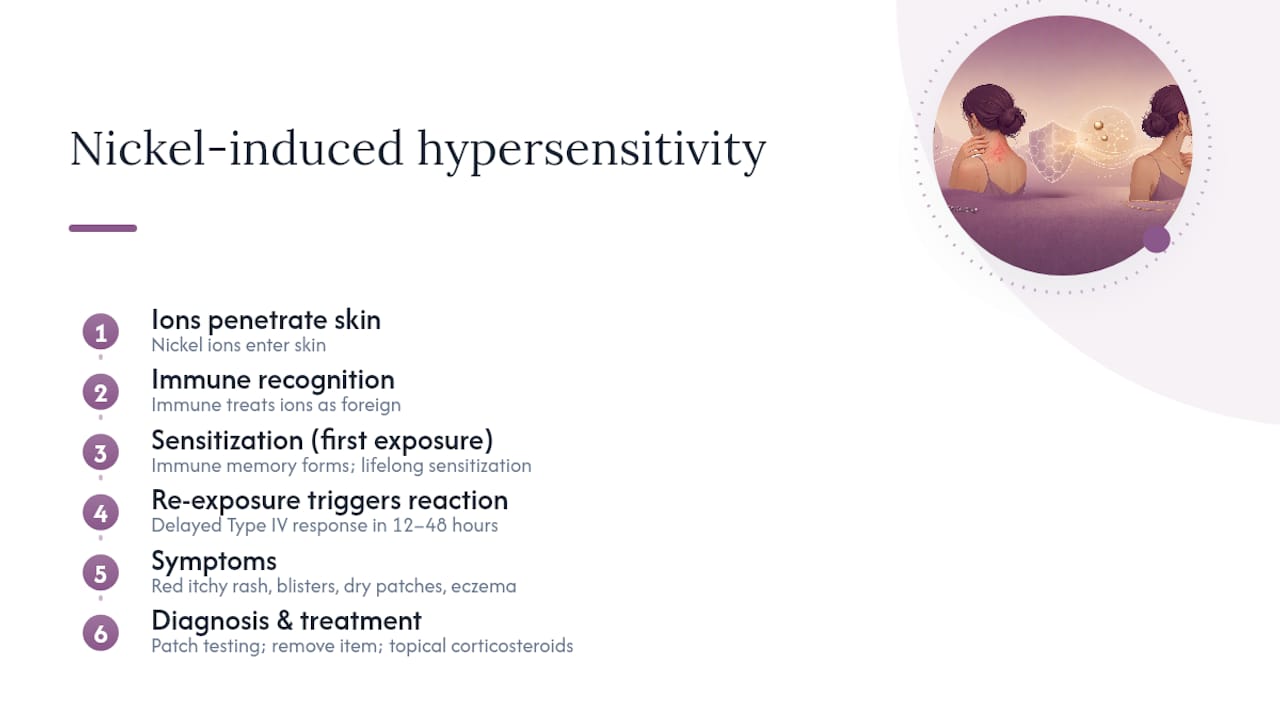
Symptoms usually appear within 12–48 hours of contact and include a localized red, itchy rash, blistering, dry patches, and in chronic cases, hand eczema from repeated contact with nickel-containing objects like coins, zippers, or clasps. The reaction can spread beyond the contact point if the exposure is prolonged.
Diagnosis is confirmed through patch testing, where a dermatologist applies small amounts of nickel sulfate to the skin under adhesive patches for 48 hours and reads the result at 96 hours. A positive result is a raised, red reaction at the test site. First-line treatment per NCBI Bookshelf is removal of the offending item, barrier creams, and topical corticosteroids.
Which metals are reliably safe for nickel-sensitive skin?
The following materials are widely recommended by medical sources as lower-risk for people with nickel allergy, per Mayo Clinic and WebMD:
- Titanium (implant-grade or commercially pure): one of the safest options, used in surgical implants
- Surgical-grade stainless steel (316L): specify surgical grade; standard stainless steel may contain nickel
- Platinum: dense, pure, and rarely alloyed with nickel
- 18K–24K yellow gold: higher karat means a higher percentage of pure gold and less room for nickel in the alloy
- Sterling silver (92.5% pure silver): generally safe, though some alloys use nickel as a hardener
- Certain plastics and resins: useful for earring backs and clasps when metal sensitivity is severe
White gold is the notable exception. It gets its color from alloy metals, and nickel is a common whitening agent. Unless a piece is explicitly labeled as using a palladium-based or nickel-free alloy, white gold carries real risk for sensitive skin.
Pro Tip: When shopping for gold jewelry, check the karat stamp. A 14K piece is 58.3% pure gold, leaving 41.7% for alloy metals that may include nickel. An 18K piece is 75% pure gold, which leaves significantly less room for nickel in the mix. Ask the jeweler specifically what fills the remaining percentage.
Why plated jewelry is riskier than it looks
Plating deposits a thin layer of one metal over a base metal. The base is almost always cheaper: brass, copper, or zinc alloy, all of which commonly contain nickel. The plating layer is measured in microns, and daily wear strips it faster than most people expect.
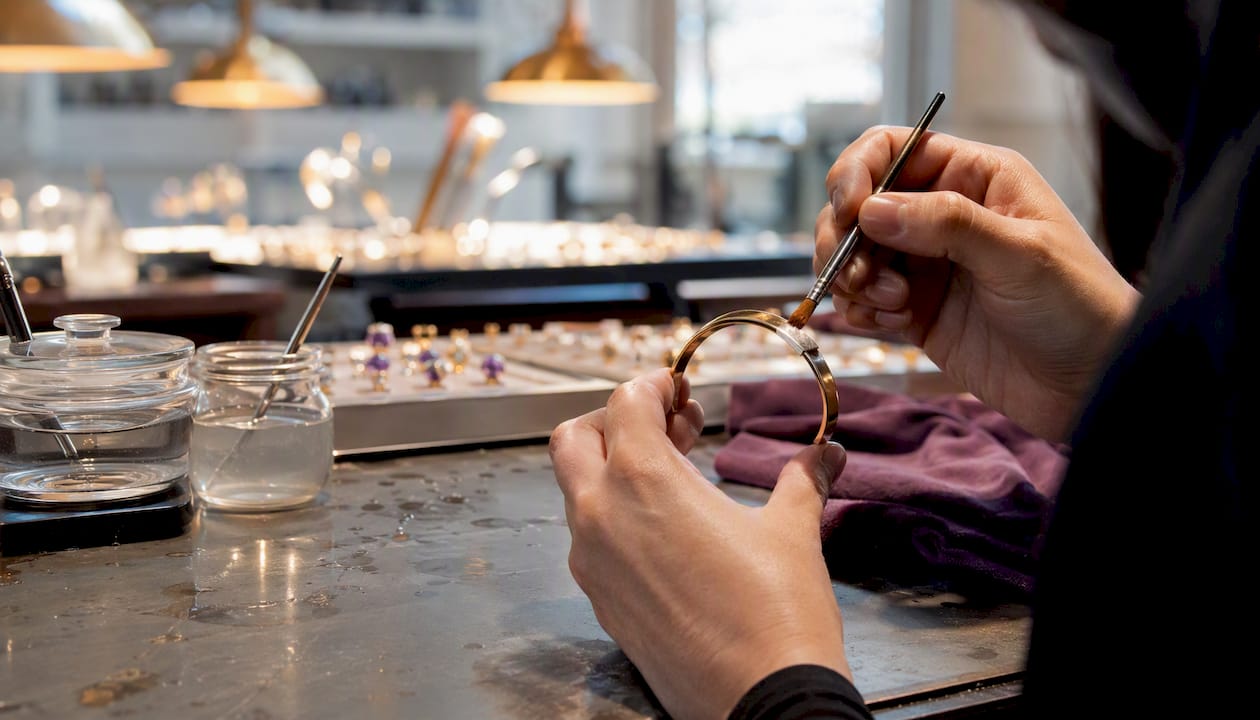
Two scenarios illustrate the difference in exposure risk. A wedding ring worn every day, through handwashing, gym sessions, and dish soap, can lose its plating within months. At that point, the skin is in direct contact with whatever base metal sits underneath. An occasional fashion ring worn a few times a year faces far less friction, so the plating holds longer and exposure stays low. The risk is not the plating itself; it is the timeline of wear.
Dr. Rajani Katta’s consumer guidance makes the point plainly: a “nickel-free” label on plated jewelry may only describe the plating, not the base metal. Re-plating can extend the protection, but it is not a permanent fix unless the base metal itself is nickel-free.
How to verify whether a piece is actually nickel-free
Before you buy or wear a piece, run through this checklist:
- Ask for written metal composition, not just a verbal assurance. A reputable seller can provide documentation.
- Request the karat and alloy breakdown for gold pieces. “Gold-filled” and “gold-plated” are not the same as solid gold.
- Prefer solid metals over plated pieces for anything you wear daily. See signs of quality in affordable jewelry to know what to look for.
- For piercings, confirm the studio uses sealed, sterile, surgical-grade instruments and can document the metal content of the jewelry they insert.
- Use the dimethylglyoxime (DMG) nickel spot test as a quick screen. The test uses a chemical solution that turns pink or red in the presence of nickel ions. A negative result is reassuring but not conclusive; the Oklahoma Allergy patient guide notes the test has limits and cannot guarantee long-term safety once plating wears.
What to do if jewelry causes a reaction
Remove the piece immediately. Wash the affected area gently with mild soap and cool water, then pat dry. A fragrance-free barrier cream can protect the skin while it heals. Over-the-counter 1% hydrocortisone cream is a reasonable first step for mild itching and redness, consistent with NCBI Bookshelf guidance on managing contact dermatitis.
Seek medical care if you notice severe swelling, spreading rash, blistering, or symptoms that do not improve within a few days of removing the jewelry. A dermatologist can confirm the diagnosis with patch testing and prescribe stronger topical corticosteroids or other treatments if needed.
This guidance is general information, not a substitute for personalized medical advice. Consult a dermatologist for diagnosis and treatment tailored to your situation.
Practical shopping strategies for people with nickel sensitivity
Building a jewelry wardrobe that does not trigger reactions takes a bit of upfront work, but the habits are straightforward once you know what to look for.
- Prioritize solid metals: platinum, titanium, and 18K+ yellow gold for daily-wear pieces. For durable everyday jewelry, solid construction matters more than surface finish.
- Avoid mystery alloys: if a seller cannot name the base metal, treat the piece as a nickel risk.
- Protect plated pieces: remove jewelry before swimming, applying lotion, or working with cleaning products. Chemicals accelerate plating wear. Good jewelry care habits extend the life of any finish.
- Check clasps and findings: earring backs, necklace clasps, and ring shanks are often made from a different metal than the decorative element. Each component needs to be nickel-free.
Pro Tip: For a wedding ring or any piece worn 16+ hours a day, solid platinum or solid titanium is the most reliable long-term choice. If you already own a ring you love, ask a jeweler whether re-plating with a palladium or rhodium finish over a verified nickel-free base is an option, per WebMD’s guidance on managing daily-wear reactions.
The case for material transparency in jewelry
Knowing what your jewelry is made of should not require a chemistry degree or a detective’s persistence. People with nickel sensitivity deserve straightforward answers from the brands they buy from, and the industry’s habit of hiding behind vague labels like “hypoallergenic” or unverified “nickel-free” claims does real harm. Merijaan publishes metal specifications and backs every piece with a lifetime warranty, which means you can ask a direct question and get a direct answer. That kind of transparency is not a bonus feature; it is the baseline any sensitive-skin shopper should expect from a jewelry brand. If a seller cannot tell you what their alloy contains, that silence is the answer.
Merijaan’s verified materials and what to check before you buy
Merijaan’s collections are built around lab-grown moissanite set in documented, ethically sourced metals, with full material specs available before you purchase. For shoppers with nickel sensitivity, that means you can verify the alloy composition before a piece ever touches your skin, not after a reaction forces the question.
Browse the Merijaan collection to review metal specifications by piece. If you have a severe sensitivity, cross-reference the karat and alloy details with your dermatologist’s recommendations before committing to a frequently worn piece. The Baden necklace is one example of a piece with documented materials and a clean design suited to sensitive skin. Club members also benefit from unlimited exchanges, so if a piece does not work for your skin, swapping it is straightforward.
Sources
- Nickel allergy - Symptoms & causes - Mayo Clinic
- Nickel allergy and allergic contact dermatitis: A clinical review of immunology, epidemiology, exposure, and treatment
- Management of contact dermatitis — NCBI Bookshelf
- Nickel (Jewelry) Allergies: Symptoms, Treatments, and Avoid Triggers - WebMD
- Nickel Allergy and Jewelry | Rajani Katta MD
- When jewelry gives you hives, a dermatologist says not to trust ‘hypoallergenic’ - The New York Times
- OAAC 504, NICKEL ALLERGY (Patient info PDF)

