

Most necklace chains follow the same core sequence: raw metal is drawn into wire, formed into links, joined by soldering or laser welding, then polished, plated, and fitted with a clasp. That’s the whole story in one sentence. Here’s what each stage actually involves:
- Wire drawing and annealing: Metal is pulled through progressively smaller dies to reach target diameter; heat cycles restore ductility between passes
- Forming and linking: Wire is coiled, cut into rings, and shaped into the chain’s specific link geometry
- Joining: Links are closed by soldering powder and tunnel furnace, hand soldering, or laser welding
- Finishing: Tumbling, polishing, diamond cutting, and rhodium or palladium plating
- Final assembly: Clasp attachment, length cutting, and quality inspection
This guide covers materials, step-by-step production, durability, timelines, and where craftsmanship genuinely matters. Merijaan’s women’s necklaces serve as a real-world example of how these choices shape finished quality.
Table of Contents
- What chain styles exist and how do they differ?
- How are necklace chains made, step by step?
- What metals and alloys go into necklace chains?
- Handmade vs. machine production: where does each fit?
- Key Takeaways
- Why craftsmanship in chainmaking still matters
- Merijaan brings this craft to finished, ethical necklaces
What chain styles exist and how do they differ?
Chain style is mostly a geometry decision made before a single link is formed. The shape of each link and how many preceding links it connects to determines drape, flexibility, and how much load the chain can bear.
Cable (trace): The most common structure. Each oval or round link connects to exactly one link on each side. Simple, flexible, and easy to machine at scale.
Curb: Cable links that are twisted flat and interlocked so the chain lies flat against skin. The interlocking adds lateral stability, which is why curb chains appear so often in timeless jewelry trends.
Box: Square cross-section links connect in a way that creates a smooth, tubular look. Less flexible than cable but very resistant to kinking.
Rope: Multiple strands twisted together. The geometry distributes load across many connection points, making rope chains among the strongest by weight.
Snake: Flat, articulated metal segments pressed tightly together. No visible links. The trade-off is that snake chains are nearly impossible to repair when kinked.
Figaro: A cable pattern interrupted by one longer link every three or four short ones. Mostly a visual choice, with no significant structural difference from standard cable.
Byzantine/wheat: Complex multi-link orientations where each ring passes through two or more preceding rings. As Skyjems’s chain-making encyclopedia explains, connecting each ring through two preceding rings produces the rolo/belcher effect, while more complex orientations yield Byzantine or herringbone characteristics. More connection points mean more load distribution, but also more labor per inch.
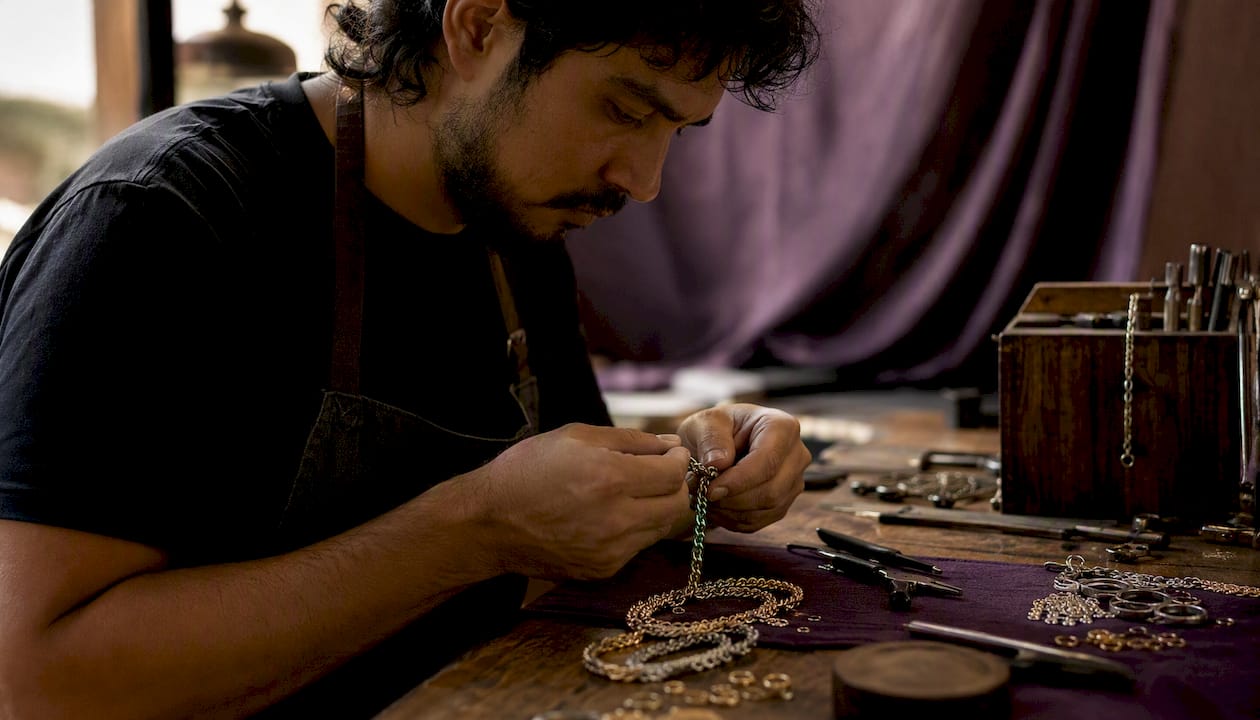
Styles like cable and curb are well-suited to machine production. Byzantine and wheat chains, with their precise multi-link threading, are more often finished or assembled by hand.
How are necklace chains made, step by step?
The necklace chain manufacturing process runs roughly eight stages from raw metal to finished piece.
- Alloy preparation. Metal is cast or purchased as bullion, then alloyed to spec. Gold chains typically use 14k or 18k alloys; silver chains use sterling (92.5% silver). Composition affects every downstream step.
- Rolling and profiling. A rolling mill reduces the cast metal to a consistent thickness and cross-section. INVIMEC’s production overview notes that rolling and forming set the wire geometry and surface consistency that quality chain production depends on.
- Wire drawing. The rolled strip is pulled through a series of progressively smaller dies. Each pass reduces diameter and work-hardens the metal, increasing tensile strength relative to the original ingot. Interweave’s chainmaking feature describes this as the step where wire diameter control is most critical.
- Annealing. Work-hardened wire becomes brittle. Annealing, heating the wire in a controlled furnace, restores ductility so forming doesn’t crack the metal. Industrial lines run annealing cycles between drawing passes.
- Coiling, cutting, and forming. Wire is coiled on a mandrel, cut into individual rings, then shaped into the target link geometry. Handmade chains use a jeweler’s saw and two pliers; machines do this in one continuous motion.
- Linking. Rings are threaded and closed. On industrial lines, Hasung’s production line documentation describes a modular sequence: vacuum casting → rolling → 12-pass drawing → annealing → chain weaving machines → tunnel furnace. Some machines integrate forming, linking, and laser welding in a single pass.
- Joining. Closed links are soldered or welded. Industrial producers apply metallurgical solder powder to the chain, then run it through a conveyor tunnel furnace in a controlled atmosphere. The controlled environment ensures uniform joints without damaging the chain’s articulation. Laser welding handles fine wires and styles where heat from conventional soldering would distort the link. Ganoksin’s palladium chain production article covers both methods in detail, including diamond-cut finishing where chains are fixed on ice-bonded cylinders and cut with diamond tooling for a bright, reflective surface.
- Finishing, clasp attachment, and QC. Tumbling removes burrs; polishing brings up the surface. Rhodium or palladium plating is applied where needed. Clasps are attached, lengths are cut, and each chain is inspected for gaps, brittle links, and uneven solder before shipping.
Pro Tip: Anneal wire in short cycles rather than one long heat. Over-annealing makes wire too soft to hold its formed shape; under-annealing leaves it prone to cracking at the link bend. A consistent schedule, matched to your alloy, is what separates clean links from cracked ones.
What metals and alloys go into necklace chains?
Metal choice shapes every step of production, from how easily wire draws to how the finished surface holds up.
- Palladium: — Naturally white, lighter than platinum, and sometimes skips rhodium plating entirely because the base metal holds its color. Ganoksin’s production methods article focuses on palladium specifically for this reason.
For readers weighing alloy options for moissanite settings, Merijaan’s metal comparison guide covers gold, silver, and platinum tradeoffs in practical terms.
Handmade vs. machine production: where does each fit?
| Criterion | Artisanal | Industrial |
|---|---|---|
| Speed | Hours to days per piece | Meters per minute |
| Customization | High; bespoke link shapes possible | Limited to machine tooling |
| Consistency | Variable; skill-dependent | Very high |
| Tooling dependency | Low; hand tools | High; proprietary machines |
| Repair/maintenance | Simple hand-tool repair | Requires in-house machining |
| Cost per unit | High | Low at volume |
The interesting wrinkle is that industrial and artisanal aren’t as separate as they look. Many chain-making facilities run machines that are decades old, and because original replacement parts are no longer manufactured, the machinists who operate them must also fabricate parts from scratch. As Interweave reports, some machines in active production are at least 80 years old. The chainmaker and the toolmaker are often the same person.
David Gariepy, a practitioner quoted in Interweave’s feature, points out that real innovation in chainmaking today rarely comes from inventing new link patterns. It comes from experimenting with wire diameter, alloy composition, and surface finishing. A slightly thinner wire in a rope chain changes its drape entirely. A different alloy changes how the surface takes a diamond cut.
Key Takeaways
Necklace chains are made through a fixed sequence of wire drawing, link forming, joining, and finishing, and every material and geometry choice along that sequence shapes the chain’s final strength, drape, and price.
| Point | Details |
|---|---|
| Core manufacturing sequence | Wire drawing and annealing → forming/linking → soldering or laser welding → polishing and plating → clasp and QC |
| Link geometry determines performance | More connection points per link (rope, Byzantine) increase load distribution; simpler geometries (cable, curb) are easier to machine |
| Material choice drives every step | Alloy affects drawability, soldering temperature, plating needs, and final cost |
| Craftsmanship persists in industrial settings | Many production machines are decades old; skilled makers must also fabricate replacement parts |
| Merijaan’s ethical approach | Lab-grown moissanite and profit-sharing with makers are structural choices, not add-ons |
Why craftsmanship in chainmaking still matters
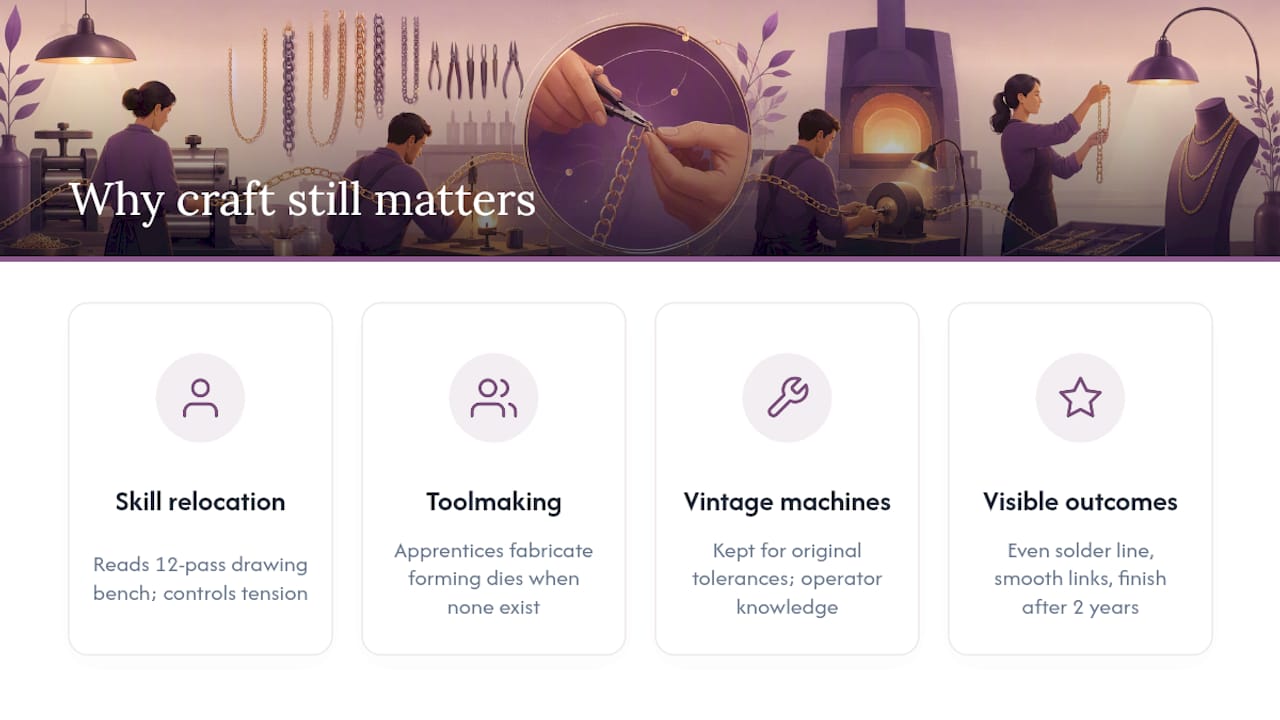
The thing most people miss about chainmaking is that the skill doesn’t disappear when machines enter the picture. It relocates. A machinist running a 12-pass drawing bench has to read the wire the way a hand-smith reads the metal under a hammer. Too much tension and the wire snaps; too little and the diameter drifts. The machine doesn’t make that call.
Apprenticeship in chainmaking has always included toolmaking. When a forming die wears out and no replacement exists, the maker fabricates one. That’s not a workaround; it’s the job. Vintage machines stay in production because they were built to tolerances that modern equivalents sometimes don’t match, and because the people who run them have spent years learning their particular quirks. There’s a kind of knowledge embedded in that relationship between maker and machine that no spec sheet captures.
What strikes me about the best chains is that the craft shows up in the details nobody advertises: the evenness of the solder line, the way the links articulate without catching, the surface that holds its finish after two years of daily wear. Those outcomes don’t happen by accident. They’re the result of someone caring about the annealing schedule, the die sequence, and the plating thickness. That’s what separates a chain worth keeping from one that’s just decorative.
Merijaan brings this craft to finished, ethical necklaces
Every step described in this guide, from alloy selection to rhodium plating, shows up in the finished pieces Merijaan sells. The difference is that Merijaan pairs that manufacturing care with lab-grown moissanite and a supply chain where 100% of profits return to the makers. You get the sparkle of a well-finished precious-metal chain without the ethical ambiguity of mined materials.

The Naters Necklace pairs a 925 silver chain with an 18k gold plating and a D-color moissanite pendant, a direct application of the drawing, plating, and finishing steps covered above. The Rapperswil Necklace shows what full moissanite coverage looks like on a finished S925 chain. Browse the full women’s necklace collection to see how these production choices translate into pieces you can actually wear.

