
Yes, you can buy jewelry directly from the manufacturer, and it typically means lower markups, real customization, and access to private-label or wholesale pricing tiers. It also means you take on more responsibility: checking minimum order quantities, confirming what’s actually made in-house, and verifying material certificates before you commit. Manufacturers like Meri Jaan build their whole model around this direct relationship, cutting out the retail middleman while keeping quality control visible to the buyer.
TL;DR:
- Buying direct from manufacturers often offers lower prices and better customization but requires verification of material quality and minimum order terms.
- Manufacturers with full in-house production provide more transparency and control over design, materials, and finishing processes.
- Materials like sterling silver, 14-karat gold, and lab-grown moissanite significantly affect pricing and turnaround times, which vary from one to eight weeks.
- Confirm the manufacturer handles critical steps internally and obtains material certificates to avoid risks associated with subcontracted work or resellers.
- Small buyers can now access low minimum order quantities, even just a single sample, reducing financial risks when testing new designs.
Table of Contents
- What Does “Schmuck Direkt Vom Hersteller” Actually Mean?
- What Should You Expect on Materials, Pricing, and Timelines?
- How Do You Verify a Manufacturer Before You Order?
- How Do You Place a Custom or Wholesale Order?
- Why Meri Jaan Chose the Direct Model
- Ready to Buy Direct? Here’s How Meri Jaan Fits
- Sources
What Does “Schmuck Direkt Vom Hersteller” Actually Mean?
“Schmuck direkt vom hersteller,” or jewelry directly from the manufacturer, sounds simple but covers three fairly different business models. A true factory-direct producer runs its own casting, setting, and finishing lines, which means the person quoting your price actually controls the process making your piece. A hybrid supplier handles design and some in-house work but subcontracts specialty steps like stone cutting or certain plating jobs. A trading house, meanwhile, is a middleman dressed up as a manufacturer. It never touches the metal.
Knowing which one you’re dealing with matters because it changes what you can expect on price, timeline, and quality control.
- In-house production commonly includes CAD design, casting, stone setting, and final QC checks.
- Frequently subcontracted steps include specialized plating (like heavy rhodium or vermeil work) and certain gemstone cutting.
- Factory-direct sourcing pays off most on custom one-off pieces, private-label sample runs, and bulk wholesale orders where the savings on markup actually add up.
Full-service manufacturers that describe end-to-end production capabilities, from CAD through plating and QC, tend to give buyers the clearest picture of where their money is going. That transparency is the real value of buying direct. It’s not just a lower price tag.
What Should You Expect on Materials, Pricing, and Timelines?
Materials drive most of the price variation you’ll see between quotes. The most common terms you’ll run into are 925 sterling silver, 585 gold (14 karat), and lab-grown moissanite, along with various plated metals like gold vermeil. Wholesale material suppliers typically stock sterling silver components and gemstone assortments that factories then use to build finished pieces, so ask exactly which grade of metal and which gem type you’re being quoted on.
Minimum order quantities used to be the biggest barrier for small buyers, but that’s shifted. Some factory-direct suppliers now advertise MOQs as low as one unit for samples, which lets you test a design before committing to a production run of 50 or 500 pieces. That single-sample option is one of the more useful developments in direct sourcing over the past few years, because it takes most of the financial risk out of trying a new design.
Turnaround times and pricing generally break down like this:
- Sample or prototype: often 1 to 3 weeks, sometimes faster with rapid prototyping services.
- Production run: typically 3 to 8 weeks depending on order size and finishing complexity.
- Expedited options: usually available at a premium, cutting production time by roughly a third to a half.
Pro Tip: Ask for a full price breakdown before you approve anything. A quote should separate design/CAD fees, sample fees, per-unit production cost, finishing or plating surcharges, and shipping or import duties. Lump-sum quotes hide where the real cost sits.
Expect additional line items for customization like engraving or private-label packaging. Most factories charge a small setup fee for these on top of per-unit pricing.
How Do You Verify a Manufacturer Before You Order?
Ask directly which production stages are handled in-house and which get subcontracted. Suppliers who run casting, setting, and QC internally can usually walk you through the process in specific detail, often with photos or short videos on request. That level of specificity is a good early signal you’re dealing with a real producer, not a reseller relabeling someone else’s stock. Industry guidance on in-house versus outsourced production is one of the clearest frameworks for judging where quality risk actually sits.
Before placing a real order, request:
- Material certificates and assay results for precious metals and stones
- Photos or short videos of actual production, not stock catalog images
- Sample packaging proofs if you’re launching a private-label product
- A written sample approval clause covering tolerances and rework policy
Payment structure tells you a lot too. A legitimate manufacturer will usually accept a staged payment (deposit up front, balance on shipment) and put return or exchange terms in writing. Watch for red flags: vague answers about who actually makes the product, refusal to send a sample, only stock photography across their entire catalog, or pressure toward unusual payment methods like personal transfers outside normal invoicing channels. Any one of those should slow you down before any of them should stop you entirely, but two or more together is a real warning sign. Public review platforms can also help you cross-check delivery and service claims before you commit to a larger order, though individual reviews always deserve some corroboration.
For a broader look at what separates a well-made piece from a mass-produced one, our guide to signs of quality affordable jewelry walks through the details worth checking on arrival.
How Do You Place a Custom or Wholesale Order?
Ordering direct from a manufacturer follows a fairly consistent five-step path, whether you’re buying one custom ring or launching a 200-piece wholesale line.
- Prepare a brief. Specify metal type, stone choice, target price per unit, and quantity before you request a quote.
- Request a detailed quote. Ask about sample rules, lead times, MOQ, and any design or setup fees up front.
- Approve the sample or CAD render. Set a payment schedule, typically a deposit to start production and the balance due on shipment.
- Monitor production. Request in-process photos and confirm final QC inspection happens before the order ships.
- Arrange shipping and inspect on arrival. Confirm import paperwork is handled and check the final pieces against your approved sample before you sign off.
Skipping the sample approval step is the most common mistake first-time buyers make. It’s also the easiest one to avoid.
Why Meri Jaan Chose the Direct Model
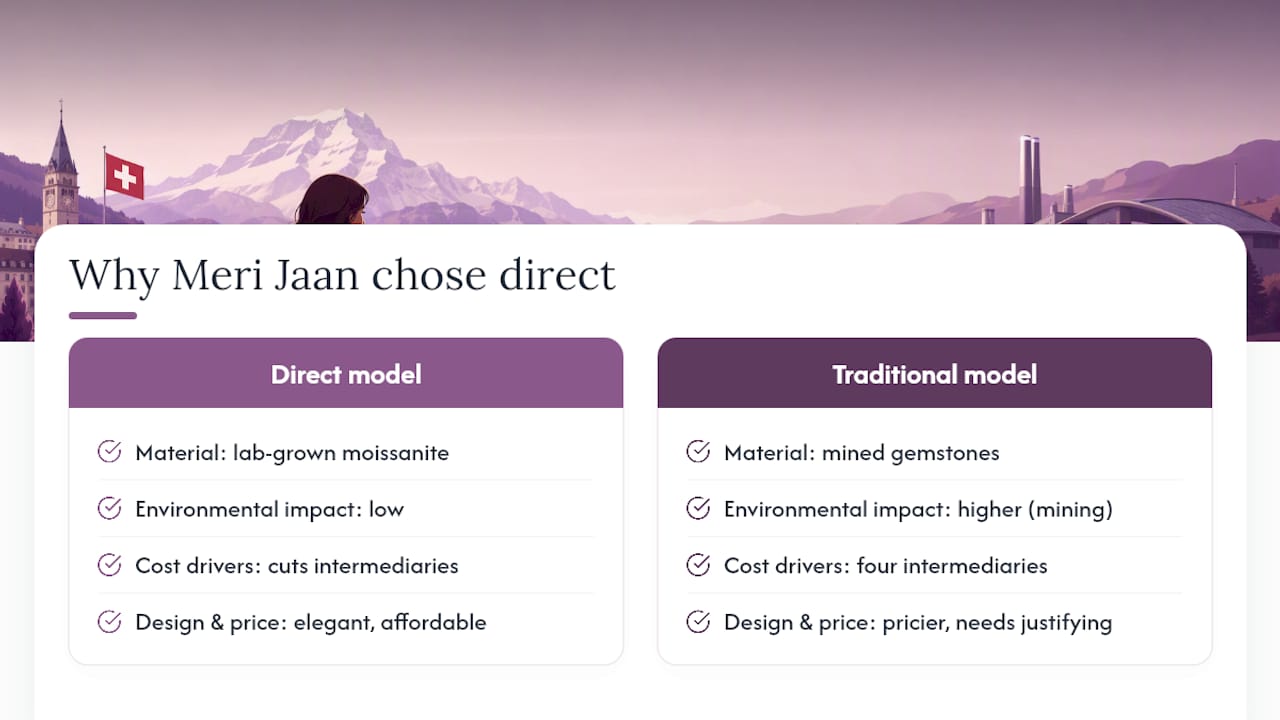
Meri Jaan builds every piece around lab-grown moissanite, partly because it delivers real fire and brilliance without the environmental cost of traditional mining, and partly because it keeps prices honest when you cut out layers of markup. That’s the whole logic behind buying direct: you’re paying for craftsmanship and material, not four intermediaries between the factory and your jewelry box.
What convinces me this model works isn’t the sparkle, though customers do mention that a lot in their feedback. It’s the consistency. Elegant, wearable designs at a price point that doesn’t require justifying the purchase for a week. Sustainability and affordability rarely sit together this comfortably in fine jewelry, and that combination is exactly what direct-to-consumer sourcing, done properly, is supposed to deliver.
— Ammar
Ready to Buy Direct? Here’s How Meri Jaan Fits
If you’ve read this far, you already know what to look for: transparent production, real material certificates, and a manufacturer that will actually show you a sample before you commit to a run. Meri Jaan fits that model directly, built for ethically minded buyers, small brands testing a first collection, and anyone who wants a custom lab-grown moissanite piece without factory-scale minimums.
Every piece ships with a lifetime warranty, and club members get unlimited exchanges if a design isn’t quite right. Low-MOQ custom orders are available for small brands who want to test a design before scaling up, and the same craftsmanship standards apply whether you’re ordering one ring or a full stacking set. Browse the necklace collection to see finished examples of what direct sourcing actually produces, or head to Merijaan to request a quote or sample for your own custom order.
Sources
For more on production models and materials, see 925CRAFT’s component catalog, Provence Jewellery’s MOQ-1 sample policy, and Meri Jaan’s own breakdown of what jewelry quality means for buyers.
- In-house vs outsourcing — what matters for jewelry production
- Provence Jewellery: Custom Fine Jewelry Manufacturer, MOQ 1
- Blazels — Silver Jewelry Manufacturer OEM, ODM & Private Label
- Edelsteine und Schmuckzubehör Silber 925

