

Recycled gold jewelry is generally worth choosing over newly mined gold, but only when the seller can prove the metal is post-consumer and document where it came from. Before you buy, check three things: the source category (old jewelry and dental gold beat vague “industrial scrap”), an assay or refinery certificate, and whether the seller can explain their chain of custody without dodging the question. The gold itself is chemically identical either way. What you’re really paying for is the paperwork behind it.
TL;DR:
- Verify that recycled gold is post-consumer by checking for clear documentation, a named refinery, and an explicit chain of custody rather than vague claims.
- Expect to pay a premium for verified recycled gold with traceability, especially when sourced from small refiners or jewelers who can provide specific certificates.
- Recognize that most recycled gold originates from jewelry and dental gold, with electronic waste playing a smaller, more complex role in the supply chain.
- Understand that while recycling reduces environmental impact compared to mining, it still involves energy-intensive refining and chemical processes that are not impact-free.
- Be aware that recycled gold jewelry generally costs the same as new mined gold and that thorough documentation is key to verifying ethical sourcing.
Table of Contents
- What “Recyceltes Gold Schmuck” Really Means: Post-Consumer vs. Pre-Consumer
- Where Recycled Gold Comes From and How It Gets Back Into Jewelry
- Environmental Benefits and the Real Limits of Recycling Gold
- How to Verify Recycled-Gold Claims Before You Buy
- Choosing Recycled-Gold Jewelry That Matches Your Values
- The Trade-Offs Nobody Mentions: Energy, Chemicals, and the Limits of “Clean” Recycling
- Market Trends: What Recycled Gold Jewelry Actually Costs and Where to Find It
- Our Approach to Sustainable Materials and Verification
- Sources
What “Recyceltes Gold Schmuck” Really Means: Post-Consumer vs. Pre-Consumer
Not all gold labeled “recycled” earned that label the same way, and the difference matters more than most shoppers realize. The World Gold Council draws a sharp line between post-consumer recycled gold, meaning material bought back from actual end users, and reuse that happens inside a factory’s own production loop. Only the first type counts as genuine recycling by their definition.
Here’s what each category looks like in practice:
- Post-consumer: A grandmother’s wedding band, melted and reformed into a new pendant.
- Pre-consumer: Scrap trimmed off during manufacturing that never reached a customer.
- Industrial reuse: Metal recirculated on-site at a factory, sometimes without ever leaving the building.
The distinction isn’t pedantic. Post-consumer recycling closes an actual loop, taking gold that already lived a full life as jewelry and giving it another one. Pre-consumer scrap, by contrast, was arguably never “waste” in a meaningful sense. When a brand’s sourcing language stays vague about which type it’s selling, treat that vagueness as the first warning sign, not a technicality to skip past.
Where Recycled Gold Comes From and How It Gets Back Into Jewelry
Recycling now supplies roughly 25 to 30 percent of the world’s gold supply. In 2025, that meant about 1,404 tonnes of recycled gold entering the market, close to 28 percent of the 5,002-tonne global total. Most of that material has a familiar origin story.
- Old jewelry makes up the bulk of it. Rings, chains, and heirloom pieces get sold back or traded in when styles change or estates get settled.
- Dental gold contributes a steady, if smaller, stream, largely from dental practices retiring old crowns and fillings.
- Electronic waste adds a growing but still modest share. Circuit boards and connectors contain trace gold, but extraction is costly and slow compared with melting down a ring.
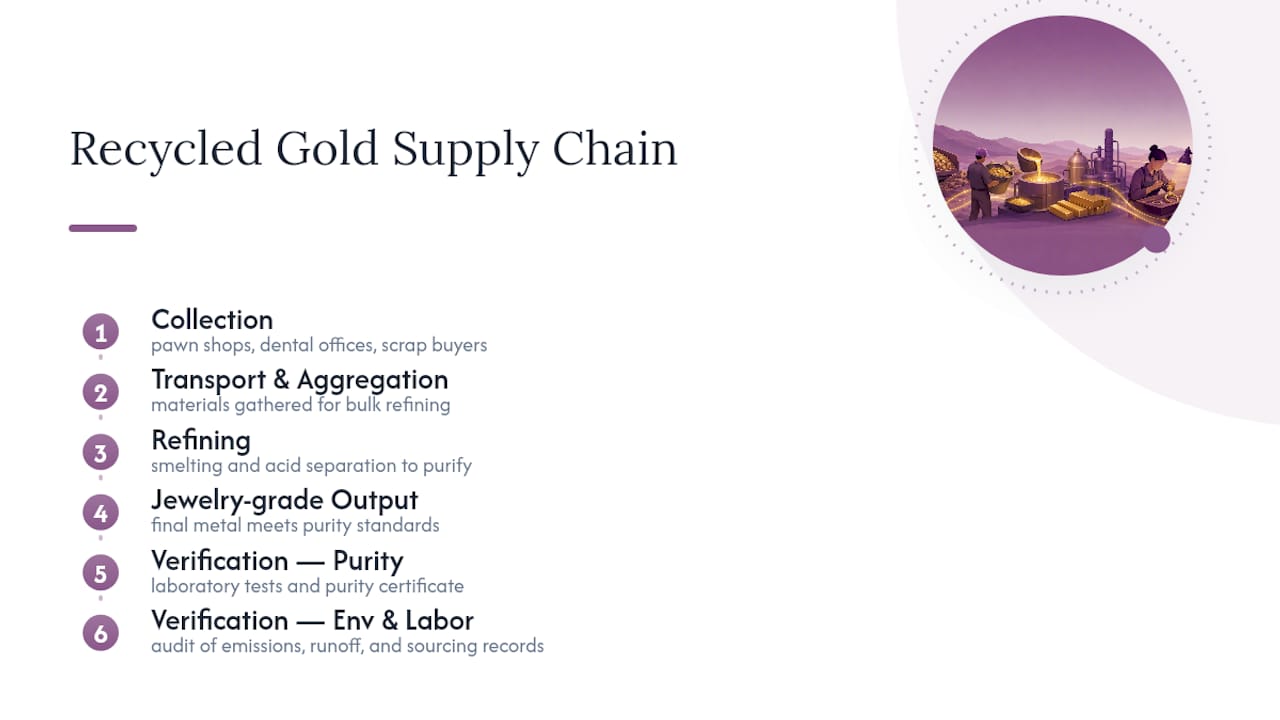
Roughly 90 percent of recycled gold traces back to jewelry, coins, and bars rather than electronics. Once collected, the metal moves through assay and sorting, then smelting and refining at a dedicated refinery, and finally remanufacture into new pieces. Refineries, called Scheideanstalten in German-speaking markets, are the checkpoint where purity gets verified and documentation either does or doesn’t get created.
Environmental Benefits and the Real Limits of Recycling Gold
Recycling gold cuts the environmental cost of jewelry substantially. Industry comparisons consistently show recycled gold requires far less energy, water, and associated carbon output than primary mining, which involves moving enormous volumes of ore, using cyanide or mercury in extraction, and often disturbing land and waterways in the process.
That said, recycling has a ceiling. It supplies roughly a quarter to a third of global gold, and how much material shows up in any given year depends heavily on gold prices and how much collection infrastructure exists locally. When prices rise, more old jewelry gets sold back for melting. When they fall, that supply tightens. Recycling alone doesn’t shut down mines. It supplements the supply chain, and it can’t grow indefinitely on demand.
Watch for these greenwashing patterns:
- Claims of “recycled gold” with no mention of post-consumer versus pre-consumer sourcing.
- No refinery name, certificate, or traceable paperwork offered on request.
- Recycled and virgin gold mixed in the same batch with no disclosure of the ratio.
Choosing recycled gold pairs well with other footprint reductions, including extending the life of pieces you already own or considering rental options for occasion jewelry instead of buying new for one event.
How to Verify Recycled-Gold Claims Before You Buy
Genuine documentation looks specific, not aspirational. A seller who can back up a recycled-gold claim will typically point to an explicit post-consumer sourcing statement, a named refinery, and some form of chain-of-custody record connecting the raw material to the finished piece.
Credible signals to look for include:
- An assay or purity certificate naming the refinery that processed the metal.
- Independent audit reports or participation in a recognized traceability scheme.
- Clear, unprompted language distinguishing post-consumer material from factory scrap.
- A hallmark stamp you can photograph and match against the certificate.
Pro Tip: Ask the seller directly: “Is this gold post-consumer, and can you name the refinery that processed it?” A confident, specific answer is a good sign. A vague answer about “eco-friendly sourcing” with no names attached usually means there’s nothing behind the claim.
Since so much recycled gold originates from old jewelry rather than electronics, smaller refiners and jewelers themselves are often the most realistic source for this kind of documentation, more so than large anonymous online marketplaces. If a seller can’t produce a certificate or explain where their metal came from within a reasonable conversation, that’s your answer.
Choosing Recycled-Gold Jewelry That Matches Your Values
Buying decisions here come down to material format as much as sourcing. Here’s how to work through it:
- Ask for the paperwork first. Request an assay report, refinery name, and hallmark photo before discussing style or price. If none of that exists, the “recycled” label is just a word on a product page.
- Compare material types honestly. Solid recycled gold costs more but lasts decades and can be resized or repaired repeatedly. Vermeil, a heavier gold plating over sterling silver, costs less but wears down over years of daily use. Recycled alloy blends purity with slightly lower cost, though disclosure of the exact mix matters.
- Expect to pay a premium for transparency. A verified chain of custody, artisan labor, and independently refined metal all cost more to produce than an unverifiable “recycled” claim slapped on a mass-market piece. That premium is often justified; an unverifiable one is not.
- Plan for upkeep. Recycled gold needs the same care as any fine jewelry: avoid harsh chemicals, store pieces separately to prevent scratching, and get prongs and clasps checked periodically.
For a broader framework on evaluating sourcing claims across materials, the guide to choosing sustainable jewelry walks through the same verification logic applied to gemstones and alternative metals.
The Trade-Offs Nobody Mentions: Energy, Chemicals, and the Limits of “Clean” Recycling
Recycling gold is cleaner than mining it, but it isn’t chemical-free. Refining scrap gold to jewelry-grade purity still requires smelting at high temperatures and, in many cases, acid-based processes to separate gold from base metals, solder, and alloy contaminants. That energy use and chemical handling is smaller in scale than what primary mining demands, but it’s not zero, and refineries vary widely in how responsibly they manage runoff and emissions.
There’s also a labor and ethics dimension that gets overlooked. Collecting old jewelry and dental gold at scale depends on a network of pawn shops, dental offices, and scrap buyers, and that chain isn’t automatically fair or transparent just because the end material is “recycled.” A refinery can process ethically questionable inputs and still output gold that tests as pure. Purity and ethics are separate questions, and a certificate proving one doesn’t automatically prove the other.
The honest takeaway is that recycled gold reduces environmental harm on average, but it doesn’t eliminate every trade-off, and buyers who assume “recycled” means “impact-free” are setting themselves up for disappointment. The better question isn’t whether the gold is recycled. It’s whether the company selling it can actually document the collection, refining, and labor practices behind that gold, start to finish.
Market Trends: What Recycled Gold Jewelry Actually Costs and Where to Find It
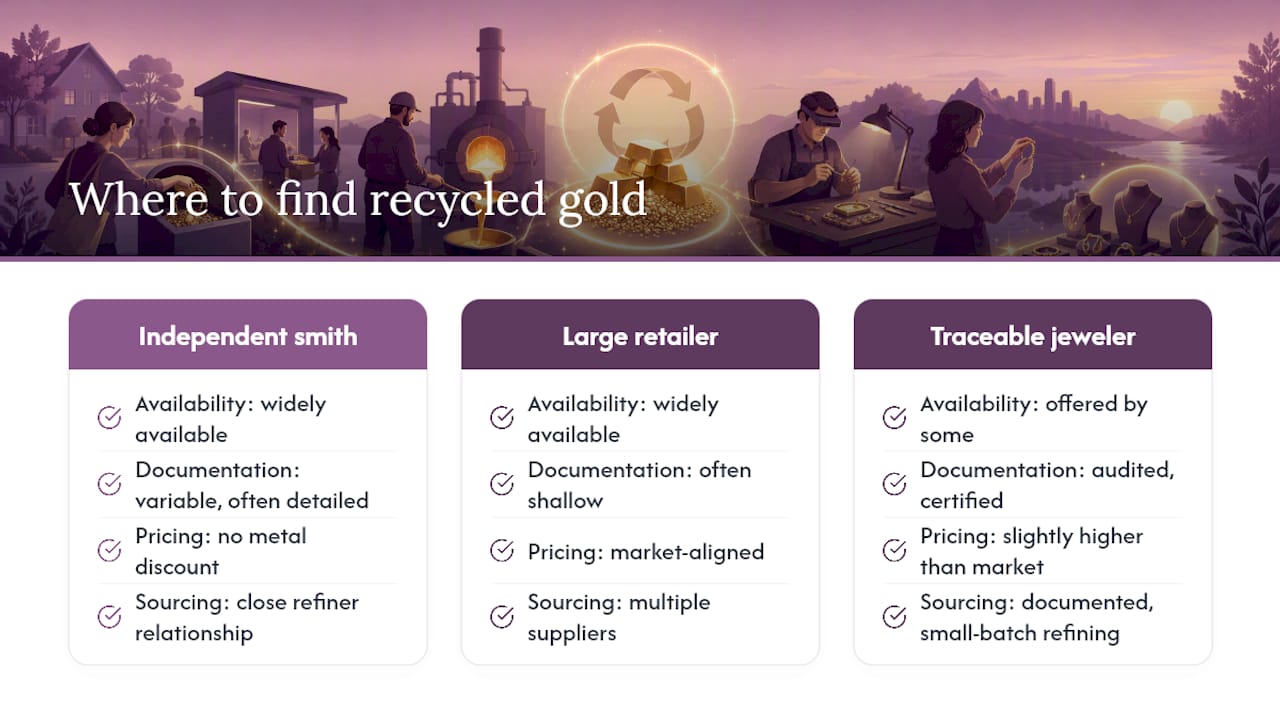
Recycled gold jewelry has moved from niche to mainstream fairly quickly, and pricing now reflects that shift. Because the metal is chemically indistinguishable from newly mined gold, recycled pieces don’t carry a discount. If anything, jewelers investing in real traceability, audits, and certified refining tend to price slightly higher than mass-market competitors, since documentation and smaller-batch refining cost more than buying anonymous bulk metal.
Availability has broadened well beyond specialty ethical jewelers. Independent goldsmiths, established jewelry houses, and online retailers now routinely offer recycled options, though the depth of documentation still varies enormously between them. A small, independent goldsmith working with recycled gold often has a closer relationship with their refiner and can answer sourcing questions with more specificity than a large retailer sourcing from multiple suppliers at once.
For buyers who want the sustainability upside without paying a metal premium at all, pairing recycled gold settings with lab-grown alternatives, like moissanite, is an increasingly common strategy. That combination lowers the cost and environmental footprint of the piece as a whole, since the stone carries none of the mining impact associated with natural gems while the setting still benefits from responsible sourcing.
Our Approach to Sustainable Materials and Verification
Sustainability claims mean little without proof, which is a big part of why Meri Jaan built its collections around lab-grown moissanite instead of mined gemstones. It delivers the same brilliance without the mining footprint, and it’s a philosophy that applies just as directly to how we think about metals: verify first, market second. It’s built into how the business operates.
Pairing a recycled or responsibly sourced setting with a lab-grown moissanite centerpiece is one of the more effective ways to lower a piece’s overall footprint without stretching your budget. If you’re shopping our necklace collection, ask us the same questions this guide walks through. We’d rather answer them than have you guess.
— Ammar
Sources
- Goldrecycling: Altgold, Angebot und Ankauf 2026 — Kettner Edelmetalle
- Gold demand trends notes and definitions — World Gold Council
- Was ist Recycling-Gold? - Fairever Blog

