

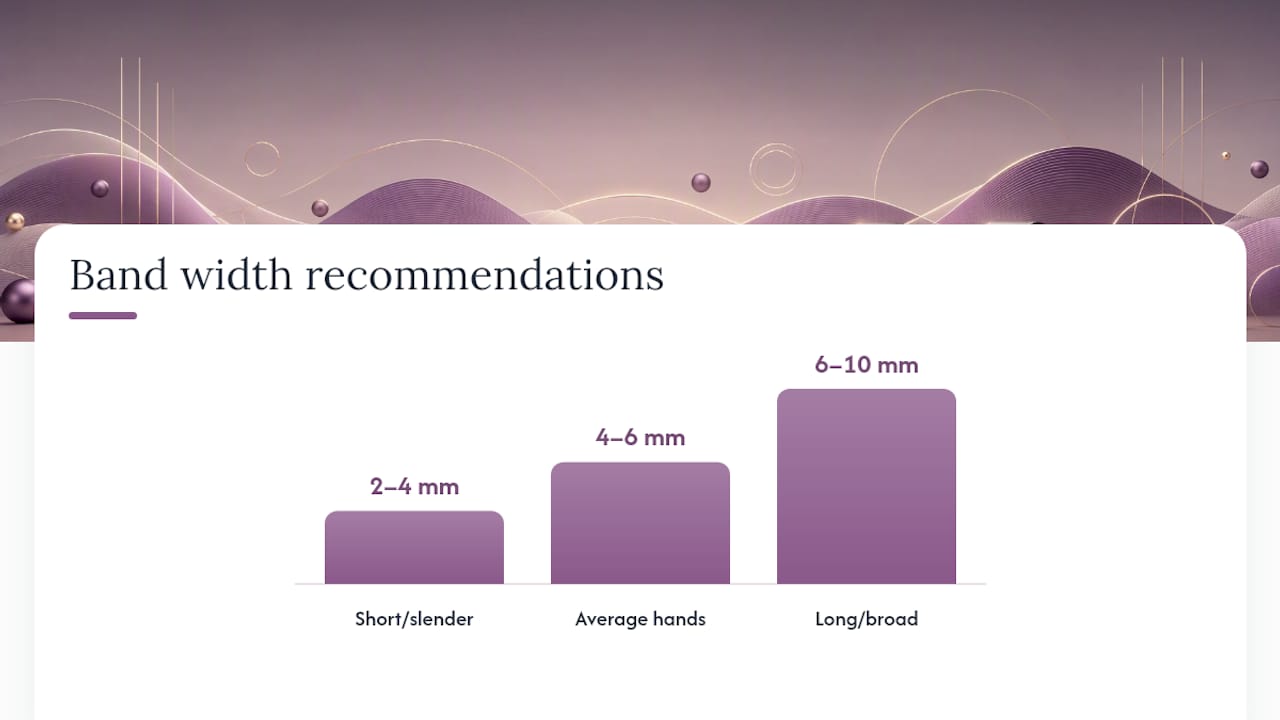
Short or narrow fingers generally look best in narrow bands, average hands have the most flexibility with medium widths, and long or broad fingers can carry wider bands without looking heavy. The one caveat that trips people up is that a wider band sits against more skin, so it usually needs to run larger than a thin band would on the same finger. Brands like Meri Jaan build their moissanite pieces with that width-to-comfort math already worked out.
TL;DR:
- Width-to-finger ratio is critical, with 2 to 4 mm suited for slender fingers while 6 to 10 mm works better for long or broad fingers.
- Accurate measurement should be taken at the end of the day with a flexible string or ring sizer, and wider bands require adding a quarter to half a size for comfort.
- The profile shape of the band, such as flat or domed, greatly influences its visual width and overall look on the finger.
- Stacking rings should balance width and finger length, with narrower bands on short fingers and wider statement pieces on long or broad fingers.
- Consider comfort tests, including passing the ring over the knuckle and wearing it for several hours, especially if hands swell during activity or heat.
Table of Contents
- Ringproportionen Hand: Finding the Right Width for Your Fingers
- How to Measure Ring Size and Adjust for Band Width
- Why Ring Profile Changes How Wide a Band Looks
- Stacking Rings to Match Your Hand Shape
- Comfort Checks Before You Commit to a Width
- Author Perspective and How Meri Jaan Approaches Proportion
- The Real Lesson on Proportion: Numbers Beat Guesswork
- Where to Try Proportional Rings From Meri Jaan
- Where to Read More on Sizing and Styling
- Sources
Ringproportionen Hand: Finding the Right Width for Your Fingers
Getting ring proportions right on your hand comes down to a simple relationship: band width relative to finger length and circumference. Jewelers call this ratio “proportion,” and it’s the single biggest factor in whether a ring looks intentional or looks like it swallowed your finger.
- 2 to 4 mm: This range suits short or slender fingers. A narrow band leaves more visible skin between the ring and the knuckle, which reads as delicate rather than cramped. It’s also the safest choice if you have multiple knuckle creases close together, since a thick band can visually shorten an already-short finger.
- 4 to 6 mm: This is the middle ground that works on most average-sized hands. It’s substantial enough to anchor a solitaire stone or a simple band design without needing a specific finger shape to pull it off.
- 6 to 10 mm: Long or broad fingers can wear this width as a genuine statement piece. On a shorter finger, the same band would look like it’s cutting the finger into segments; on a longer one, it fills the visual gap and balances the hand.
Nail length and finger-to-palm ratio shift the perception too. Longer nails elongate the whole finger, which means a slightly wider band can still look proportionate. Fingers with a high palm-to-finger ratio (where fingers are notably longer than the palm is wide) can generally handle wider bands than fingers that are short relative to the palm, regardless of overall hand size.
The industry consensus on this 2 to 4, 4 to 6, and 6 to 10 millimeter breakdown holds up across most sizing guides, largely because visual weight depends on both the millimeter width and the finger’s actual circumference. A 6 mm band on a size 5 finger reads considerably wider than the same 6 mm band on a size 9 finger.
How to Measure Ring Size and Adjust for Band Width
Getting an accurate finger measurement takes five minutes and a few household items. Skip this step and you risk ordering a ring that fits perfectly in the morning and pinches by dinner.
- Wrap a strip of paper or string around your finger at the base, where the ring will sit, and mark where it overlaps.
- Measure that length in millimeters with a ruler, then compare it to a printable sizing chart or an online conversion table to find your matching size.
- Try an adjustable plastic or metal ring sizer if you have one. These tend to give a more consistent result than string, which stretches and skews the reading.
- Repeat the measurement two or three times, ideally at different points in the day, and use the largest reading you get.
- Add roughly a quarter to a half size if you’re buying a band wider than 6 mm, since more surface area against the skin means less room to slide over the knuckle.
Timing matters more than most people expect. Jewelers Mutual recommends measuring at the end of the day, when fingers are at their largest, and avoiding measurement right after exercise, in cold weather, or after eating salty food or drinking alcohol. All three can cause temporary swelling that throws off your reading. If you’ve ever bought a ring that felt snug for a week and then loose, this is usually why.
Why Ring Profile Changes How Wide a Band Looks
The physical height and curve of a band, what jewelers call its profile, changes how wide it looks and how it feels on your hand, sometimes more than the millimeter measurement itself.
- Flat or straight profiles show their full width to the eye, which makes a 5 mm flat band look every bit as bold as its measurement suggests.
- Domed or bombé profiles curve upward in the middle, which visually narrows the band and softens its presence on the finger.
- Comfort-fit interiors, which round the inside of the band rather than leaving it flat, reduce pressure points during daily wear and let some people size a wider band without the tight, restrictive feeling a flat interior would cause.
If you’re pairing a wide band with a tall setting, like a raised solitaire or a cluster mount, a narrower shank often balances the design better than matching width for width. The setting already carries visual weight; the band doesn’t need to compete with it.
Pro Tip: Try on the same width in both a flat and a domed profile before you decide. The difference in how they sit against your knuckle is often bigger than the millimeter number would suggest.
Stacking Rings to Match Your Hand Shape
Stacking works best when it respects the same proportions that govern a single ring. Pile on too much width relative to your finger length, and even beautiful individual rings start to look cluttered.
- Short fingers: Stick to two or three narrow bands (2 to 3 mm each) on one finger, or spread single rings across two fingers instead of stacking them all on one.
- Long or broad fingers: You have room for a heavier stack. Combine one wider statement band (6 mm or more) with one or two thinner supporting rings.
- Where to place weight: Put the widest or most detailed ring closest to the knuckle and thinner bands closer to the palm. This creates a visual hierarchy instead of a wall of metal.
- Metal and contrast: Mixing tones (gold with silver, or a textured band with a smooth one) breaks up the eye’s path and makes a stack look curated rather than accidental. This kind of stacking hierarchy, one focal ring supported by quieter bands, keeps proportion intact no matter which hand shape you’re working with.
A quick example: on an average hand, a 5 mm textured band as the anchor, flanked by two 2 mm plain bands, reads as intentional rather than busy.
Comfort Checks Before You Commit to a Width
Looks matter, but a ring you can’t stand to wear for more than an hour isn’t solving anything. Run these three checks before you finalize a purchase.
- The knuckle pass test: Slide the ring over your knuckle and back off several times. It should require a little effort going on but shouldn’t need serious force either direction.
- The movement test: Wear it for at least an hour while typing, cooking, or doing normal tasks. A band that felt fine standing still can feel completely different once your hand is in motion.
- The end-of-day test: Check the fit again after several hours. If it’s noticeably tighter, your finger has swollen and the ring may need a comfort-fit interior or a slightly looser size.
If your hands swell during exercise, in heat, or from manual work, lean toward a thinner band or a rounded comfort-fit interior even if a wider style caught your eye. People who wear gloves regularly or work with their hands should generally size down in width first and compensate with design details instead.
Pro Tip: If you’re torn between two widths, choose the narrower one. You can always size up later, but a band that’s too wide for daily comfort tends to end up in a drawer.
Author Perspective and How Meri Jaan Approaches Proportion
Ammar has spent years studying how ethical sourcing and design choices intersect in fine jewelry, and the pattern that shows up again and again is this: proportion problems are almost always width problems, not stone problems. People obsess over carat size and cut, then wonder why the ring still looks off on their hand.
Meri Jaan builds every piece around the idea that sustainable materials shouldn’t mean compromised design. Their lab-grown moissanite rings are shaped with width-to-finger ratios in mind from the sketch stage, not adjusted after the fact. A comfort-fit interior and a slightly domed profile show up on their wider bands specifically so the width reads as intentional rather than oversized, and so the ring holds up to daily wear without the pinch a flat-interior band can cause.
— Ammar
The Real Lesson on Proportion: Numbers Beat Guesswork
Most sizing advice out there leans too hard on style preference and skips the math that actually determines fit. Conventional wisdom says “pick what you love,” which is fine advice for choosing a stone but useless for choosing a width. Width is a physical relationship between millimeters and finger circumference, and that relationship doesn’t bend to taste.
Here’s what the research actually supports: start with the mm range for your finger length, confirm it with an accurate measurement taken at the right time of day, then let style and profile decide the details from there. Skip that order and you’ll end up reordering a ring or living with one that never quite feels right.
The biggest gap between advice and reality is the sizing caveat almost every guide buries in a footnote. Width changes required size. Ignore that, and even a mathematically perfect proportion choice will feel wrong on your hand the first week you wear it.
— Ammar
Where to Try Proportional Rings From Meri Jaan
Meri Jaan builds every ring around lab-grown moissanite set in real craftsmanship, so you get the sparkle of a fine stone with sustainable sourcing and a price that doesn’t require a second mortgage.

If you’ve worked through the mm ranges above and want to see proportion done right, the Frauenfeld necklace shows the same width-and-profile thinking applied across a full jewelry line, not just rings. Check the ring size guide to confirm your measurement before ordering, and if you’re already picturing a stack, the engagement ring styles page shows how Meri Jaan handles width and profile on their core pieces. Club members get unlimited exchanges, so if a width doesn’t sit the way you expected once it’s on your hand, swapping it isn’t a hassle.
Where to Read More on Sizing and Styling
- Jewelers Mutual’s measurement guide covers step-by-step sizing and swelling factors.
- Tiffany & Co.'s size chart converts diameter and circumference across US, UK, and European systems.
- ICRUSH’s stacking guide breaks down stacking rules by hand shape.
- The bridal bracelet sizing guide applies the same swelling and timing principles to bracelets.
Sources
- How to Measure Ring Size | Jewelers Mutual
- Ring Size Chart & Guide: How to Measure my Ring Size? | Tiffany & Co.
- Ring Stacking nach Handform: Der passende Stack für jede Hand - ICRUSH

