

Moissanite is an affordable, high-sparkle diamond alternative, not an investment. A near-colorless 1-carat equivalent typically retails between $350 and $600 depending on brand and quality tier. You’re trading resale value for size, fire, and a much lower price tag. That’s the whole trade.
TL;DR:
- Moissanite’s price is driven by manufacturing quality, brand standards, and certification, not scarcity or mining costs, making it consistent across sellers.
- Its hardness of 9.25 allows for daily wear, but it is less scratch-resistant than a diamond, requiring careful handling and cleaning.
- Larger moissanite stones offer more visual size per dollar compared to diamonds, but resale value remains minimal, and it is not a good investment.
- Pricing for moissanite varies by size, setting, and brand, with a 1-carat equivalent typically costing between $350 and $600 in the mid-range market.
- Buyers should always verify measurements, certification, and return policies to ensure high-quality purchase and realistic expectations.
Table of Contents
- What Drives Moissanite Wert: How It’s Made and Why That Matters
- Hardness, Fire, and Weight: The Physical Traits Behind the Price
- Moissanite vs. Diamond: Where the Money and the Meaning Split
- Typical Moissanite Prices and What Pushes Them Higher
- How to Evaluate a Moissanite Listing Before You Buy
- Caring for Moissanite and Setting Realistic Expectations
- Studs, Solitaires, and Halos: What You’ll Actually Pay
- What Meri Jaan’s Own Resources Show About Pricing and Durability
- Who Should Actually Buy Moissanite
- An Honest Look at What Moissanite Buyers Actually Get
- Shop Ethical Moissanite Without the Guesswork
- Sources
What Drives Moissanite Wert: How It’s Made and Why That Matters
Moissanite occurs naturally, but only inside meteorites, in quantities far too small to supply any jewelry market. Every stone you’ll find in a ring or pendant today is lab-grown silicon carbide, manufactured under controlled conditions rather than mined.
That single fact explains most of what shoppers find confusing about moissanite wert, or moissanite value. There’s no scarcity premium baked into the price the way there is with a mined diamond. A lab can produce consistent, high-quality stones at scale, which keeps costs down and supply steady.
That shifts pricing away from rarity and toward manufacturing and brand:
- No mining costs, conflict-mineral concerns, or geological scarcity to price in.
- Quality depends on production consistency, not the luck of what nature happened to compress underground.
- Price differences between sellers usually reflect grading standards, certification, and warranty coverage, not the raw material itself.
That last point is where most of the real price variation in this category actually lives.
Hardness, Fire, and Weight: The Physical Traits Behind the Price
Moissanite rates roughly 9.25 on the Mohs hardness scale. For comparison, diamond sits at a perfect 10, and most everyday jewelry (sapphire, ruby) falls in the 8 to 9 range.
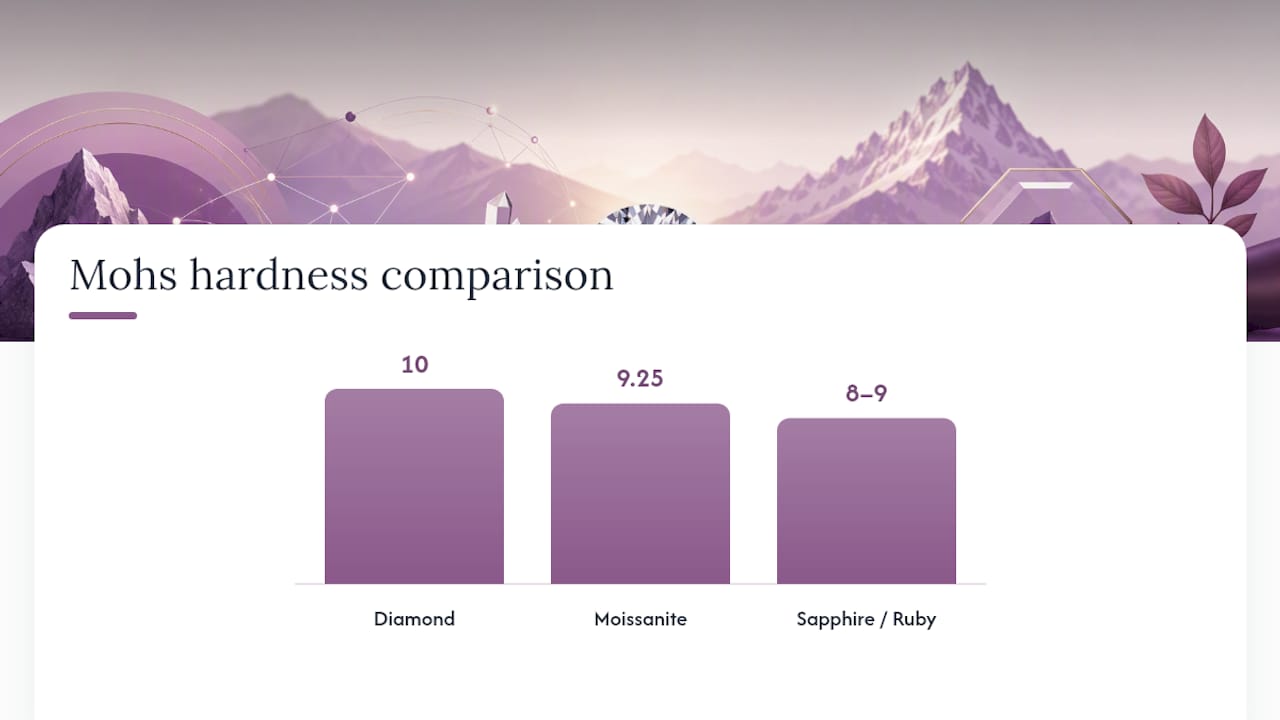
Quick fact: at 9.25 on Mohs, moissanite can handle daily wear, knocks, and years of use without scratching under normal conditions, even though it’s technically softer than diamond.
Three other traits shape how a stone looks and what it costs:
- Fire (dispersion): moissanite scatters light into more visible rainbow flashes than diamond does. Some buyers love the extra sparkle. Others find it a little too colorful for a classic diamond look.
- Weight: moissanite is less dense than diamond, so a stone typically weighs about 15% less than a diamond of the same dimensions. That’s why sellers list size in millimeters or “diamond-equivalent weight” (DEW) rather than carat alone.
- Color and clarity grading: reputable sellers use tiered color categories (often labeled something like colorless, near-colorless, and faint tint) along with clarity terms. These grades move price the same way they do with diamonds, just without one universal grading body behind them.
Moissanite vs. Diamond: Where the Money and the Meaning Split
Price is where the gap is widest. A moissanite stone that looks nearly identical to a 1 carat diamond in a photo can cost a small fraction of what that diamond runs. That’s the entire appeal for budget-conscious buyers.
Resale is where the comparison flips hard in diamond’s favor. Diamonds have an established secondary market, graded by bodies like GIA, with prices that hold up reasonably well over decades. Moissanite doesn’t have that infrastructure. Resale value is minimal to nonexistent, and you should treat any moissanite purchase as a jewelry expense, not a store of value.
So which one fits your situation?
- Moissanite makes sense if you want maximum visual size and sparkle for your budget, you care about avoiding mined-diamond supply chains, or you’re buying jewelry for enjoyment rather than legacy.
- Diamond makes sense if you’re building an heirloom piece meant to pass down, or you want an asset with some resale liquidity behind it.
- Neither is “wrong.” They’re solving different problems. One is about appearance per dollar. The other is about tradition and long-term retained value.
Nobody needs to feel talked into either choice. The honest answer is that they’re not really competing for the same job.
Typical Moissanite Prices and What Pushes Them Higher
Retail moissanite pricing generally splits into three tiers: budget, mid-range, and premium. Where a stone lands depends less on the material and more on who’s selling it and what backs the sale.
Here’s roughly what to expect by size, based on sourced retail bands and typical market listings:
- 0.5 to 1 carat equivalent: budget stones start under $150; well-known mid-tier sellers land closer to the $350–$600 range for near-colorless 1 carat equivalents.
- 1 to 2 carat equivalent: prices climb with size, and premium branded lines with certificates and warranties push well past the entry-level bands.
- Larger stones (2+ carat equivalent): still dramatically cheaper than a comparable diamond, but you’ll pay a real premium over smaller sizes within the moissanite category itself.
Beyond raw stone size, a few other factors move the final number:
- Setting and metal: solid gold or platinum settings cost more than plated alternatives, independent of the stone.
- Design complexity: halo settings, pavé bands, and three-stone designs add labor and extra small stones, which stacks on top of the center stone price.
- Certification and branding: premium sellers who provide certificates or brand-specific grading reports, sometimes referencing standards like GRA, charge more because that paperwork adds accountability the moissanite market otherwise lacks.
You can see real breakdowns of how these variables stack up in practice in Meri Jaan’s guide to what a moissanite ring actually costs.
Pro Tip: Don’t compare stones by carat label alone. A “1 carat equivalent” from one seller and another can differ in actual millimeter size. Always ask for exact dimensions before comparing price tags.
How to Evaluate a Moissanite Listing Before You Buy
Run through this checklist before you commit to a purchase, whether you’re shopping online or in a store.
- Request exact measurements in millimeters. Diameter and depth tell you the real visual size better than any “carat equivalent” claim does.
- Ask for certificate or brand verification. A named grading standard or brand-backed report signals a seller stands behind their quality claims.
- Check the return policy and warranty terms. A seller confident in their stones will offer a real inspection window, not just a final-sale disclaimer.
- Request 360-degree video or multiple photos. Static, angled product shots can hide inclusions or a dull cut.
- Compare price by like-for-like specs. Match color grade, cut quality, and size before deciding one listing is a better deal than another. A cheaper stone with a worse cut isn’t actually cheaper.
Sellers who hesitate on any of these five points are worth a second look before you hand over payment.
Caring for Moissanite and Setting Realistic Expectations
Moissanite holds up well to daily wear. A quick soak in warm water with mild dish soap, followed by a soft brush and a lint-free cloth, keeps it sparkling without any special products.
Because it sits at 9.25 on Mohs, moissanite resists scratches better than most everyday materials, but it’s not indestructible. Avoid wearing it during heavy manual labor, rock climbing, or anything likely to cause a hard direct impact.
On resale, keep expectations grounded. Moissanite isn’t built to function as an investment, and secondhand buyers typically won’t pay anywhere close to retail. If you want more detail on wear patterns and long-term care, Meri Jaan’s durability breakdown covers real-world scenarios.
Pro Tip: Skip ultrasonic cleaners for daily upkeep. They’re fine occasionally, but warm soapy water and a soft brush do the job without any risk to the setting.
Studs, Solitaires, and Halos: What You’ll Actually Pay
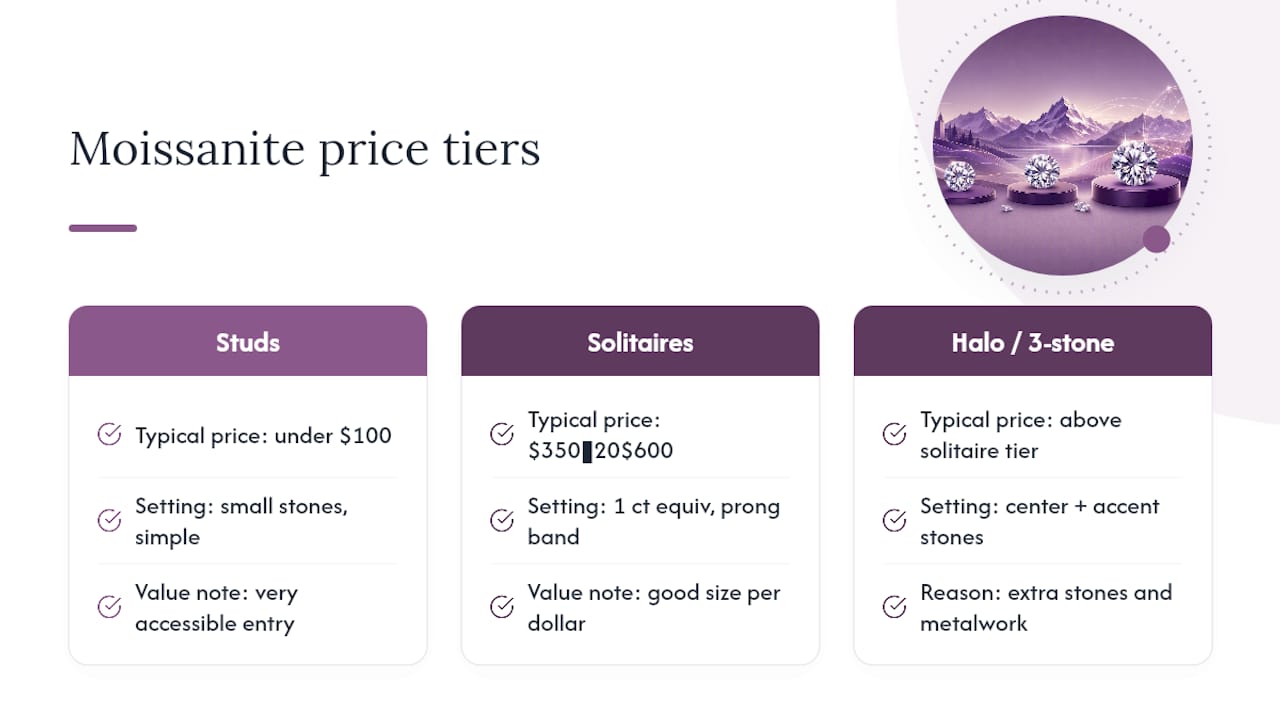
Simple stud earrings with small moissanite stones often start under $100 per pair, making them one of the most accessible entry points into the category.
Solitaire rings sit in the middle. A well-cut 1 carat equivalent in a simple prong setting typically lands in that $350 to $600 band once you factor in a solid metal band. Halo and three-stone settings run higher, since you’re paying for the center stone plus a ring of smaller accent stones and more intricate metalwork.
One practical note: because moissanite weighs less than diamond and doesn’t carry a scarcity premium, larger center stones often deliver more visual size per dollar than the equivalent jump would cost in diamond. If visual impact matters more to you than a specific carat number, sizing up is usually the better value move.
What Meri Jaan’s Own Resources Show About Pricing and Durability
Meri Jaan builds its entire catalog around lab-grown moissanite, and that focus comes with a specific commitment: profits get reinvested directly into the people who make the jewelry, not just the sale.
That first-hand focus shows up in a few concrete resources worth checking before you buy anywhere:
- The beginner’s guide to moissanite walks through the material basics without the sales pressure.
- The carat-size measurement guide explains exactly which four numbers to check before trusting a listed carat equivalent.
- The lab diamond pricing comparison breaks down where moissanite sits against other lab-grown alternatives on cost.
A lifetime warranty and unlimited exchanges for club members give buyers a real safety net most standalone moissanite sellers don’t offer, which matters more than any single price comparison once the ring is actually on your hand.
Who Should Actually Buy Moissanite
Buy moissanite if your budget is fixed, you want maximum sparkle and size for that number, and you’re not counting on resale. Skip it if you specifically want an heirloom asset or a stone with real secondary-market liquidity.
Before buying anywhere: set your budget, confirm exact millimeter measurements against the listed carat equivalent, and check the warranty terms in writing. Those three steps prevent almost every regret shoppers report after the fact.
An Honest Look at What Moissanite Buyers Actually Get
The biggest misconception about moissanite wert isn’t the price. It’s the assumption that a cheaper stone must be a compromise. In practice, cut quality and certification matter more to how a stone looks and holds up than whether it’s moissanite or diamond in the first place. A poorly cut diamond will look flatter than a well-cut moissanite every time.
If I had one piece of advice for a first-time buyer, it’s this: spend your attention on cut quality and certification before you spend it on brand names or size. A well-cut, well-documented stone at a smaller size will outshine a larger, sloppily cut one in almost every lighting condition you’ll actually wear it in.
— Ammar
Shop Ethical Moissanite Without the Guesswork
Merijaan gives you what a lot of moissanite sellers won’t: a lifetime warranty, unlimited exchanges for club members, and full transparency on where your money actually goes. A hundred percent of profits go straight back to the artisans who make each piece, which is a different model than most jewelry brands running on the same lab-grown material.
If you’ve read this far, you already know the questions to ask before buying: exact measurements, certificate details, return terms. Merijaan’s rings, necklaces, and stacking sets are built around answering those questions upfront rather than making you dig for them. Browse the current collection, check a piece against the checklist above, and see how the pricing compares to what you researched here. Start with the piece that fits your budget, confirm the specs match what you expect, and place your order with the warranty already backing it.
Sources
- Moissanite jewelry and gemstone information — Gem Society
- Moissanite vs. Diamond: Brilliance, Color, Durability & Price — Blue Nile
- Moissanite — Gemrockauctions (Moissanite price & value)
- Moissanite Price Calculator — Moissanite by Aurelia

