
Moissanite is a genuine, highly durable lab-grown gemstone, and most of the moissanite myths circulating online are misunderstandings rather than facts. It’s not a “fake diamond.” It’s a distinct mineral, silicon carbide, that scores around 9.25 on the Mohs scale and bends light more aggressively than diamond does, which is why it throws more colorful “fire.” It also typically costs a fraction of a comparable diamond. The myth-by-myth breakdown below sorts out where the confusion actually comes from.
TL;DR:
- Moissanite scores around 9.25 on the Mohs scale, making it harder and more scratch-resistant than sapphires but slightly less durable than diamonds.
- Its optical properties include a higher refractive index and dispersion than diamond, leading to more colorful flashes often called “disco fire,” which is a style preference.
- Most people cannot reliably distinguish high-quality moissanite from diamond in normal lighting, as the differences are subtle and related to the type of sparkle rather than presence.
- Resale value for moissanite is lower than diamond due to limited secondary markets and lack of established grading systems, so it is best bought for its appearance and durability rather than investment.
- Proper care involves routine cleaning and occasional professional check-ups, with discoloration usually caused by residue buildup rather than the gemstone itself losing color.
Table of Contents
- Moissanite Mythen: The Biggest Claims, Debunked
- What the Physical Differences Actually Mean for You
- Where the “Kitsch” Stigma Actually Came From
- What Moissanite Actually Costs, and What It’s Worth Later
- Keeping Moissanite Looking New
- Why Meri Jaan Talks About This Stuff Openly
- Where Moissanite Actually Came From
- The Chemistry Behind the Sparkle
- Deciding by What You Value, Not by What You’ve Heard
- Ready to See Moissanite for Yourself?
- Sources
- FAQ
Moissanite Mythen: The Biggest Claims, Debunked
Search “moissanit mythen” and you’ll find the same handful of claims repeated across forums, comment sections, and jewelry blogs. Almost none of them hold up once you check the numbers against a gemological source instead of a rumor.
- Myth: Moissanite is a cheap “fake diamond.” Fact: Moissanite is silicon carbide (SiC), a mineral first identified in a meteorite crater and now produced almost entirely in labs. It’s not diamond dressed up. It’s its own gemstone with its own crystal structure, confirmed by the mineral’s documented composition and lab origin.
- Myth: Moissanite looks obviously different from diamond, and everyone can tell. Fact: Side by side under normal lighting, most people cannot reliably tell them apart. What differs is the type of sparkle, not whether there’s sparkle at all.
- Myth: Moissanite scratches or chips easily. Fact: At roughly 9.25 on the Mohs hardness scale, it’s harder than sapphire and tough enough for daily wear, even if it sits just below diamond’s perfect 10.
- Myth: Jewelers can’t tell moissanite from diamond, so it must be “just as good.” Fact: Early handheld diamond testers did confuse the two because both conduct heat well, but gemological labs use additional tests, and gem identification standards exist precisely because simulants and distinct gemstones need to be labeled correctly.
- Myth: Moissanite has no real value and can’t hold up as jewelry. Fact: Value isn’t the same as price. Moissanite’s value lies in its durability and optical performance relative to what you pay, not in mimicking diamond’s price tag.
What the Physical Differences Actually Mean for You
Numbers on a spec sheet don’t mean much until you translate them into what you’ll actually see on your hand. Here’s the translation.
Moissanite’s refractive index sits around 2.65 to 2.69, against diamond’s 2.42, according to the same moissanite versus lab-diamond comparison. A higher refractive index means light bends more sharply as it passes through the stone, which is part of why moissanite reads as brighter under indoor lighting. Combine that with the dispersion difference mentioned above, and you get a stone that produces more colored flashes, sometimes called “disco fire,” especially in sunlight or under strong LED light.
That’s a style difference, not a defect. Diamond’s fire is more restrained and white; moissanite’s is more colorful and pronounced. Which one you prefer is entirely a matter of taste, and it’s worth comparing both in person before deciding, something the beginner’s guide to moissanite walks through in more detail.
On identification: moissanite’s thermal conductivity is close enough to diamond’s that older thermal diamond testers sometimes misread it as diamond. That’s a testing quirk, not evidence of fraud, and modern labs use electrical conductivity and optical tests to tell the two apart, per GIA’s gem identification guidance.
| Property | Moissanite | Diamond |
|---|---|---|
| Mohs hardness | ~9.25 | 10 |
| Refractive index | ~2.65–2.69 | 2.42 |
| Dispersion | 0.104 | 0.044 |
| Typical origin | Lab-grown (natural moissanite is extremely rare) | Mined or lab-grown |
Statistic callout: A hardness gap of less than one point on the Mohs scale sounds small, but in practice it means moissanite resists scratching from everyday contact, sand, and most household surfaces, just like diamond does, according to GemRockAuctions’ hardness comparison.
Where the “Kitsch” Stigma Actually Came From
The idea that moissanite looks “cheap” or “too sparkly” traces back to its earliest commercial years, when cutting techniques weren’t as refined and marketing leaned hard into the “more fire than diamond” angle, sometimes at the expense of subtlety. That combination gave moissanite an early reputation for looking flashy in a way some buyers associated with costume jewelry rather than fine jewelry.
Tastes have shifted. Cutting quality has improved, and more buyers now actively want a stone with visible personality rather than diamond’s cooler, quieter sparkle, a shift that gemstone comparisons increasingly note. Setting and metal choice still matter if you want to soften the effect.
- Choose a bezel or halo setting to contain some of the light dispersion and reduce the “disco ball” look.
- Pick yellow or rose gold tones, which mute cooler flashes compared to white metals like platinum or white gold.
- Go with a lower dispersion cut style (like a cushion or emerald cut) if you want fire that reads as elegant rather than loud.
Pro Tip: If you’re worried about disclosure at a social event, you don’t owe anyone an explanation, but a simple “it’s moissanite, I chose it for the sparkle and the ethics” tends to end the conversation faster than dodging the question.
What Moissanite Actually Costs, and What It’s Worth Later
Moissanite typically sells for a significantly lower fraction of what a similarly sized, similarly clear diamond costs according to gemstone price comparisons. Lab-grown diamonds sit in between: chemically identical to mined diamond but priced below it, and still well above moissanite.
Resale is where expectations need adjusting. Diamonds, especially certified mined ones, tend to hold resale value better because there’s an established secondary market with graded pricing. Moissanite doesn’t have that same resale infrastructure yet, so reselling it for close to what you paid isn’t realistic. That’s not a flaw in the stone. It’s a reflection of buying moissanite for what it delivers now: appearance and durability at a lower entry price, not as a resale investment.
Before you buy, protect your purchase value with a short checklist:
- Ask for a certificate or documentation confirming the stone is genuine moissanite, not an unlabeled simulant.
- Keep your receipt and any warranty documentation in one place.
- Buy from a brand that stands behind its pieces with clear return or exchange policies.
- Confirm the metal (gold-plated, sterling silver, solid gold) since that affects both price and long-term care.
Keeping Moissanite Looking New
Moissanite doesn’t need exotic care, but a little routine maintenance keeps it looking the way it did on day one.
- Wipe the stone with a soft, lint-free cloth after wearing it to remove skin oils and everyday grime.
- Soak it in warm water with a drop of mild dish soap every couple of weeks, then brush gently with a soft toothbrush around the setting.
- Use an ultrasonic cleaner only occasionally, and skip it entirely if the piece has glued accents or delicate plating.
- Take the piece to a jeweler once a year to check that prongs are tight and the setting hasn’t loosened.
Perceived yellowing almost always comes from buildup of lotion, soap residue, or oxidation on plated metal, not the moissanite itself losing color, based on jewelry care research. If a gold-plated piece looks dull after a year or two of daily wear, that’s the plating wearing thin, not the stone. A jeweler can replate or reset it.
Pro Tip: Take rings off before applying lotion or hairspray. Product buildup around the setting is the number one reason people think their stone has “changed color” when it’s really just residue.
Why Meri Jaan Talks About This Stuff Openly
Meri Jaan builds every piece around lab-grown moissanite specifically because it delivers real durability and real sparkle without the markup that comes from mined diamond scarcity. We’re upfront that moissanite isn’t a diamond substitute pretending to be something else. It’s a distinct, ethically sourced gemstone we chose on its own merits, a position explained in more depth in why Meri Jaan only uses moissanite.
That transparency extends to pricing and resale expectations too. We’d rather tell you plainly what moissanite is worth and what it isn’t than let a myth do the talking. For readers weighing sustainability claims specifically, our deeper look at moissanite’s environmental footprint breaks down sourcing in more detail than a product page ever could.
Where Moissanite Actually Came From
Moissanite’s story starts in 1893, when French chemist Henri Moissan discovered tiny crystals of silicon carbide in rock samples from the Canyon Diablo meteorite crater in Arizona. He initially thought he’d found diamond, and it took further analysis to confirm the crystals were a different mineral entirely, one that would later be named moissanite in his honor.
Natural moissanite turned out to be exceptionally rare, found only in trace amounts in certain meteorites and a handful of geological settings. That rarity meant it never became commercially viable as a mined gem. The moissanite in jewelry today, including virtually everything sold on the market, is lab-grown, produced through controlled crystal growth methods refined since the 1990s, according to documentation of the mineral’s discovery and lab origin.
That lab-grown status isn’t a downgrade. It’s the reason moissanite jewelry can exist at accessible prices at all. Since there’s no meaningful natural supply to mine, every commercial stone comes from a controlled, repeatable process, which also means fewer of the environmental and labor concerns tied to traditional diamond mining. The gem’s origin story is really a science story: a 19th-century chemist’s misidentified meteorite sample eventually became one of the more interesting alternatives in modern fine jewelry.
The Chemistry Behind the Sparkle
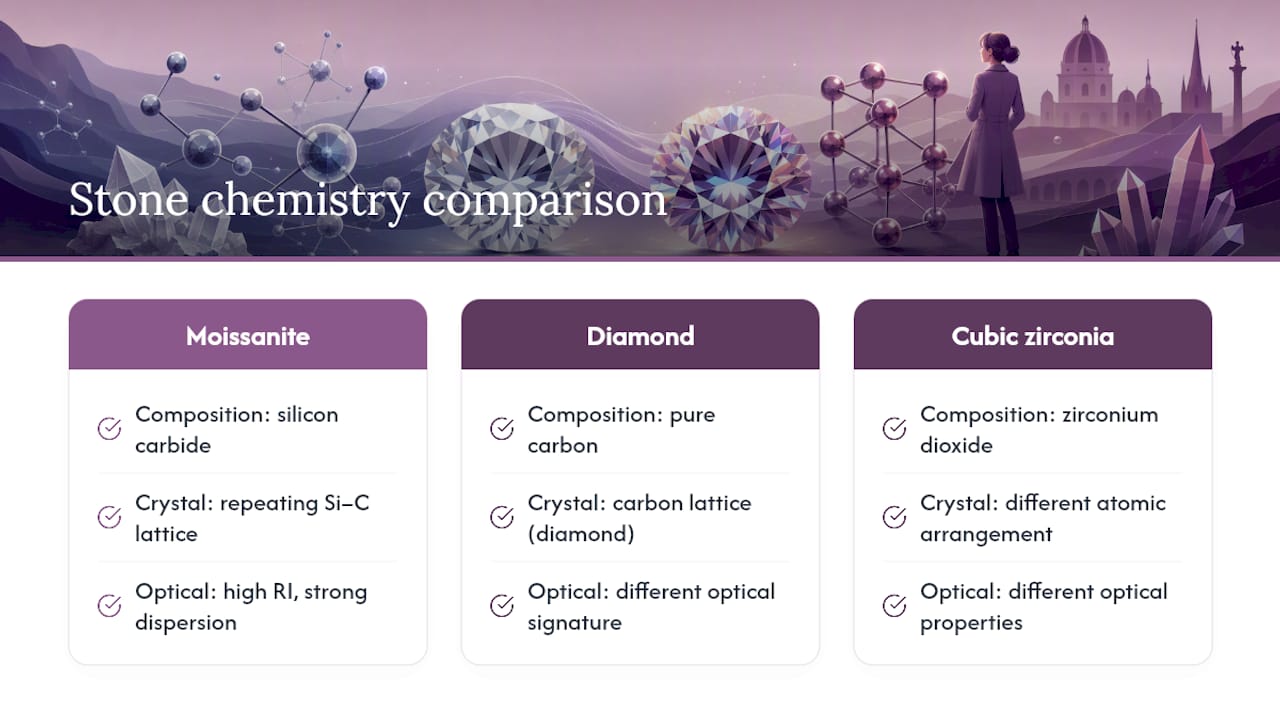
Moissanite is silicon carbide, meaning each crystal is built from silicon and carbon atoms bonded in a repeating lattice structure. That’s fundamentally different from diamond, which is pure carbon, and different again from cubic zirconia, which is zirconium dioxide. The atomic arrangement is what gives moissanite its specific hardness, its higher refractive index, and its distinctive dispersion rating compared to other stones on the market.
This crystal structure is also what makes moissanite so thermally stable. Silicon carbide is used industrially in high-heat applications precisely because it holds up under extreme temperatures better than many other materials, including diamond in certain conditions, according to materials research on silicon carbide. For jewelry purposes, that translates into a stone that isn’t going to degrade from normal exposure to heat, sunlight, or the occasional trip through an ultrasonic cleaner.
It’s worth contrasting this briefly with lab-grown diamond, since the two get confused constantly. Lab-grown diamond is grown using processes like HPHT or CVD that replicate the exact carbon structure of mined diamond, according to GIA’s explanation of diamond growth processes. It’s chemically identical to mined diamond, just made faster and cheaper. Moissanite was never trying to be that. It’s a separate mineral with its own chemistry, its own optical signature, and its own reason to exist in a jewelry box.
Deciding by What You Value, Not by What You’ve Heard
If you’re choosing between moissanite and diamond, the honest answer is that it comes down to values more than facts once you strip the myths away. If durability and daily wearability matter most, moissanite performs well. If you want maximum fire and don’t mind paying more, it may edge out diamond on pure sparkle. If resale value is your priority, be realistic about where moissanite currently sits in the secondary market.
My advice: see both stones in person before committing. Photos and specs don’t capture how a stone catches your specific lighting at home. Use the purchase checklist above, ask questions, and don’t let outdated moissanite myths make the decision for you.
— Ammar
Ready to See Moissanite for Yourself?
Meri Jaan is the direct route to ethically sourced, lab-grown moissanite jewelry without paying mined-diamond markups for comparable fire and durability. Every piece is built for daily wear, backed by a lifetime warranty, and covered by unlimited exchanges if you’re a club member, so testing your assumptions about moissanite comes with a real safety net.

Browse the ring collection if you’re shopping for an engagement or stacking piece, or check out vintage-style rings for a more classic silhouette. Prefer something you can wear every day without a second thought? The women’s bracelet collection and necklace collection both run on the same warranty and exchange terms. And if you’re shopping for someone outside your own jewelry box, whether a gift for a partner or something for a corporate occasion, the same ethical sourcing logic applies broadly, something echoed in this roundup of sustainable corporate gift ideas. Head to Merijaan to see current pieces and pricing.
Sources
- Moissanit — Wikipedia (German)
- Gem imitation — GIA
- Moissanit vs. Diamanten: Was sind die Unterschiede? | GemRockAuctions
FAQ
Is Moissanite Valuable?
Yes, in terms of durability and optical performance for the price, but it doesn’t carry the same resale infrastructure or long-term price retention that certified diamonds have.
What Does “Moissanite” Actually Mean?
Moissanite refers to silicon carbide gemstones, named after chemist Henri Moissan, who first identified the mineral in meteorite samples in 1893.
Is Moissanite Better Than Diamond?
Neither is objectively “better.” Moissanite offers more fire and a much lower price at around 9.25 on the Mohs scale, while diamond offers slightly greater hardness and stronger resale value.
Is Moissanite Better Than Cubic Zirconia?
Yes, for long-term wear. Moissanite is significantly harder and more durable than cubic zirconia, which scores below moissanite on the Mohs scale and tends to cloud or scratch faster with daily use.
Does Meri Jaan’s Moissanite Turn Yellow Over Time?
High-quality moissanite, like the stones Meri Jaan uses, holds its clarity under normal wear; any discoloration typically comes from residue buildup rather than the gemstone itself.

