
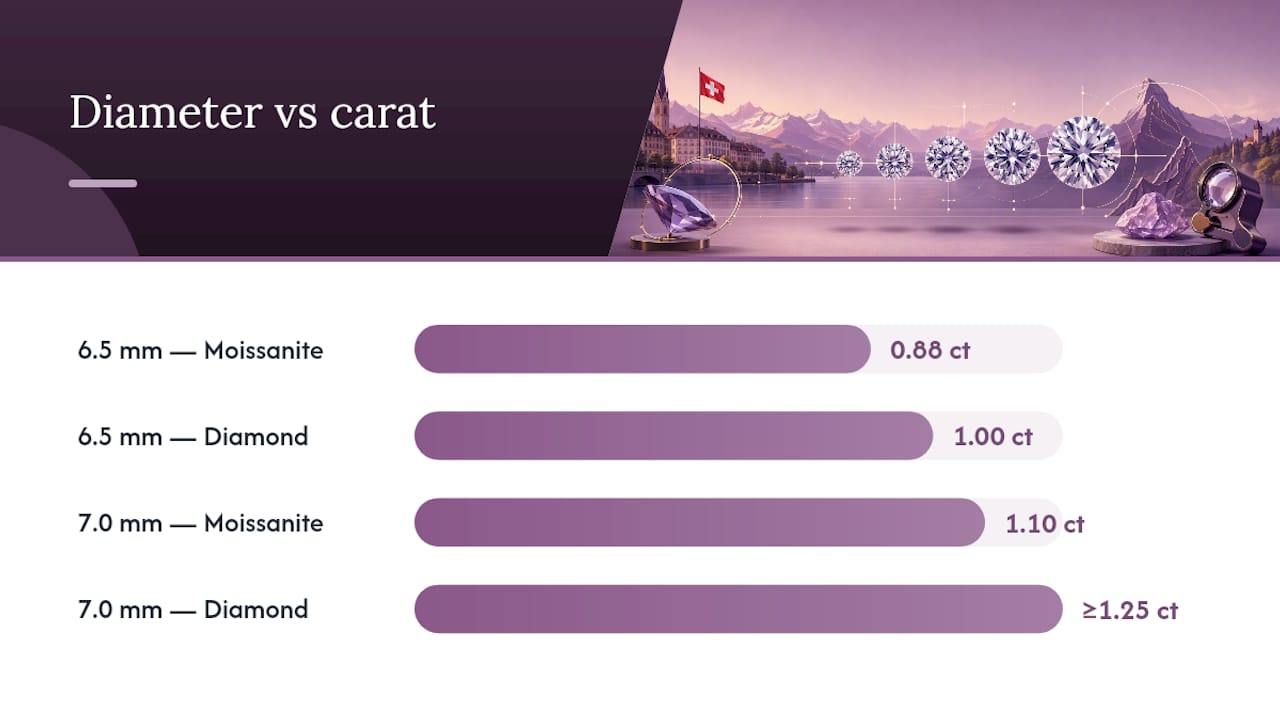
Moissanite’s carat measures weight, not size, and that distinction changes how you should shop. A 6.5 mm round moissanite weighs about 0.88 carats yet looks like a 1.0 carat diamond, because moissanite is less dense than diamond. Compare stones by millimeter diameter, not carat weight, and check the Mohs hardness rating (about 9.25) to confirm you’re getting a durable stone built for daily wear.
TL;DR:
- Comparing moissanite to diamond by carat weight alone is misleading because moissanite is less dense, meaning a 6.5 mm moissanite weighs about 0.88 carats, not 1.0.
- Buyers should prioritize millimeter diameter over carat weight, since size impacts appearance more accurately and guides better purchasing decisions.
- Good cut quality and precise millimeter measurements are crucial for ensuring maximum brilliance and fire, regardless of the carat label.
- Retail prices are generally based on millimeter size rather than carat weight, with moissanite typically costing less than a diamond of similar visual size.
- Confirming the exact millimeter measurement and lab-grown status before purchasing helps avoid common size-related misunderstandings and overestimations.
Table of Contents
- Why Carat Comparisons Between Moissanite and Diamond Fall Apart
- Moissanite Size Chart: Millimeters to Approximate Carat Weight
- What Do Common Moissanite Sizes Look Like on a Ring?
- The Physical Properties Behind Moissanite’s Size Illusion
- How Moissanite Is Actually Priced
- A Practical Checklist for Choosing Moissanite Size
- How Meri Jaan Sizes and Quality Checks Every Stone
- Seeing Moissanite Next to Diamond at the Same Carat Weight
- Common Moissanite Carat Myths That Trip Up Buyers
- How to Verify Moissanite Authenticity and Quality
- Why Mm-First Shopping Beats Carat Chasing
- See Moissanite Sizing in Action on Meri Jaan Pieces
- Sources
- FAQ
Why Carat Comparisons Between Moissanite and Diamond Fall Apart
A carat equals exactly 0.2 grams, full stop, no matter which gem you’re weighing. The catch is that moissanite and diamond pack that weight into different amounts of space, because moissanite is measurably less dense than diamond. That density gap means two stones with identical face-up diameters won’t weigh the same.
Here’s the real-world version: a 6.5 mm round moissanite weighs less than a 6.5 mm round diamond, which is often around 1.0 carat. Same visual footprint on your finger, different carat weight. This is exactly why engagement ring specialists recommend sizing by millimeter rather than carat when you’re weighing moissanite against diamond.
A few things to keep in mind as you read spec sheets:
- Carat weight tells you mass, not the diameter you’ll see when the ring is on your hand.
- Cut proportions (shallow versus deep) shift how much a stone weighs at a given diameter.
- Some sellers report weight to the nearest 1/1000 of a carat, which can make near-identical stones look different on paper even when they’re visually indistinguishable.
If a listing gives you carat weight alone, you’re missing the number that actually predicts how the stone will look.
Moissanite Size Chart: Millimeters to Approximate Carat Weight
Product pages rarely agree on units, which is exactly why you need a reference point before you start comparing listings. The table below gives you rough carat equivalents for common round moissanite diameters, based on standard cutting proportions.
| Diameter (mm) | Approximate Carat Weight | Common Use |
|---|---|---|
| 4.0 mm | small fraction of a carat | Stud earrings, accent stones |
| 4.5 mm | slightly larger fraction | Small pendants, stacking rings |
| 5.0 mm | about half a carat | Everyday studs, delicate solitaires |
| — | modest carat weight | Pendants, modest engagement rings |
| 6.0 mm | moderate carat weight | Classic solitaire engagement rings |
| 6.5 mm | close to a carat | Popular engagement ring size |
| 7.0 mm | above a carat | Statement solitaires |
| — | significantly over a carat | Bold centerpiece rings |
Treat these as approximate. Cut quality, table percentage, and brand cutting standards can shift the actual weight at a given diameter, sometimes by a tenth of a carat or more. That’s a big part of why buying guides consistently point buyers toward millimeter measurements instead of carat when comparing across sellers.
Pro Tip: If a listing only shows carat weight, email the seller and ask for the exact millimeter diameter before you buy. A reputable jeweler will have that number on hand instantly.
What Do Common Moissanite Sizes Look Like on a Ring?
Size perception depends on more than the raw number. Finger width, setting style, and metal color all change how a stone reads on the hand.
- Small stones (4.0 to 4.5 mm): These read as delicate and understated, ideal for stacking rings, minimalist pendants, or a first piece for someone new to moissanite.
- Medium stones (5.0 to 6.5 mm): This range covers the sweet spot for classic solitaire engagement rings. A 6.5 mm stone on a medium finger (size 6 to 7) reads as a confident, traditional carat-plus diamond look without tipping into flashy territory.
- Large stones (7.0 mm and up): These become the visual anchor of the piece. A halo setting or thin band amplifies the size effect further, since the eye reads the whole silhouette, not just the center stone.
Petite fingers make a 6.0 mm stone look larger than it would on a broader hand, and a thin pavé band exaggerates center stone size more than a chunky solitaire mount does.
The Physical Properties Behind Moissanite’s Size Illusion
Moissanite is silicon carbide, grown in a lab, and it earns a Mohs hardness rating of about 9.25. Only diamond and a handful of lab-created materials sit higher, which means moissanite shrugs off the daily scratches and knocks that dull softer stones over years of wear.
Hardness explains durability. Optics explain why moissanite often looks bigger and brighter than its carat weight suggests.
- Refractive index: Moissanite measures roughly 2.65 to 2.69, well above diamond’s 2.42.
- Dispersion (“fire”): Moissanite’s dispersion sits around 0.104, compared to diamond’s roughly 0.044, which is where those rainbow flashes come from.
That combination of higher refractive index and stronger dispersion means light bounces around inside a moissanite stone more aggressively than in a diamond of the same size. A well-cut moissanite throws more visible sparkle per millimeter, which is part of why a 6.5 mm stone can read as more eye-catching than its 0.88 carat weight implies on paper. Cut quality still decides whether that fire looks brilliant or overdone. A shallow cut can push moissanite toward a disco-ball effect rather than the balanced sparkle most buyers want.
How Moissanite Is Actually Priced
Moissanite pricing works differently than diamond pricing, and understanding the unit sellers use saves you from bad comparisons. Most retailers price by stone size (millimeter bands) rather than a strict per-carat formula, since weight varies with cut even at the same diameter.
- Loose stones are often listed in defined size ranges from around 0.10 ct up to several carats, with millimeter measurements listed alongside weight.
- Retail examples show moissanite running substantially cheaper than a diamond of comparable face-up size, though exact figures vary widely by brand, cut, and color grade.
- Resale value works differently than diamond too. Moissanite is generally bought to wear and enjoy rather than as an investment, so think about resale expectations before comparing it dollar for dollar against a diamond’s often-touted resale narrative, which is itself frequently overstated.
Price per millimeter, not price per carat, is the number that actually tells you what you’re paying for visible size.
A Practical Checklist for Choosing Moissanite Size
Before you commit, run through these checks:
- Confirm the exact millimeter diameter. Don’t accept carat weight alone as the size spec.
- Check the color grade. Aim for near-colorless grades if you want a diamond-like look.
- Evaluate cut quality. A well-proportioned cut balances brilliance and fire instead of tipping into excessive flash.
- Ask about clarity. Moissanite is typically eye-clean, but grading still varies by supplier.
- Confirm warranty and return policy. A lifetime warranty or clear exchange policy signals a seller confident in their stones.
- Request the lab or manufacturer source. Lab-grown origin should be stated plainly, not buried in fine print.
Shopping online, ask for a photo of the stone on a hand or finger, not just a macro studio shot. In a store, bring a loupe and check the stone under daylight, not just jewelry-case spotlights designed to maximize sparkle.
Pro Tip: A listing with no millimeter measurement, no return policy, and only a vague carat number is a red flag. Walk away or ask direct questions before you buy.
How Meri Jaan Sizes and Quality Checks Every Stone
Meri Jaan works exclusively with lab-grown moissanite, listing millimeter measurements alongside carat weight on every product page so you’re never guessing at real-world size. That mm-first approach reflects the same logic gemological guides recommend: size by diameter, confirm weight second.
Seeing Moissanite Next to Diamond at the Same Carat Weight
Picture two 1.0 carat round stones sitting side by side, one diamond, one moissanite. The diamond measures close to 6.5 mm across. The moissanite, being less dense, needs to be cut slightly larger, closer to 6.7 to 6.8 mm, to hit that same 1.0 carat weight. Flip that comparison around and the pattern holds: a 6.5 mm moissanite weighs in around 0.88 carats while a 6.5 mm diamond sits near a full carat.
This is the visual trap that trips up a lot of first-time buyers. Someone shopping by carat alone assumes a “1 carat moissanite” will look identical to a “1 carat diamond” on the finger, and technically, weight for weight, it will look roughly the same size, maybe marginally larger given the diameter difference. But if that same shopper compares a 6.5 mm moissanite against a 6.5 mm diamond thinking the carat numbers should match, they’ll be confused when the receipt says 0.88 ct instead of 1.0 ct.
The fix is simple once you see it laid out: anchor every comparison to millimeter diameter first, then let carat follow as a secondary confirmation. If you’re staring at two listings, one quoting “1 ct moissanite” and one quoting “6.5 mm moissanite,” ask for the missing number on each so you’re comparing apples to apples. A quick mental chart helps: at 6.5 mm, expect roughly 0.88 ct in moissanite versus roughly 1.0 ct in diamond. At 7.0 mm, moissanite runs closer to 1.10 ct while a diamond of that diameter often exceeds 1.25 ct. The gap widens as stones get larger, which matters more the bigger your budget gets.
Common Moissanite Carat Myths That Trip Up Buyers
The biggest misconception is thinking “1 carat” means the same physical size no matter what stone you’re buying. It doesn’t. Carat is a weight unit, full stop, and two materials with different densities will hit that weight at different diameters, as the mm chart above shows plainly.
A second myth: assuming a higher carat number always means a more impressive-looking stone. Cut quality changes that equation constantly. A well-cut 0.75 ct moissanite with ideal proportions can outshine a poorly cut 1.0 ct stone that leaks light through a shallow pavilion. Weight is only half the story; light performance does the rest.
Third, some buyers assume moissanite “fakes” a diamond’s carat weight through some kind of optical trick. It doesn’t fake anything. It’s a distinct gemstone with its own refractive index and dispersion values, and its size-to-weight ratio simply follows different physics than diamond’s. Comparing the two by carat alone ignores that they’re different materials with different densities, not a diamond substitute pretending to hit the same numbers.
Finally, don’t assume every seller uses the same rounding or measurement standard. One brand’s “6.5 mm” stone might run a hair smaller or larger than another’s, since cutting houses don’t all follow identical proportion standards. When in doubt, ask for the stone’s exact millimeter measurement and total depth percentage, not just a size label. That extra step avoids most of the confusion buyers run into when they shop by carat number alone across multiple retailers.
How to Verify Moissanite Authenticity and Quality
Confirming you’re getting genuine lab-grown moissanite, and a well-cut one at that, comes down to a handful of concrete checks rather than guesswork.
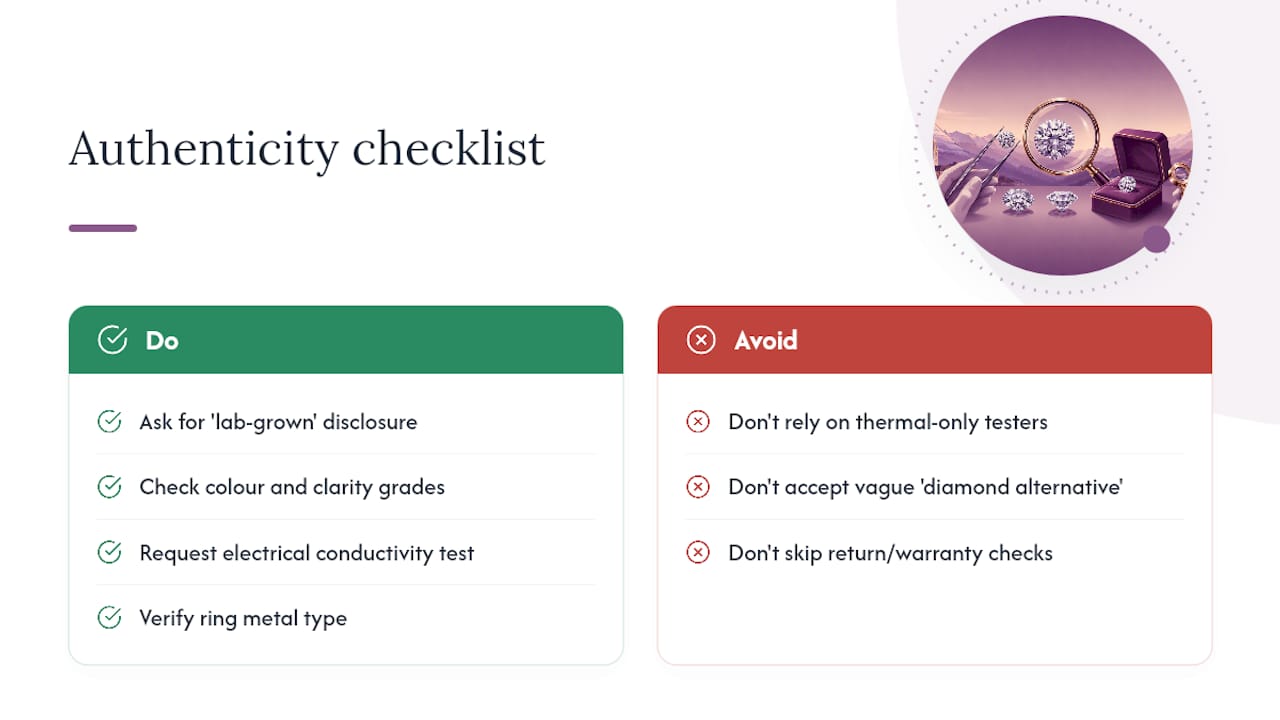
Start with documentation. A legitimate seller should tell you plainly that the stone is lab-created silicon carbide, not attempt to blur that line with vague language like “diamond alternative” without specifics. Reputable sellers list the stone’s grading (color and clarity) on the product page itself, not buried in a separate FAQ you have to dig for.
Ask about the testing method if you’re buying secondhand or from an unfamiliar seller. Standard diamond testers based purely on thermal conductivity can sometimes misread moissanite as diamond, since both conduct heat efficiently. Jewelers who work with moissanite regularly use testers that also check electrical conductivity, which reliably distinguishes the two materials. If you’re verifying a stone you already own, a jeweler with moissanite-specific testing equipment is your best bet, not a generic pawn shop tester.
Check the metal setting too. Moissanite is commonly set in sterling silver plated with gold, solid gold, or platinum, so ask specifically which metal you’re getting rather than assuming “gold ring” means solid gold throughout.
Finally, look for a clear warranty or return window. A seller confident in their grading and sourcing will back the stone with a real policy, not just a satisfaction guarantee with vague terms. That policy, more than any single certificate, tells you how seriously a seller stands behind what they’re selling.
Why Mm-First Shopping Beats Carat Chasing
The conventional advice floating around most jewelry sites still leans on carat weight as the headline number, and that’s backwards for moissanite shoppers. Carat tells you what a stone weighs on a scale, not what it looks like on your hand. Once you understand that moissanite’s lower density shifts the weight-to-size ratio, chasing a specific carat figure stops making sense as your primary filter.
What the research actually supports is simple: pick your millimeter diameter first, based on how the stone should look and fit your setting, then treat carat weight as a secondary confirmation number, not the headline spec. Buyers who lead with carat often end up disappointed, either overpaying for weight they can’t see or underestimating how a well-cut stone at a slightly lower carat will still look plenty impressive.
The other place people get tripped up is treating fire and brilliance as pure marketing language. Moissanite’s dispersion numbers are real, and they change how a stone reads in different lighting, which matters more for daily wear than a certificate ever will. Prioritize millimeter size and cut quality first. Everything else, including carat, follows from there.
— Ammar
See Moissanite Sizing in Action on Meri Jaan Pieces
Meri Jaan is the practical alternative to guessing your way through vague carat listings elsewhere: every product page states the millimeter diameter alongside carat weight, so you’re sizing the stone the way gemologists actually recommend, not the way most retailers still market it.

Browse the full rings, necklaces, bracelets, and earrings collection to compare sizes directly, or check a specific style like the Vintage Rings collection if you want a classic solitaire silhouette in a medium mm range. When you’re evaluating any product page, check three things before adding to cart: the exact millimeter diameter, the color grade, and whether the piece includes a lifetime warranty. Meri Jaan lists all three upfront, and club members get unlimited exchanges if a size doesn’t work once it’s on your hand.
If you already know the mm range you want but need help matching it to a specific setting, reach out through the site for custom sizing guidance, or start browsing the Women’s Rings collection to see how different diameters look across current styles.
Sources
- Gem Society: Moissanite jewelry and gemstone information
- EngagementRing-Guide: Moissanit overview and measurement guidance
- AJLuxe: Moissanite vs Diamond comparison
FAQ
How Much Is 1 Carat of Moissanite?
Pricing varies by seller, cut, and color grade, and retail examples show moissanite running well below the cost of a similarly sized diamond. Check current listings directly, since per-carat pricing shifts with quality grade and brand.
Is Moissanite a Fake Diamond?
No. Moissanite is a distinct gemstone made of silicon carbide, not a diamond imitation, with its own refractive index (about 2.65 to 2.69) and dispersion values that give it a different, often more colorful sparkle than diamond.
Is Moissanite Worth Any Money?
Yes, moissanite holds real retail value, though it’s generally purchased to wear rather than as a resale investment. Its lab-grown origin and lower cost compared to diamond mean resale prices are typically modest, so most buyers should think of it as a buy-to-wear purchase.
How Much Is Moissanite Worth Per Carat?
Per-carat pricing depends heavily on cut quality, color grade, and seller, so there’s no single fixed figure. Comparing sellers by millimeter size and grading, rather than carat price alone, gives you a more accurate sense of value for what you’re actually buying.
