

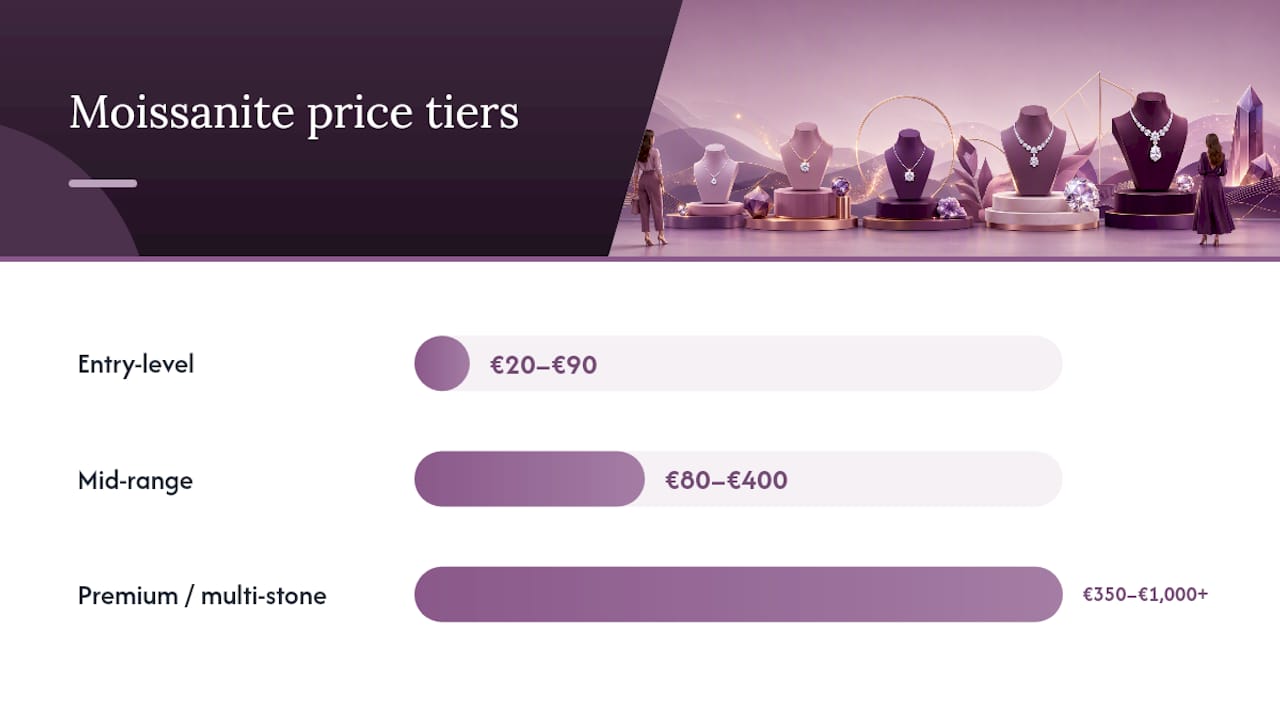
A basic moissanite pendant in sterling silver runs roughly €20 to €90, a solid 0.3 to 1 ct near-colorless solitaire on a plated or sterling chain lands between €80 and €400, and multi-stone or larger-carat designs in solid gold settings climb past €350, sometimes over €1,000. If a listing sits far below these bands, check the certification and metal content before buying. Meri Jaan’s own pricing breakdown uses similar bands to help buyers spot a fair deal versus a corner cut on quality.
TL;DR:
- Entry-level moissanite pendants under €90 mainly feature small stones in sterling silver or plated metals, with frequent deep discounts that may not reflect true value.
- Certification and detailed stone specifications typically appear in mid-range (€80 to €400) pieces, which offer more buyer protection and transparency.
- Larger or multi-stone designs in solid gold can exceed €1,000, but price differences often depend more on setting complexity and metal type than on stone size alone.
- Comparing listings requires verifying carat weight, stone quality, metal type, and certification, as vague descriptions or missing serial numbers are red flags.
- Prioritizing wearability and matching certifications before buying ensures long-term satisfaction more than chasing the lowest price.
Table of Contents
- Moissanit Halskette Preis: What You Actually Pay By Stone Size
- What Actually Drives the Price of a Moissanite Necklace
- How Do You Compare Two Moissanite Necklace Listings?
- How Meri Jaan Prices Moissanite Necklaces
- Prioritize Wearability Over Shaving a Few Dollars Off the Price
- Ready to Compare a Necklace You Can Actually Verify?
- Sources
- FAQ
Moissanit Halskette Preis: What You Actually Pay By Stone Size
The price of moissanite necklaces splits into three clear tiers, and once you know them, spotting an inflated or suspiciously cheap listing gets a lot easier. Retailers price almost entirely on three variables: total carat weight, stone quality grade, and metal. Everything else, chain length, packaging, brand story, sits on top of those three.
Entry-level pendants (roughly €20 to €90): These typically feature a small moissanite stone, often under 0.5 ct, set in sterling silver or gold-plated brass. You’ll see this tier heavily on discount retail sites. One ShopLC listing shows a 45 cm, 925 silver necklace with a roughly 2.76 ct moissanite marked down to €80.99, illustrating just how much promotional discounting shapes this category. Original list prices on these pages often sit two or three times higher than the sale price, so the “discount” itself is part of the pricing strategy, not necessarily a reflection of real value.
Mid-range solitaires (roughly €80 to €400): This is where certification starts showing up on listings, and where most everyday buyers land. A GRA-certified moissanite necklace with a 0.51 ct D-VVS stone on a 925 silver chain lists at €91.99, near the low end of this band but backed by paperwork the entry-level tier usually skips. Move up toward 1 ct and you’ll see prices stretch toward the top of this range, especially once the setting shifts from plain prong to anything with pavé detail or a heavier gold-plated band.
Premium and multi-stone designs (roughly €350 to €1,000+): Larger total carat weight pushes prices here fast. A 2 ct moissanite necklace with a bow-style design lists between roughly €138 and €149, still on silver, showing that carat weight alone doesn’t guarantee a jump into four-figure territory unless the metal changes too. Swap that same stone into solid 14k or 18k gold, or add a tennis-style multi-stone layout, and the price climbs well past €500.
For a rough middle reference point, buyers evaluating a near-colorless 1 ct moissanite in a similar market context can expect something in the $350 to $600 range, a number that tracks closely with the mid-to-premium bands above once you factor in currency and setting differences.
Here’s the pattern across every price example above:
- Silver settings keep prices in the entry to mid-range band regardless of stone size.
- Certification (GRA, GIC, or similar) tends to appear starting in the mid-range tier, not the cheapest listings.
- Gold plating adds a modest premium; solid gold adds a substantial one.
- Multi-stone and tennis-style designs price by cumulative carat weight, not per-stone cost.
- Heavy discounting from list price is common and doesn’t automatically signal a bad deal or a good one.
What Actually Drives the Price of a Moissanite Necklace
Once you understand the bands, the next question is why one listing at €90 and another at €90 for what looks like the same stone size can be completely different purchases. Six factors do almost all the work.
- Stone size and total carat weight. A single 1 ct stone and three stones totaling 1 ct (written as 1 ct t.w. or “total weight”) read the same on a spec sheet but look and price differently. Always check whether a listing quotes per-stone size or combined carat weight before comparing two necklaces side by side.
- Color and clarity grade. Moissanite is graded on similar color and clarity scales to diamonds, though not identically. A D-color, VVS-clarity stone (near-colorless, eye-clean) commands more than a lower grade of the same size, and reputable sellers state this grade directly on the product page rather than burying it in generic marketing copy.
- Cut quality. A well-cut moissanite throws noticeably more fire and brilliance than a poorly cut one of the same size. Cut isn’t always labeled with a grade, but photos under consistent lighting are a reasonable proxy.
- Metal choice. Sterling silver sits at the bottom of the cost curve. Gold-plated silver or brass adds a modest premium and requires occasional replating. Solid 14k or 18k gold costs meaningfully more upfront but holds up longer and doesn’t wear thin.
- Setting complexity. A simple four-prong solitaire costs less to produce than a halo setting, a pavé band, or a tennis-style continuous line of stones. Labor and metal usage both scale with design complexity, which is why two necklaces with identical stones can differ by $100 or more based on setting alone.
- Certification and lab documentation. A GRA, GIC, or comparable lab certificate verifies the stone’s specs against a serial number, and legitimate sellers let you match that number to your physical piece and its accompanying photos. This paperwork adds a small cost to production but gives buyers real proof rather than a seller’s word alone.
Warranty and returns policies also factor into total cost of ownership, even though they don’t appear as a line item on the price tag. A lifetime warranty against stone loosening, free resizing, or an extended returns window effectively lowers your long-term risk, which matters more on a $300 purchase than a $30 one. Skimping here to save a few dollars upfront on an unfamiliar seller usually isn’t worth it. Merijaan’s own breakdown of what a moissanite ring actually costs applies the same cost logic to rings, and the same principles carry over almost exactly to necklaces and pendants.
Pro Tip: Ask any seller for the stone’s total carat weight AND individual stone size before you buy, especially on multi-stone pieces. Sellers who only quote one number are usually hiding the less flattering one.
Durability matters too, particularly for a piece you’ll wear daily. A comparison of waterproof necklace options is worth a look if you’re choosing between finishes that hold up to sweat, showers, and pool water versus ones that need to come off before you get near water.
How Do You Compare Two Moissanite Necklace Listings?
Put two listings side by side and run through this checklist before deciding which one is the better buy:
- Stone carat weight and grade. Confirm whether the quoted number is per-stone or total weight, and check for a color/clarity grade.
- Metal type. Sterling silver, gold-plated, or solid gold, stated explicitly, not implied by photos alone.
- Photo quality. Real product photography under consistent lighting beats generic stock imagery every time.
- Certificate reference. A serial number you can actually match to a lab document, not just a logo in the listing.
- Returns and warranty window. Anything under 14 days or with no mention of stone-related coverage deserves a second look.
- Shipping and tax clarity. Total landed cost, not just the sticker price, is what you’re actually comparing.
Red flags cluster around vague language: “high quality moissanite” with no carat number, stock photography with no close-up of the actual piece, a certificate mentioned in the description but no serial number anywhere, or a returns window so short it barely covers shipping time. Unusually low shipping paired with an otherwise opaque listing is often a signal the seller is cutting corners somewhere else. Third-party review platforms add another layer of confidence here. Feedback on sites like Trustpilot reveals a lot about how a seller handles returns and complaints after the sale, which matters more than the price tag once something goes wrong.
Say you’re comparing a “budget pendant” at $45 against a “certified solitaire” at $95. The budget option lists no carat weight and generic stock photos. The certified option states 0.5 ct, D-color, includes a GRA reference number, and offers a 30-day return window. The $50 gap buys real documentation and recourse, not just a bigger stone.
How Meri Jaan Prices Moissanite Necklaces
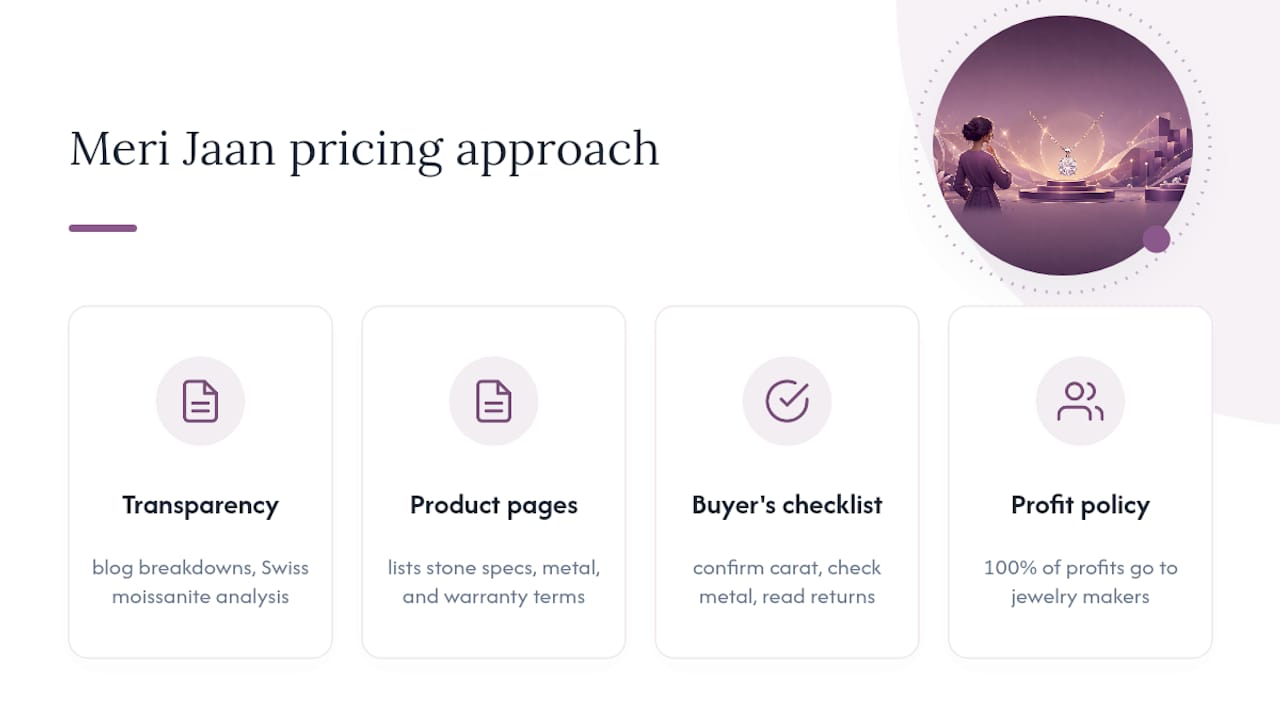
Meri Jaan builds every necklace around lab-grown moissanite, chosen specifically because it delivers the size and brilliance buyers want without the traditional diamond markup. Pricing transparency runs through the brand’s blog content, including detailed breakdowns like the Swiss moissanite value analysis, rather than leaving buyers to guess at what a fair price should look like.
Product pages list stone specifications, metal type, and warranty terms directly, the same information this guide’s comparison checklist asks you to verify before buying anywhere. That structure means you can apply the checklist from the previous section directly to a Meri Jaan listing: confirm the carat weight, check the metal, and read the returns terms before adding anything to your cart. One notable difference in how Meri Jaan operates its business: 100% of profits go back to the jewelry makers themselves, a detail worth knowing if ethical sourcing factors into your buying decision alongside price.
Prioritize Wearability Over Shaving a Few Dollars Off the Price
Most people fixate on getting the biggest stone for the lowest number, then wonder why the necklace ends up in a drawer after two months. Realistic stone size for how you’ll actually wear the piece, paired with a seller who stands behind clear return and warranty terms, beats squeezing out a marginal discount almost every time.
Buyers building a daily-wear collection tend to gravitate toward smaller, sturdier stones in solid gold, prioritizing longevity oversize. Special-occasion shoppers lean the other way, choosing larger stones or statement settings in silver since the piece won’t take daily wear and tear. Neither approach is wrong, but knowing which camp you’re in before you shop saves a lot of second-guessing.
Whatever you choose, verify the certificate number and match it against real product photos before you buy. That single habit catches more problems than any price comparison ever will.
— Ammar
Ready to Compare a Necklace You Can Actually Verify?
Merijaan lists stone weight, metal type, and warranty terms directly on every product page, so you’re never guessing at what you’re paying for the way you might on a listing with vague descriptors and stock photos. Lab-grown moissanite keeps the price accessible without cutting corners on brilliance, and every piece comes backed by a lifetime warranty plus unlimited exchanges for club members.
Before you buy from any seller, including this one, check three things first: the exact carat weight, the metal (sterling silver, gold-plated, or solid gold), and the returns window. Merijaan’s women’s necklace collection lists all three clearly on each product page, so you can run the comparison checklist from this guide in under a minute. Browse the current necklace lineup and see how the pricing stacks up against what you’ve just learned to look for.
Sources
FAQ
Is Moissanite Valuable?
Moissanite holds real value as a durable, brilliant gemstone, though it doesn’t appreciate or resell like a diamond typically does. Its value comes from what you get for the price: a stone with more fire than diamond at a fraction of the cost, priced from roughly €20 for small pendants up to €1,000 or more for large, certified, solid-gold pieces.
Is Moissanite Better Than Diamond?
Moissanite isn’t strictly better or worse than diamond, it’s a different trade-off. It offers more brilliance and a dramatically lower price for comparable size, while diamond retains stronger resale value and cultural weight; a fuller moissanite versus diamond comparison covers hardness, brilliance, and ethics side by side.
Is Moissanite Better Than Cubic Zirconia?
Moissanite outperforms cubic zirconia on durability and long-term sparkle. Cubic zirconia clouds and loses brilliance faster with regular wear, while moissanite keeps its fire for years, which is why moissanite typically costs more but holds up better as an everyday piece.
What Exactly Is a Moissanite?
Moissanite is a lab-grown gemstone made of silicon carbide, prized for brilliance that often exceeds a diamond’s under normal lighting. Nearly all moissanite sold today, including Meri Jaan’s, is created in a lab rather than mined, which is part of why it costs significantly less than a comparably sized diamond.
How Much Does a Meri Jaan Moissanite Necklace Cost?
Current prices for Meri Jaan’s necklaces are listed directly on the necklace collection page, where stone weight and metal are specified alongside the price. Checking that page directly gives you the most accurate figure, since pricing can shift with new designs and seasonal collections.

