
Yes, moissanite handles everyday wear better than almost any gemstone besides diamond. Its Mohs hardness of roughly 9.25 to 9.5 means normal daily contact with keys, doorknobs, and fabric won’t scratch it. The real question isn’t whether moissanite survives daily life. It’s which cut, setting, and care habits keep it looking sharp for years, and that’s what the rest of this guide covers.
TL;DR:
- Properly set moissanite in protective settings like bezels or flush mounts can last for years of daily wear without noticeable damage.
- Its hardness of approximately 9.25 to 9.5 makes moissanite more scratch-resistant than cubic zirconia and comparable to sapphire, but impacts can still chip it.
- Regular cleaning with mild soap, warm water, and a soft brush every few weeks maintains its brilliance, while avoiding harsh chemicals and pool chemicals prevents damage.
- Risks of wear come mainly from loose prongs or impact on prong edges, emphasizing the importance of annual setting inspections by a jeweler.
- High-quality lab-grown moissanite offers better durability and visual appeal for everyday jewelry than lower-cost options like cubic zirconia, especially in rings and earrings.
Table of Contents
- Moissanite Alltag Durability: Hardness, Toughness, and What Actually Happens to the Stone
- Moissanite vs. Diamond vs. Cubic Zirconia for Daily Wear
- How to Clean and Care for Moissanite You Wear Every Day
- Which Pieces and Settings Actually Hold Up Day After Day
- Why Merijaan Approaches Moissanite the Way It Does
- What Actually Matters When Choosing Moissanite for Daily Wear
- Start Wearing Moissanite Every Day With Merijaan
- Sources
- FAQ
Moissanite Alltag Durability: Hardness, Toughness, and What Actually Happens to the Stone
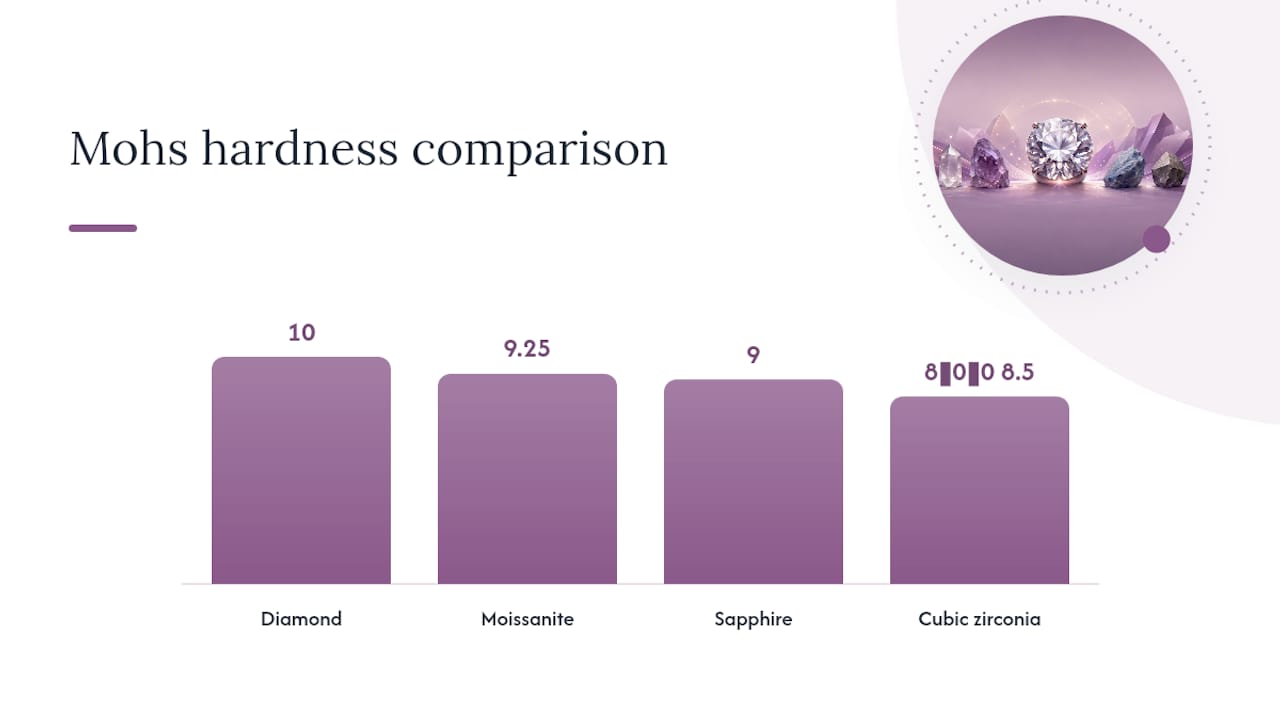
Moissanite sits around 9.25 on the Mohs hardness scale, just below diamond’s perfect 10 and above sapphire’s 9. Cubic zirconia, by comparison, only reaches 8 to 8.5. That gap matters more than it sounds. Hardness measures scratch resistance, and most household materials, dust, sand, even a stainless-steel countertop, fall well below 9. A moissanite stone worn every single day for years will not pick up the fine surface scratches that dull cheaper stones over time.
But hardness and toughness are not the same thing, and this is where most online advice gets sloppy. Hardness tells you how resistant a stone is to scratching. Toughness tells you how it handles a sharp impact, like catching a ring on a car door or dropping an earring on tile. Moissanite performs well here too, though no gemstone is immune to a hard enough blow at the wrong angle. The stone can chip if struck directly on a facet edge, just like a diamond can. This is rare in daily wear, but it’s not impossible.
What does real-world evidence say? Practical durability guides tracking daily-wear feedback report that many people wear moissanite jewelry for years with minimal visible wear, provided the stone is properly set and the setting itself is checked periodically. The stone isn’t the weak point. Loose prongs are.
A few myths deserve to be retired:
- “Moissanite scratches easily.” False. At 9.25 to 9.5 hardness, it’s harder than nearly everything it will contact in daily life.
- “Moissanite clouds over time.” Also false. Clouding usually comes from soap residue or lotion buildup, not stone degradation, and it wipes away with cleaning.
- “Moissanite is fragile like glass.” Glass sits around 5.5 on the Mohs scale. Moissanite is nearly twice as hard.
The number that matters most for daily wear: a Mohs rating near 9.5 puts moissanite closer to sapphire and diamond than to cubic zirconia, which is the comparison most shoppers actually need. If you want a deeper breakdown of how that hardness plays out over years of wear, the durability analysis on daily moissanite use covers specific wear scenarios in more detail.
Moissanite vs. Diamond vs. Cubic Zirconia for Daily Wear
| Factor | Moissanite | Diamond | Cubic Zirconia |
|---|---|---|---|
| Hardness (Mohs) | 9.25–9.5 | 10 | 8–8.5 |
| Brilliance/fire | Higher dispersion than diamond, very sparkly | High brilliance, classic sparkle | Noticeably less fire, can look glassy |
| Toughness/chip risk | Good, chips possible on hard direct impact | Excellent, still chips under sharp force | Fair, more prone to surface wear over time |
| Price/value for daily use | Strong value, high durability per dollar | Highest cost for comparable size | Lowest cost, but degrades faster |
| Maintenance needs | Low, occasional soap-and-water cleaning | Low, similar routine | Moderate, needs more frequent replacement or polishing |
The hardness numbers tell part of the story, but the visual difference is where moissanite actually pulls ahead for everyday pieces. Moissanite has a higher refractive index and greater dispersion than diamond, which is the technical way of saying it throws more colorful flashes of light. In everyday indoor lighting, that extra fire often makes a moissanite stone look more “alive” than a diamond of similar size, which is exactly why so many buyers switch.
So when does a diamond still make sense? If you want the absolute minimum chip risk for a stone that gets knocked around constantly (construction work, gym equipment, manual labor), diamond’s perfect 10 hardness gives it a slight edge. For everyone else, moissanite covers the same daily-wear demands at a fraction of the cost.
Cubic zirconia is the one to be cautious with. At 8 to 8.5 hardness, CZ picks up surface abrasions faster under constant wear, and it tends to lose its sparkle within a year or two of daily use. It’s fine for occasional-wear costume jewelry. It’s not built for a ring you put on every morning.
By jewelry type:
- Rings (most exposure to knocks and abrasion): moissanite in a protective setting is the smart daily choice.
- Earrings (lower impact risk): moissanite’s fire makes studs look brighter under office lighting than CZ, with far better longevity.
- Necklaces and pendants (minimal contact): any of the three works, but moissanite still wins on sparkle-per-dollar.
How to Clean and Care for Moissanite You Wear Every Day
Moissanite doesn’t need a special maintenance schedule. It needs a five-minute routine every couple of weeks, plus a little common sense about when to take it off.
- Soak briefly. Mix warm water with a few drops of mild dish soap. Let the piece sit for five to ten minutes to loosen oils and lotion residue.
- Brush gently. Use a soft-bristled brush (an old toothbrush works fine) to clean around the setting and underneath the stone, where buildup collects.
- Rinse and dry. Rinse under warm running water, then pat dry with a lint-free cloth. Avoid paper towels, which can leave fibers behind.
- Repeat every one to two weeks if you wear the piece daily, or whenever it starts looking dull.
This exact method, warm water, mild soap, soft brush, is the standard recommendation for keeping moissanite’s brilliance intact, and it avoids the risk of harsh chemicals damaging the metal setting.
What to avoid: chlorinated pools and hot tubs, which can discolor certain metal settings even though they won’t harm the stone itself. Skip bleach, ammonia-based cleaners, and abrasive polishing compounds. None of these will scratch the moissanite, but they can pit or discolor sterling silver or gold plating over time.
Have your prongs and settings checked once a year by a jeweler. This is the single most overlooked step in daily-wear maintenance. Annual inspection catches loose prongs before they become a lost stone, and it takes a jeweler about five minutes.
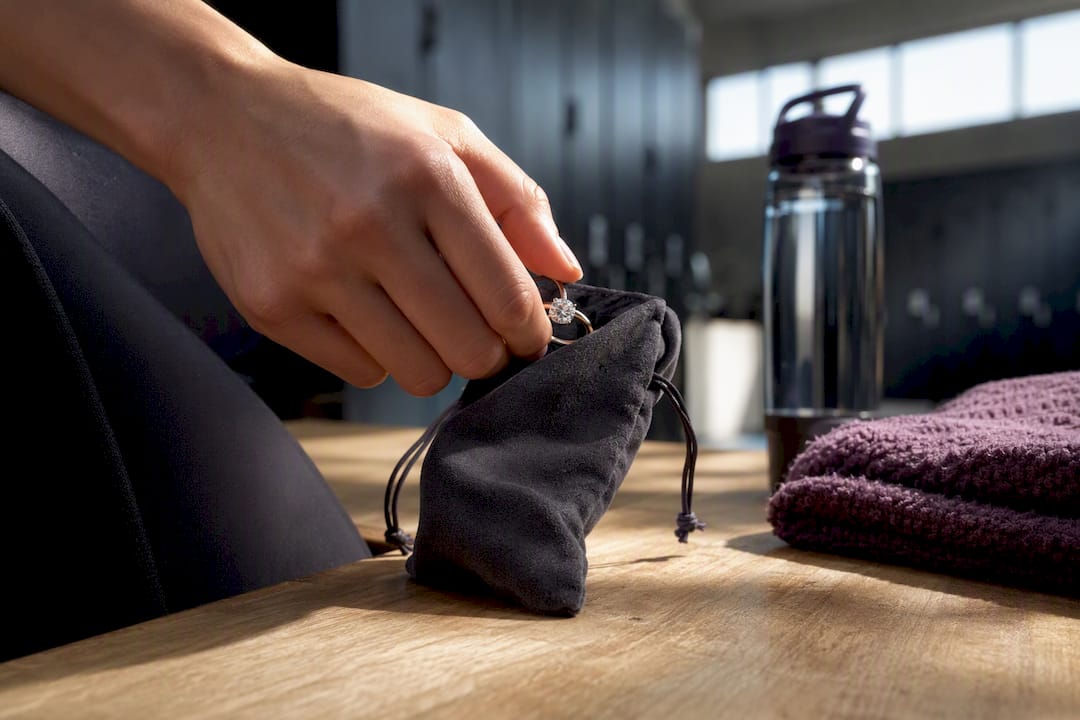
Pro Tip: Keep a small soft pouch in your gym bag or desk drawer. Slip rings off before lifting weights, doing dishes, or gardening, not because moissanite can’t handle it, but because a direct impact on a hard surface is the one scenario where any gemstone can chip.
Which Pieces and Settings Actually Hold Up Day After Day
Not every moissanite piece is built the same for constant wear, and the setting matters as much as the stone.
Bezel settings, where a metal rim wraps fully around the stone’s edge, offer noticeably better protection than traditional high-prong settings. Lower-profile settings reduce snag and impact risk, which matters if your hands are busy all day, whether that’s typing, cooking, or lifting kids. Flush-set rings, where the stone sits level with the band, offer similar protection with a cleaner, more minimal look.
For pieces you barely think about removing, prioritize:
- Stud earrings over dangling styles, since they catch on less and sit close to the ear.
- Pendant necklaces with secure bail settings rather than open-frame designs.
- Bezel or flush-set rings over tall prong settings if you work with your hands.
Metal choice adds another layer. Sterling silver is affordable and looks bright next to moissanite’s fire, but it’s softer and can show wear faster than gold. Gold, whether yellow, white, or rose, holds up better under constant friction and doesn’t tarnish the way silver can. Gold-plated pieces sit in between: attractive at a lower price point, but the plating can thin with years of daily contact.
Styling-wise, a single moissanite pendant or a pair of small studs works with almost anything, from a work blazer to weekend jeans, which is part of why so many people treat moissanite as their default “never take it off” jewelry rather than saving it for occasions. If you’re building a daily necklace rotation, these everyday silver necklace picks offer useful guidance on chain styles that hold up to constant wear.
Why Merijaan Approaches Moissanite the Way It Does
Merijaan works exclusively with lab-grown moissanite because the stone delivers real daily-wear durability without the sourcing concerns tied to mined diamonds. Every piece is built around designs meant to be worn constantly, not saved for special occasions, which shapes decisions on setting type, metal choice, and stone cut.
That approach lines up with why moissanite gained traction in the first place: it’s not just a budget-friendly stand-in for diamond. Lab-grown stones avoid the environmental impact of mining while still holding up to years of wear, which is exactly the combination Merijaan designs around, quality craftsmanship paired with sustainable sourcing.
Customers ask about maintenance often, and the answer is consistent: warm water, mild soap, a soft brush, and an annual check of the setting. Pieces also come with a lifetime warranty and unlimited exchanges for club members, so if a setting ever loosens with daily wear, replacing or repairing it isn’t a hassle.
What Actually Matters When Choosing Moissanite for Daily Wear
The durability data on moissanite is solid, but most guides stop at “it’s hard, so it’ll last.” That’s only half the story. The setting is usually the first thing to fail, not the stone, and almost nobody mentions this until something goes wrong.
Conventional advice treats moissanite like a lower-cost diamond substitute and leaves it there. That undersells it. The higher fire and dispersion mean moissanite often looks better in daily lighting than a diamond twice its price, and the ethical sourcing angle matters to a growing share of buyers, not as an afterthought, but as the actual reason they chose it.
If you’re buying for daily wear, prioritize setting type and metal quality over squeezing out a slightly larger carat weight. A well-set 6mm moissanite in a bezel mount will outlast a poorly set 8mm stone in flimsy prongs, and it’ll look better doing it.
— Ammar
Start Wearing Moissanite Every Day With Merijaan
If you’ve read this far, you already know moissanite handles daily wear better than most alternatives at its price point. Merijaan builds around that fact directly. The vintage rings collection leans into low-profile, secure settings suited to constant wear, while the broader women’s rings collection covers everything from bezel styles to classic bands if you want more sparkle on display.

Every piece comes with a lifetime warranty, and club members get unlimited exchanges, so committing to a daily-wear ring or pendant doesn’t mean guessing whether it’ll hold up.
Ready to find a piece that fits your daily routine? Browse the women’s rings collection and filter by setting style to find one built for constant wear.
Sources
- Moissanit — Wikipedia
- Moissanite jewelry and gemstone information — GIA/Gem Society article
- Is Moissanite Good for Daily Wear? Durability Explained — Lukhidiamond blog
- Moissanit-schmuck
FAQ
Is Moissanite Actually Valuable?
Yes, moissanite holds real value based on its rarity as a lab-grown material, hardness near 9.25 to 9.5, and exceptional brilliance, even though it costs significantly less than a diamond of comparable size.
Is Moissanite or Cubic Zirconia Better for Everyday Wear?
Moissanite is the better choice for daily wear. Its 9.25 to 9.5 Mohs hardness resists scratching far longer than cubic zirconia’s 8 to 8.5 rating, and it keeps its sparkle instead of dulling within a year or two.
What Effect Does Moissanite Have Visually?
Moissanite produces more brilliance and fire than diamond due to its higher refractive index and dispersion, giving it a brighter, more colorful sparkle in everyday lighting.
What’s the Difference Between Moissanite and Lab-Grown Diamonds?
Moissanite is lab-created silicon carbide with a Mohs hardness around 9.25 to 9.5, while lab-grown diamonds are chemically identical to mined diamonds at a hardness of 10. Moissanite typically costs less and shows more fire, while lab-grown diamond matches mined diamond’s exact optical and physical properties.

