

Moissanite is an heirloom-capable gemstone. Its roughly 9.25 Mohs hardness, combined with a toughness that outperforms many harder-looking stones, makes it durable enough for daily-wear rings and necklaces when it’s set correctly and cared for. The main exceptions are extreme lifestyles: manual labor without a protective setting, or anyone who is genuinely rough on jewelry.
The evidence behind that verdict is straightforward:
- Hardness: moissanite sits at roughly 9.22 to 9.5 on the Mohs scale, with 9.25 as the commonly cited trade figure.
- Toughness: its crystal structure resists chipping better than stones with clean cleavage planes.
- Thermal stability: moissanite tolerates high heat, which matters when a jeweler resizes or repairs the setting.
Read on for the material science behind those numbers, then the sections on care and buying decisions that actually determine how a stone ages in real life.
Key Takeaways
Moissanite’s roughly 9.25 Mohs hardness paired with strong chip resistance makes it durable enough for daily-wear jewelry when properly set and maintained.
| Point | Details |
|---|---|
| Hardness vs. toughness | Moissanite scores 9.25 on Mohs hardness and resists chipping better than diamond’s perfect-cleavage structure. |
| Realistic lifespan | Decades of daily wear are typical for a well-set moissanite ring or pendant with routine care. |
| Annual prong checks | Loose settings, not stone wear, cause most moissanite repair requests, so yearly inspections matter. |
| Care routine | Weekly mild soap soaks and yearly professional cleaning remove oil film that mimics dulling. |
| Protective settings from Merijaan | Bezel and halo settings plus a lifetime warranty on Merijaan pieces reduce long-term wear risk. |
Table of Contents
- Moissanite Haltbarkeit: What the Hardness Number Actually Means
- Moissanite Vs. Diamond, Sapphire, and Cubic Zirconia: What Actually Matters for Wear
- How Long Does a Moissanite Ring Actually Last Day to Day?
- Caring for Moissanite: The Routine That Keeps It Sparkling
- Buying for Longevity: Settings and Cuts That Protect the Stone
- Why Merijaan Backs Every Claim in This Guide
- Who Should Choose Moissanite, and Who Might Look Elsewhere
- Ready to Choose a Setting Built to Last?
- Sources
Moissanite Haltbarkeit: What the Hardness Number Actually Means
“Moissanit Haltbarkeit,” or moissanite durability, comes down to two separate properties that people often confuse: hardness and toughness. Understanding the difference is the single most useful thing you can learn before buying any gemstone, moissanite included.
The Mohs scale measures scratch resistance on a range from 1 to 10, and moissanite ranks around 9.25, just below diamond’s 10. That places it well above sapphire and ruby at 9, and far above cubic zirconia, which sits around 8 to 8.5. In practice, this means moissanite resists surface scratches from sand, countertops, and the general scuffing that happens when you don’t take your ring off to do the dishes.
Toughness is a different measurement entirely. It describes how well a material resists chipping, cracking, or breaking under impact. A stone can be extremely hard and still chip easily if it has “perfect cleavage,” meaning it splits cleanly along specific crystal planes when struck at the wrong angle. Diamond has this trait. Moissanite’s crystal structure doesn’t share that vulnerability, which is why jewelry repair technicians report it holds up better against angled impacts than its Mohs number alone would suggest.
- Scratching affects the surface and dulls shine over time.
- Chipping affects the stone’s structural integrity and usually requires replacement or repair.
- Moissanite resists both, but chipping resistance is where it quietly outperforms expectations.
Thermal stability rounds out the picture. Moissanite holds up under high heat better than diamond does in open air, according to Wikipedia’s material data. That matters more than most buyers realize: when a jeweler resizes a ring or re-tips a prong, the torch gets hot. A stone that can’t handle that heat risks damage during routine service, not just during accidents.
Moissanite’s Mohs hardness of 9.25 combined with strong chip resistance is why gemologists rate it durable enough for daily-wear engagement rings, a point reinforced by Gem Society’s guidance on everyday jewelry.
Moissanite Vs. Diamond, Sapphire, and Cubic Zirconia: What Actually Matters for Wear
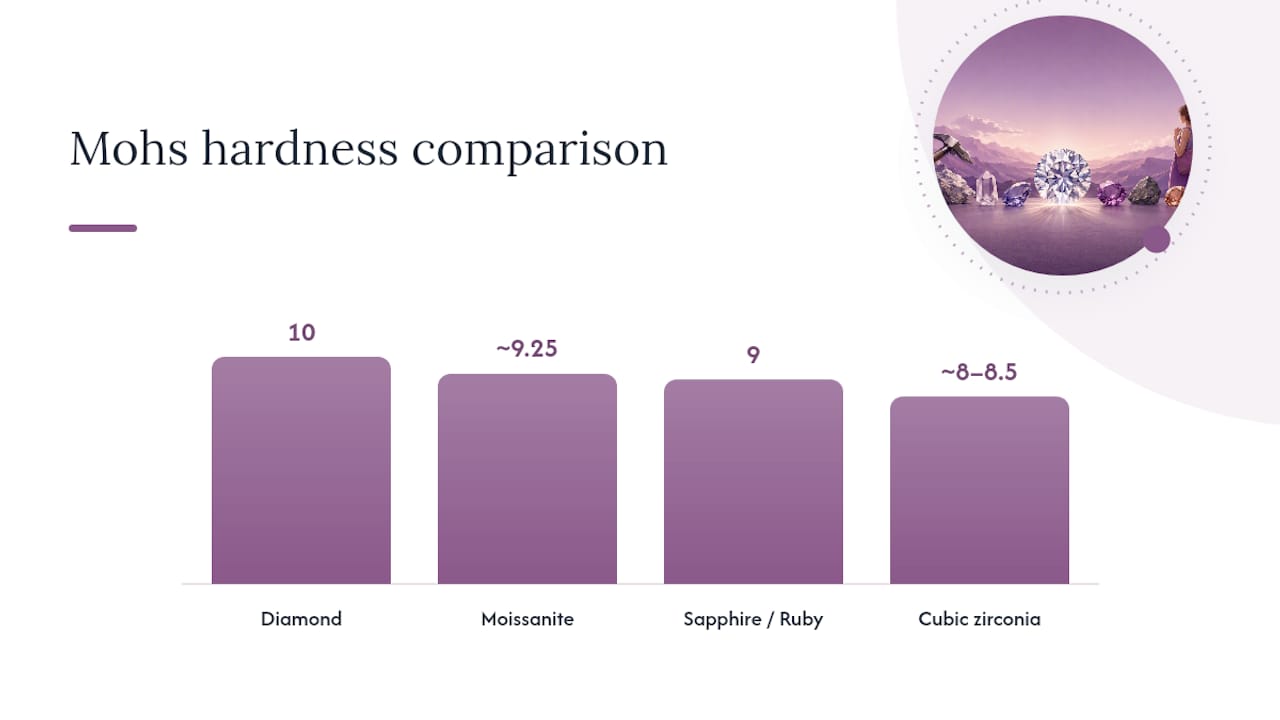
Hardness numbers alone don’t tell you which stone will look better in ten years. The real story is hardness and toughness working together, and that’s where moissanite separates itself from the alternatives people compare it against.
Here’s how the numbers stack up in practice:
- Diamond (Mohs 10): the hardest natural material, but its perfect cleavage means a sharp blow at the right angle can chip or crack it despite that top hardness score.
- Moissanite (Mohs ~9.25): slightly softer, but its structure resists cleaving, so it often survives impacts that would chip a diamond of similar size.
- Sapphire and ruby, corundum family (Mohs 9): durable and a common diamond alternative, but a full point softer than moissanite on the scale.
- Cubic zirconia (Mohs ~8 to 8.5): the softest of the common simulants, and the one most likely to scratch, cloud, and lose brilliance within a few years of regular wear.
Blue Nile’s educational comparison makes a point worth repeating: diamond’s superior Mohs score doesn’t automatically translate into superior real-world survival. A diamond dropped on a hard tile floor at an unlucky angle can chip. A moissanite stone in the same fall is statistically less likely to.
Cubic zirconia tells a different story. It’s not that CZ shatters easily. It simply accumulates microscopic surface scratches faster because it’s softer, and those scratches scatter light instead of reflecting it cleanly. Within a year or two of daily wear, a CZ stone can look noticeably duller even though nothing has technically broken. Moissanite, sitting nearly a full point higher on the hardness scale, resists that gradual clouding far longer, which is a large part of why trade commentary treats it as near heirloom grade for most wearers.
How Long Does a Moissanite Ring Actually Last Day to Day?
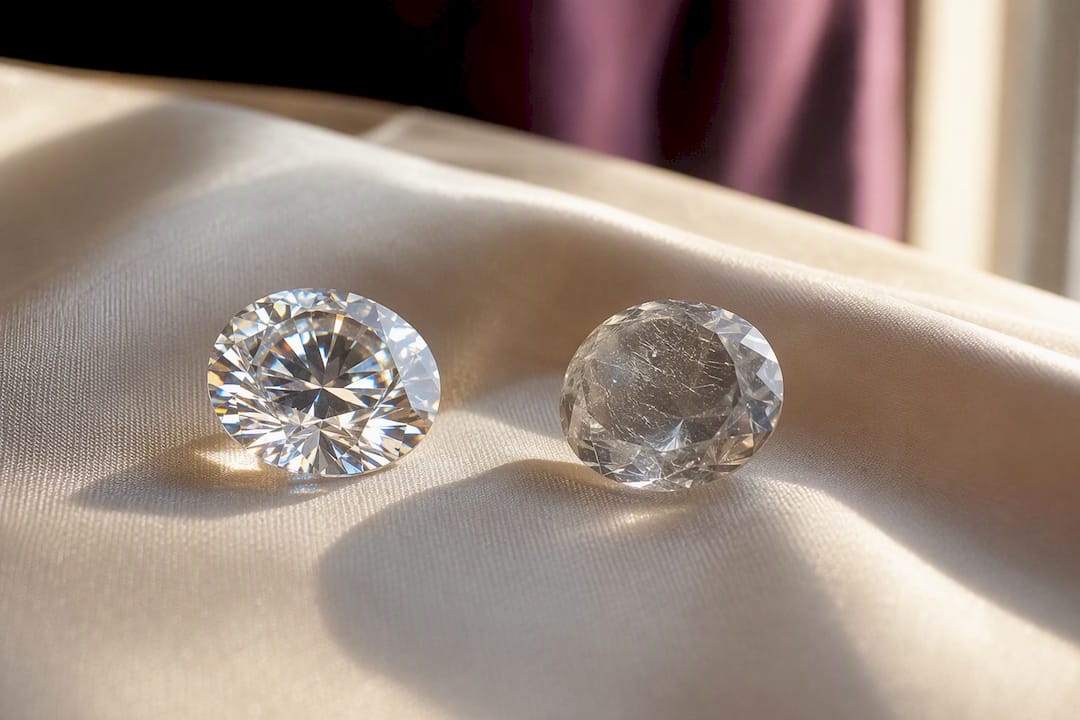
For most people, a well-set moissanite stone in a ring or pendant will look essentially the same after decades of regular wear as it did on day one. That’s not marketing optimism. It’s what you’d expect from a Mohs 9.25 material with strong chip resistance, worn the way most people actually wear jewelry: gardening, gym sessions, the occasional bump against a doorframe.
The caveats matter, though. Lifespan depends heavily on the setting, not just the stone. A stone in a flimsy prong setting can loosen and fall out regardless of how hard the material is. A stone that’s rarely removed during heavy manual labor, contact sports, or chemical-heavy work will show wear faster than one that’s protected during those activities.
Common issues to watch for, in order of how often they actually happen:
- Loose prongs, which cause stones to shift or fall out. This is a setting problem, not a stone problem, and it’s by far the most common repair request.
- Surface film from lotion, soap, or oils, which mimics dulling but wipes away with cleaning rather than indicating real wear.
- Minor edge chipping, usually from a hard direct impact on an unprotected point cut like a pear or marquise tip.
- Setting metal wear, where prongs or bezels thin out over years of contact with clothing and surfaces, not the stone itself.
Pro Tip: Get your ring’s prongs checked by a jeweler once a year, the same way you’d get a car inspected. It takes five minutes and catches a loose setting before you lose the stone, not after.
Most jewelers recommend an annual prong check regardless of the gemstone, and Gem Society echoes that guidance specifically for moissanite pieces worn daily.
Caring for Moissanite: The Routine That Keeps It Sparkling
Moissanite doesn’t need exotic care, but a little consistency goes a long way toward keeping that brilliance sharp instead of letting it fade under a film you don’t even notice building up.
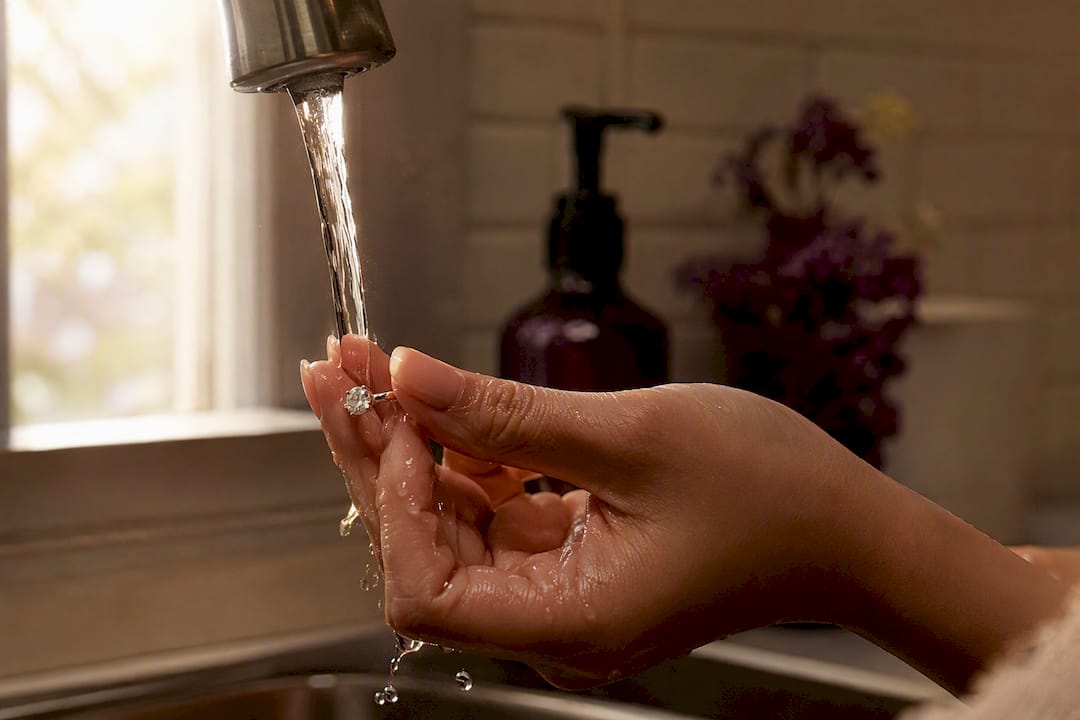
- Daily habit: rinse the stone under warm water if you notice it looking hazy after wearing lotion or sunscreen, then pat dry with a soft cloth.
- Weekly clean: soak the piece for 10 to 15 minutes in warm water with a few drops of mild dish soap, then scrub gently behind the stone with a soft toothbrush where oil and skin residue collect.
- Monthly deep clean: if your setting allows it, a home ultrasonic cleaner is safe for most moissanite pieces, though open, delicate settings with pavé accents do better with the hand wash method to avoid loosening small stones.
- Storage: keep pieces separated in a soft-lined box or individual pouches. Moissanite is hard enough to scratch softer metals and other jewelry if they’re tossed together in a drawer.
- What to avoid: chlorine, harsh household cleaners, and abrasive polishing cloths on the metal setting, since the metal usually wears out before the stone does.
That surface haze you sometimes notice isn’t the stone degrading. It’s typically a thin film from lotion or fine dust settling into the setting, and trade sources confirm it’s a cleaning issue rather than permanent damage.
Pro Tip: If your ring looks dull after a day at the beach or a workout, don’t assume the stone is wearing out. Wash it first. Nine times out of ten, the sparkle comes right back.
Read Merijaan’s beginner’s guide to moissanite for a broader rundown on care basics if you’re new to the stone. A professional cleaning and inspection once a year, timed with that prong check, catches most issues before they become expensive ones.
Buying for Longevity: Settings and Cuts That Protect the Stone
The stone’s hardness only gets you so far. The setting decides whether that hardness actually pays off over years of wear.
For anything worn daily, bezel settings and well-built halo designs offer the most protection, since they wrap metal around the stone’s edges instead of leaving them exposed the way a basic prong setting does. If you prefer a classic prong setting, look for six prongs on a solitaire rather than four. It’s a small difference that meaningfully reduces the odds of a stone shifting loose.
Shape matters too. Round and cushion cuts have no exposed points and tend to hold up better under daily impact than pear, marquise, or princess cuts, which have sharp corners more prone to chipping if struck directly. If you love a fancy shape, ask about protective prongs or a guard ring that shields the vulnerable tips.
Before buying, ask the seller these questions:
- Does the piece come with a warranty that covers loose stones or setting defects?
- What’s the repair policy if a prong bends or a stone needs re-securing?
- Is there a certificate confirming the stone’s specifications?
- What are the return or exchange terms if the setting doesn’t hold up as expected?
Merijaan pieces include a lifetime warranty and unlimited exchanges for club members, which covers exactly these scenarios without extra negotiation. For more on choosing settings built for daily professional wear, this guide walks through the trade-offs in more detail.
Why Merijaan Backs Every Claim in This Guide
This guide was written by Ammar, drawing on gemology sources including Gem Society and the same trade data referenced throughout this piece, alongside Merijaan’s own beginner’s guide to moissanite for buyers who want a fuller primer.
Merijaan builds every piece around the durability principles covered here: protective settings, lifetime warranty coverage, and unlimited exchanges for club members if a piece doesn’t hold up the way it should. That’s not a marketing claim detached from the science. It’s the same hardness and toughness data above, translated into a purchase policy.
Moissanite’s durability only matters if the business behind it stands by the piece long after checkout. A lifetime warranty is where the gemology and the guarantee actually meet.
- 100% of profits return to the artisans who make each piece.
- Every stone ships with documentation confirming its specifications.
- Club members get unlimited exchanges, which removes the risk of committing to a setting or size before you’ve worn it.
Explore Merijaan’s landing page to see how these commitments show up across the full collection.
Who Should Choose Moissanite, and Who Might Look Elsewhere
Moissanite makes the most sense for daily wearers who want serious durability without diamond pricing: office workers, parents chasing kids around, anyone who wants a ring that survives real life without babying it. It’s also the clear pick for buyers who care about the ethical sourcing story, since lab-grown moissanite skips the environmental and labor concerns tied to mined stones.
Where might someone look elsewhere? If you specifically want the resale market and cultural weight tied to a mined diamond, no simulant will satisfy that particular want, and that’s a fair reason to choose differently. For everyone else optimizing for brilliance, durability, and value, moissanite is a genuinely strong stone, not a compromise.
Ready to Choose a Setting Built to Last?
Merijaan designs every piece around the same durability principles covered in this guide: hard, chip-resistant moissanite set into settings meant for real, daily wear, not just photos.

Every piece comes backed by a lifetime warranty and, for club members, unlimited exchanges if a size or style needs adjusting after the fact. That protection matters more than the sparkle alone. If you’re choosing between a pendant and a ring for daily wear, the Rapperswil Necklace is a strong example of a protected setting that holds its brilliance without demanding constant babysitting. Pick a size that sits comfortably against your skin, since necklaces that catch on clothing or hair take more wear over time than ones that lie flat. Browse the collection and check current availability before you decide.
Sources
- Moissanite - Wikipedia
- Moissanite jewelry and gemstone information - Gem Society
- Moissanite Hardness: Is 9.25 Actually Hard Enough for Everyday Wear? | Moissanite by Aurelia
- Moissanite vs. Diamond: Brilliance, Color, Durability & Price - Blue Nile
Recommended
- Eco-Friendly Elegance: Why Moissanite Is the Sustainable Jewelry Choice – The Meri Jaan
- Is Moissanite Sustainable? Eco-Friendly Gemstone Deep Dive 2026 – The Meri Jaan
- Durable Jewelry for Daily Professional Wear in 2026 – The Meri Jaan
- Why Ethical Gems Matter for Fashion: A Moissanite Guide – The Meri Jaan

