

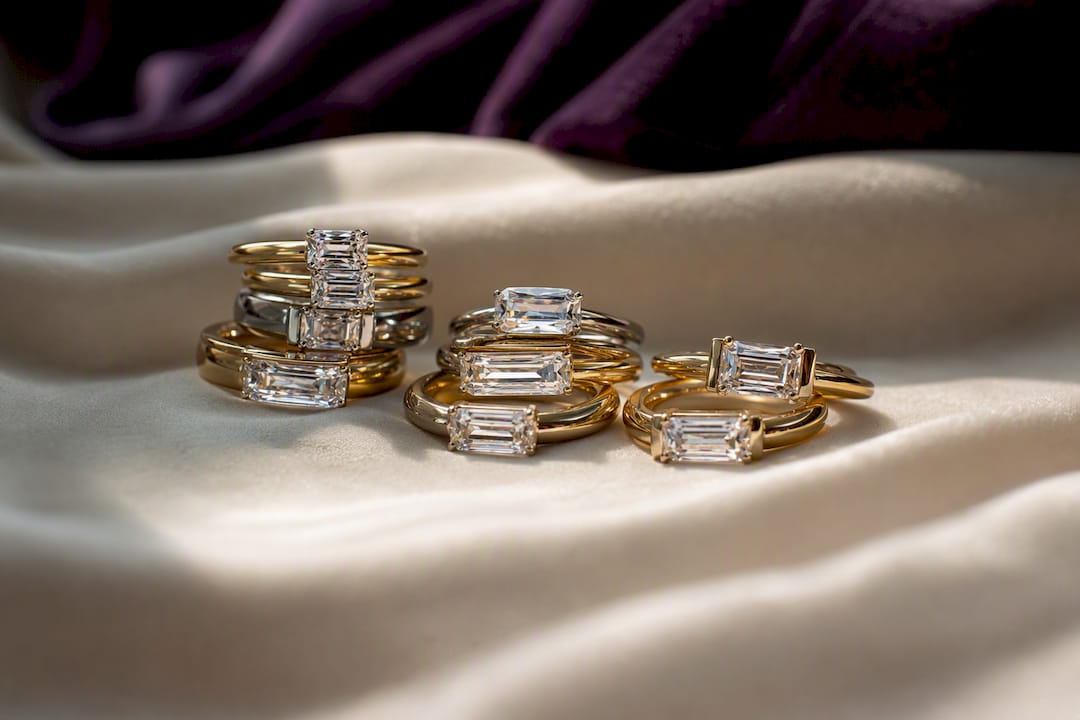
East-west settings, elongated cuts, warm two-tone metals, stackable everyday bands, and bold color accents lead the moissanite design trends shaping engagement rings and fine jewelry right now. Add vintage details like filigree and milgrain, plus a firm push toward ethical sourcing, and you have the full picture. Moissanite fits every one of these looks because it throws serious fire, survives daily wear, and costs a fraction of an equivalent diamond, which means the budget goes into the setting instead of just the stone.
The trends worth knowing:
- East-west stone orientation
- Elongated and architectural cuts (oval, emerald, kite, marquise)
- Two-tone and warm metal finishes
- Stackable, everyday-wear silhouettes
- Colored moissanite and pearl accents
- Vintage-inspired filigree and milgrain detailing
- Ethical, lab-grown positioning as a real category, not a substitute
Key Takeaways
Moissanite’s hardness, brilliance, and price point make it the material best suited to 2025–2026’s biggest jewelry trends: east-west settings, elongated cuts, warm two-tone metals, and stackable everyday pieces.
| Point | Details |
|---|---|
| Shapes to look for | Elongated ovals, emerald, marquise, and kite cuts define current moissanite ring styles. |
| Settings driving the trend | East-west orientation and two-tone metals update classic shapes without added fragility. |
| Vintage details matter | Filigree and milgrain add a designer feel to an otherwise simple setting at low extra cost. |
| Buy with a checklist | Confirm certification, setting security, and warranty terms before committing to a piece. |
| Merijaan’s approach | Merijaan pairs these 2026 trends with lifetime warranty coverage and transparent ethical sourcing. |
Table of Contents
- Which Moissanite Cuts Are Trending Right Now?
- What’s Happening With Settings and Metal Choices?
- How Do You Stack and Style Moissanite Rings for Everyday Wear?
- Are Colored Moissanite and Pearls Really Trending?
- Why Are Vintage Details Making a Comeback?
- How Does Moissanite Fit the Ethical Jewelry Conversation?
- What Are the Real Pros and Cons of Choosing Moissanite?
- How Should You Choose a Moissanite Ring in 2025–2026?
- How Merijaan Interprets These Trends in Real Pieces
- Sources
Which Moissanite Cuts Are Trending Right Now?
Elongated ovals, emerald cuts, marquise, and kite (elongated hexagon) shapes are dominating moissanite ring styles headed into 2026. Each one changes how the ring reads on the hand. An elongated oval or marquise stretches the finger and gives a soft, almost fluid line. Emerald cuts do the opposite: they’re architectural, with clean step facets that read modern and a little severe in the best way. Kite and hexagon shapes lean vintage and geometric at once, which is why they’re showing up so often in custom moissanite pieces.
Moissanite’s higher refractive index than diamond means these cuts throw more visible fire even in a smaller carat weight, so elongated shapes look luminous instead of glassy.
- Elongated oval or marquise: softens the hand, adds visual length
- Emerald: architectural, quiet sparkle, editorial
- Kite/elongated hexagon: geometric and vintage-leaning
- Radiant and cathedral-leaning cuts: brighter facet pattern, more forgiving of inclusions
Pro Tip: If you’re set on an east-west or bezel setting, size the stone slightly smaller than you’d expect. A longer stone in a horizontal setting can look top-heavy and catch on clothing if the proportions aren’t right.
What’s Happening With Settings and Metal Choices?
East-west settings, where the stone sits horizontally instead of pointing toward the knuckle, moved from niche to mainstream fast. Celebrity engagement rings pushed this shift hard through 2026, and it caught on because it updates a familiar oval or marquise shape without demanding a fragile, top-heavy mount or a bigger budget.
Two-tone metal is right behind it. Pairing rose gold with white gold, or yellow gold with platinum accents, gives a ring more personality and makes it easier to mix with mismatched wedding bands or existing jewelry.
- East-west settings: modern update on classic shapes, low added cost
- Two-tone metals: warmer, more customizable, pairs well with mixed metal wardrobes
- Bezel settings: protective, sleek, ideal for active hands
- Tension and sculptural shanks: dramatic but require careful sizing for comfort
How Do You Stack and Style Moissanite Rings for Everyday Wear?
Good stacking comes down to contrast and repetition, not randomness, and you might add a natural strawberry quartz bracelet as a stylish complementary piece to your moissanite rings. Pick one focal moissanite ring, then build around it with a plain band, a textured band, or a thin pavé line, repeating either the metal tone or a design motif so the stack reads intentional. Fall 2026 jewelry coverage leans toward twinkling, stacked, story-driven pieces rather than a single statement piece worn alone.
Everyday stacks tend to be lower profile: a sculptural shank paired with one thin pavé band. Editorial looks go bigger, layering three or four sparkle bands at once.
- Match band profiles so wedding bands nest flush against the center ring
- Repeat one metal tone across the stack to keep it cohesive
- Mix widths deliberately (thick focal band, thin supporting bands) rather than stacking identical widths
Pro Tip: Ask your jeweler to contour the wedding band to match your engagement ring’s shank. A flat band pushed against a curved setting will rock and wear unevenly within months.
Are Colored Moissanite and Pearls Really Trending?
Yes, but selectively. Colored moissanite and colored side accents are showing up as small, deliberate details, often as accent stones flanking a clear center rather than as the whole ring. That restraint is part of the appeal. It reads bespoke instead of costume. Pearls are following a similar pattern: modern pearl accents appear in 2026 engagement trend coverage, usually as an earring or necklace pairing rather than an engagement ring centerpiece, since pearls chip and scratch far more easily under daily wear.
- Colored accents work best as side stones, not centers, for everyday rings
- Pearls suit earrings, necklaces, and statement pieces over daily-wear rings
- Save pearl centers for special-occasion jewelry, not the ring you’ll wear at the gym
Why Are Vintage Details Making a Comeback?
Filigree, milgrain edging, and openwork gallery details are back in a big way, and they pair unusually well with moissanite’s brightness. Milgrain adds tiny beaded texture along the edge of a band. Filigree brings in delicate metal scrollwork underneath or beside the stone. Neither costs much extra, but combining even one of these details with an otherwise simple setting gives a ring a designer, one-of-a-kind feel without commissioning a fully custom piece.
- Filigree: scrollwork detail, usually along the shank or gallery
- Milgrain: beaded metal edging, adds texture and shadow
- Openwork galleries: lets light through the setting, boosts perceived sparkle
A kite-shaped moissanite center with a milgrain-edged chevron band is a good example of how far a small vintage detail can carry a modern shape.
How Does Moissanite Fit the Ethical Jewelry Conversation?
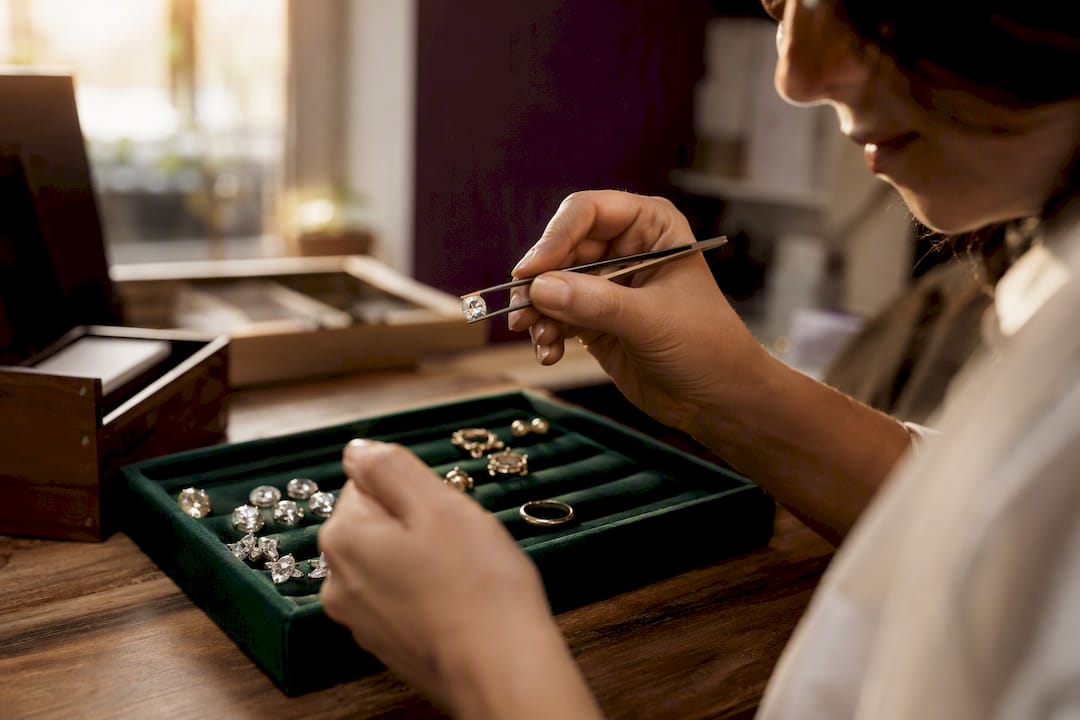
Lab-grown moissanite skips the environmental disruption of diamond mining and comes with a traceable, transparent origin, which is exactly why sustainability-focused editorial coverage keeps circling back to it. ELLE’s fall jewelry coverage frames this kind of accessible, well-made fine jewelry as a real category, not a discount stand-in for diamonds. Bridal fashion coverage has been building that same acceptance for a few seasons now, treating moissanite pieces as legitimate style statements in their own right.
When you’re evaluating a piece, ask for a clear origin statement, a grading or quality certificate, and a written warranty and aftercare policy. Merijaan’s own approach to why moissanite fits ethical, sustainable jewelry covers this in more depth if you want the longer version.
- Ask for origin transparency, not just a “lab-grown” label
- Confirm certification or grading documentation exists
- Check warranty terms before you buy, not after
What Are the Real Pros and Cons of Choosing Moissanite?
Moissanite scores around 9.25 on the Mohs hardness scale, just under diamond, which means it holds up fine to daily wear, gym trips, and years of stacking rings. Its fire and brilliance often outshine a diamond of similar size, and the lower price point means more of the budget goes into the setting.
The tradeoffs: moissanite has a different optical signature than diamond, some diamond testers flag it as a “positive” result which can confuse a jeweler unfamiliar with the material, and its resale value doesn’t track diamond resale markets. Most buyers researching this shift aren’t chasing resale anyway. They want brilliance and an ethical story at a workable price.
- Pro: high brilliance, near-diamond hardness, more setting budget
- Con: distinct optical character, resale value differs from diamond, tester confusion is possible
How Should You Choose a Moissanite Ring in 2025–2026?
- Check certification. Ask for grading documentation on the center stone, especially above one carat.
- Weigh cut against setting. Elongated cuts look best in bezel or east-west mounts; round and cushion cuts tolerate prong settings better.
- Confirm setting security. Bezels protect the stone edge for active hands; prongs show more brilliance but need periodic tightening; tension settings look dramatic but need a jeweler experienced with the style.
- Pick metal for how you live. Platinum and white gold resist wear best; rose and yellow gold need more frequent polishing.
- Ask about aftercare. Resizing, prong checks, and cleaning policy should be spelled out before you buy.
Questions worth asking any jeweler: Where does the stone come from? Is there a written grading or quality certificate? What’s the repair and resizing policy? Can the band be contoured to sit flush with a stacking ring?
Red flags: vague sustainability language with no specifics, no warranty offered, or no clear grading information on a larger center stone.
- Certification and grading documentation
- Setting type matched to lifestyle and cut
- Metal choice based on wear habits
- Written warranty and repair policy
How Merijaan Interprets These Trends in Real Pieces
Merijaan builds these exact trends into pieces backed by a lifetime warranty and full ethical sourcing transparency, which is the standard why we only use moissanite explains in detail. In practice, that means an elongated oval set low in an east-west bezel for daily protection, or a kite-shaped stone paired with a milgrain chevron band for a vintage-modern hybrid.
- Ethical sourcing with a transparent origin statement on every piece
- Lifetime warranty backing every ring, necklace, and stacking set
- Unlimited exchanges for club members if a style or size needs adjusting
Getting a 2026 editorial look shouldn’t mean choosing between durability and design. A well-built moissanite piece, set properly, holds its brilliance and its shape for decades, not just a season.
A Quick Styling Note From Ammar
Choose a setting that protects the stone’s edges before you fall for a shape. I’ve watched too many people pick a dramatic cut, then regret it the first week of daily wear. Trends photograph well. Durability is what you actually live with.
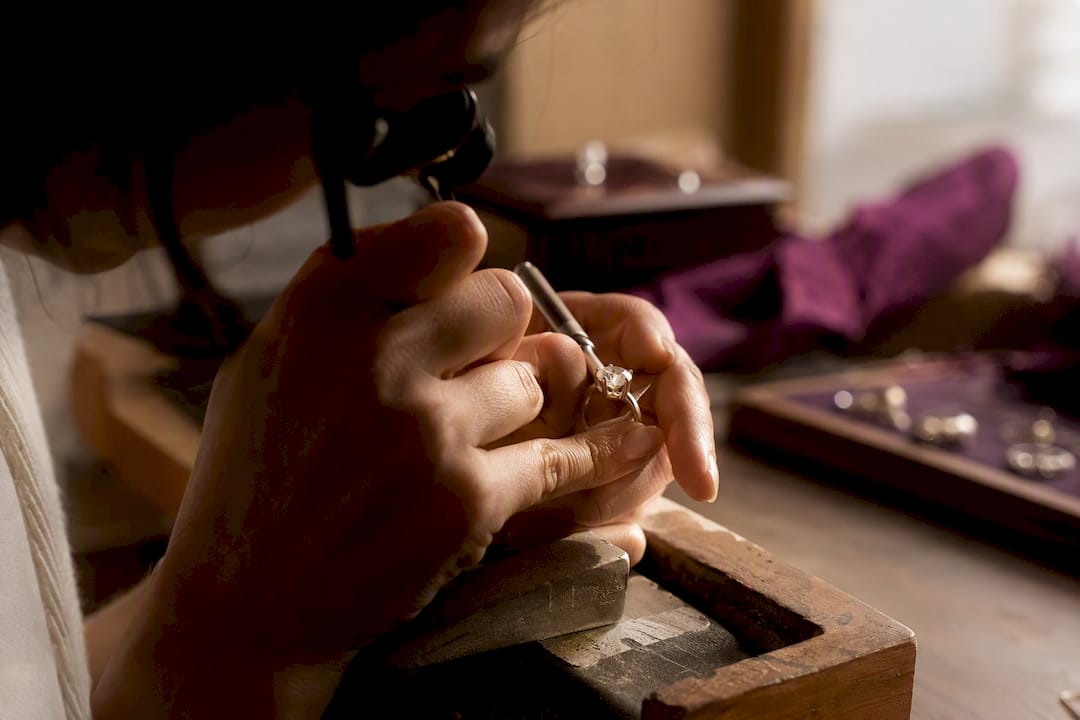
See These Trends in a Finished Piece
Merijaan builds ethically sourced moissanite pieces that carry a lifetime warranty and unlimited exchanges for club members, so trying a new shape or setting doesn’t feel like a gamble.
If the east-west and warm-metal looks in this guide caught your eye, the Frauenfeld Necklace shows how those same design cues translate into a piece you’d wear daily, not just for photos. Every Merijaan piece ships with clear origin documentation and a warranty that covers repairs, not just the first year. Browse the full collection and see which cut and setting fits how you actually live.
Sources
Recommended
- Moissanite vs. Diamond 2026: Hardness, Brilliance, Price & Ethics – The Meri Jaan
- Eco-Friendly Elegance: Why Moissanite Is the Sustainable Jewelry Choice – The Meri Jaan
- How to Choose Sustainable Jewelry: 2026 Trends – The Meri Jaan
- Modern Professional Jewelry Trends for 2026: Your Style Guide – The Meri Jaan

