

A moissanite engagement ring typically runs from low to mid hundreds up to around two thousand dollars for the full piece, stone and setting included, while comparable diamond rings usually cost several times more. The gap exists because moissanite is lab-grown silicon carbide, not a mined stone, so producing a large, clean, high-fire gem costs a fraction of what a diamond of similar visual size demands.
Here’s the quick breakdown before you dig into specifics:
- Budget tier: $150–$400 (small center stone, sterling silver or plated band)
- Typical tier: $400–$900 (0.5 to 1.0 carat equivalent, solid 14k gold)
- Premium tier: $900–$2,500+ (1.5+ carat equivalent, 18k gold or platinum, detailed pavé)
Moissanite’s price per carat is generally in the lower hundreds, much less than the thousands diamonds typically command, largely because it can be manufactured to consistent quality instead of mined and sorted.
Three things swing the price fastest:
- Stone size (carat equivalent) — the single biggest lever
- Setting metal — silver, gold, or platinum can double or triple the price
- Brand and service level — warranty, resizing, and return policy all get baked into the sticker price
Pro Tip: Don’t shop by carat weight alone. A well-cut 1.0 carat moissanite can look bigger than a poorly cut 1.2 carat stone, and it usually costs less.
Key Takeaways
A moissanite engagement ring typically costs several hundred to a couple thousand dollars depending on stone size and metal, generally representing a significantly lower price than a comparable diamond ring.
| Point | Details |
|---|---|
| Price scales with size, not linearly | Doubling carat equivalent often more than doubles price, since larger flawless stones are harder to produce. |
| Metal choice moves price the most | Switching from silver to platinum can shift the same ring’s price by $500 to $1,500. |
| Hidden fees hide in resizing and shipping | Confirm return windows, resizing costs, and import duties before checkout, not after. |
| Reviews and payment options signal trust | Check Trustpilot ratings and installment terms like Klarna before buying from an unfamiliar seller. |
| Merijaan fits the typical-to-premium band | Merijaan prices lab-grown moissanite rings within these ranges and includes lifetime warranty and unlimited member exchanges. |
Where to verify facts and check merchant trust
For technical background on moissanite’s properties, gemology references are a solid starting point, and merchant reviews on platforms like Trustpilot help confirm real buyer experiences. Note that simple thermal testers can misread moissanite as diamond, so ask sellers for lab documentation on higher-value stones.
Table of Contents
- How Moissanite Ring Preis Is Actually Calculated
- What Do Moissanite Rings Cost at Each Size?
- How Do You Compare Moissanite Ring Offers Online?
- What Payment and Return Terms Should You Expect?
- Is Moissanite Tough Enough for Everyday Wear?
- What to Know Before You Check Out
- Sources
How Moissanite Ring Preis Is Actually Calculated
Ask any jeweler why one ring costs $400 and a nearly identical-looking one costs $1,200, and the answer almost always comes down to five variables stacking on top of each other. Understanding them turns you from a passive price-checker into someone who can spot a fair deal in ten seconds.
Stone size drives cost more than anything else. Moissanite is measured in “carat equivalent,” a stand-in for the diamond carat weight it visually matches, since moissanite is actually lighter than diamond gram-for-gram. A 1.0 ct equivalent moissanite looks roughly the size of a 1.0 ct diamond but weighs less. Price scales with size, though not in a straight line. Doubling the carat equivalent from 0.5 to 1.0 often more than doubles the price, since larger rough material is harder to grow flawlessly.
Cut and shape matter almost as much. Round brilliant cuts maximize fire and sparkle and tend to cost slightly more per carat than fancy shapes like cushion or emerald cut, which lose less rough material during cutting. Oval and pear shapes often look larger than their carat equivalent suggests, a trick worth knowing if you’re working with a tight budget.
Color and visual grade show up in listings as terms like “colorless” or graded letter equivalents borrowed from diamond language (D-F range). Higher-grade stones cost more, but the difference between a top-grade and a very-good-grade moissanite is far less dramatic to the naked eye than the price tag implies.
Setting metal is where a lot of buyers get surprised. Sterling silver settings are cheapest but wear faster and can tarnish. Solid 14k gold is the sweet spot for durability and price.
Brand and service factors round things out. A lifetime warranty, free resizing, engraving, and expedited shipping all cost the seller money, and that gets folded into the retail price. This is also where hidden fees creep in.
Watch for these common add-on traps:
- Shipping insurance charged separately at checkout after you’ve already committed to a price
- Resizing fees quoted only after the ring arrives, sometimes $50–$100 per adjustment
- Engraving charged per character rather than a flat fee
- Import duties on rings shipped from outside your country, not disclosed until customs
Pro Tip: Before checkout, search the seller’s FAQ or shipping page for the word “resizing.” If you can’t find a clear policy, email and ask before you buy, not after.
What Do Moissanite Rings Cost at Each Size?
Numbers help more than adjectives here, so let’s get concrete. These bands reflect what shows up across major online jewelry retailers for engagement-style rings, not loose stones.
| Stone Size (Carat Equivalent) | Low (Silver/Plated) | Typical (14k Gold) | Premium (18k Gold/Platinum) |
|---|---|---|---|
| — | lower end hundreds | lower to mid hundreds | mid hundreds and up |
| 0.5 ct | low to mid hundreds | mid hundreds | mid to high hundreds |
| 1.0 ct | mid hundreds | mid to high hundreds | approaching low thousands |
| 1.5+ ct equivalent | higher hundreds to around a thousand | low thousands | low to mid thousands and beyond |
These figures are estimates drawn from patterns across online retail category pages and vary by vendor, region, and current promotions, so treat them as a planning range rather than a quote.
The metal jump is the part shoppers underestimate most. Retail listings for moissanite engagement rings frequently span from roughly $280 to $1,400 within a single size category, purely because of metal and setting complexity, according to pricing patterns visible on European retail sites. A 1.0 ct round moissanite in a plain sterling silver band might land around $380. Move the same stone into a solid 14k gold solitaire setting and you’re closer to $750. Push to platinum with a pavé band and you can clear $1,500 without changing the center stone at all.
A few illustrative examples, based on typical product listings (not specific products, and not guarantees of current pricing):
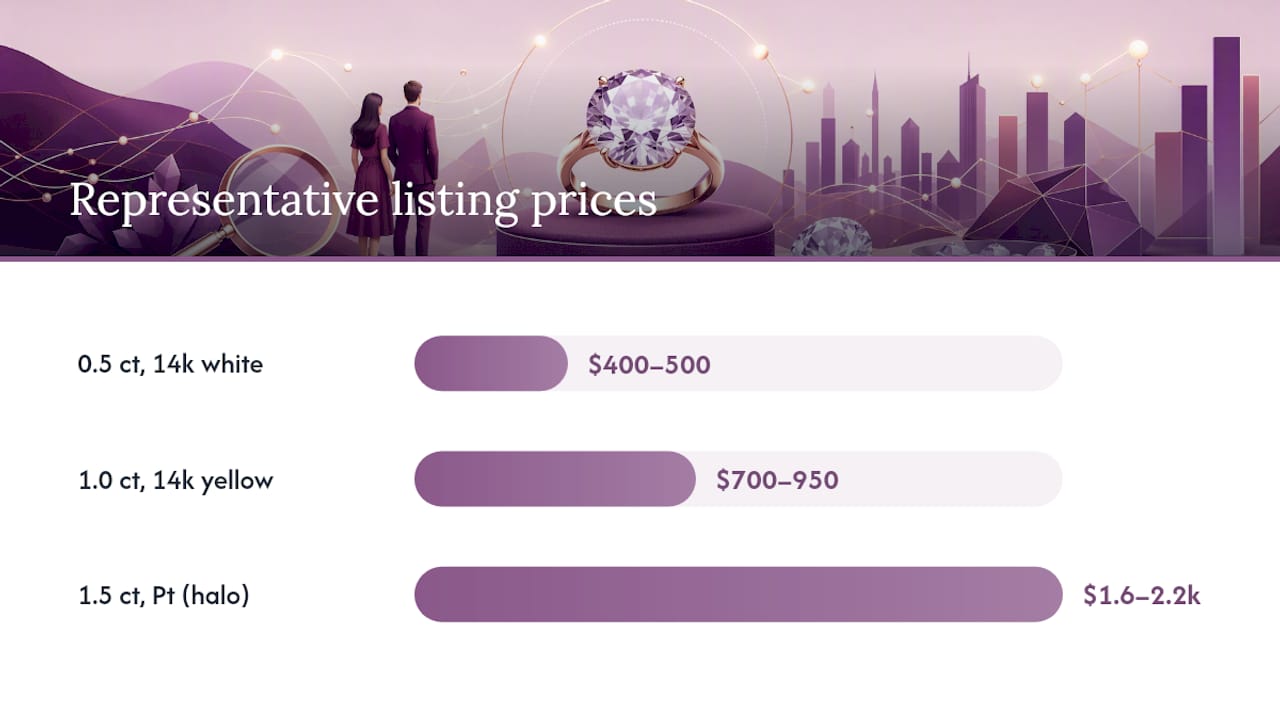
- A 0.5 ct round moissanite solitaire in 14k white gold, simple prong setting: roughly $400–$500
- A 1.0 ct oval moissanite with a thin pavé band in 14k yellow gold: roughly $700–$950
- A 1.5 ct cushion-cut moissanite in platinum with a halo setting: roughly $1,600–$2,200
Many retailers organize their catalogs into price buckets like “under $500” or “$500 to $1,000,” which reflects how the market itself segments moissanite engagement rings. That’s a useful shorthand for browsing, but it can mask real differences in stone quality hiding inside the same bucket. A $600 ring with a mediocre cut and a $600 ring with an excellent cut can look identical in a price filter and completely different on the hand.
One more variable worth flagging: side stones and detailed band work (milgrain, filigree, halo settings) can add $100–$400 to any of the bands above, independent of the center stone size. If a listing looks unusually cheap for its stated carat equivalent, check whether the band is a plain shank or has hidden labor costs stripped out.
How Do You Compare Moissanite Ring Offers Online?
Price alone tells you almost nothing without context. Two rings priced identically can differ wildly in what you actually get, so work through this checklist before adding anything to a cart:
- Confirm the stone’s carat equivalent, cut, and color grade are all listed explicitly, not buried in a generic product title.
- Check the metal purity marking (925 silver, 14k, 18k, platinum) and make sure it’s stated, not implied by a photo.
- Read the return window length and whether custom or engraved rings are excluded.
- Look for warranty terms: what’s covered, for how long, and whether resizing is included.
- Check shipping timelines and whether insurance is included or an extra charge.
- Search for a lab report or certificate of authenticity, especially for larger center stones.
Red flags that should make you pause before buying:
- No stone specifications beyond “sparkly stone” or a vague carat range
- No visible return or exchange policy anywhere on the product page
- Product photos that are all rendered graphics with no real photography under natural light
- Zero customer reviews, or reviews that all read suspiciously similar
- No trust badges, no secure payment icons, no way to contact a real person
Before you buy, it’s worth emailing or messaging the seller directly. Ask where the stone was cut, whether resizing after purchase is free or paid, how long shipping actually takes (not the marketing estimate), and whether there are any fees not shown at checkout. A seller who answers clearly and quickly is a good sign. One who dodges specifics is not.
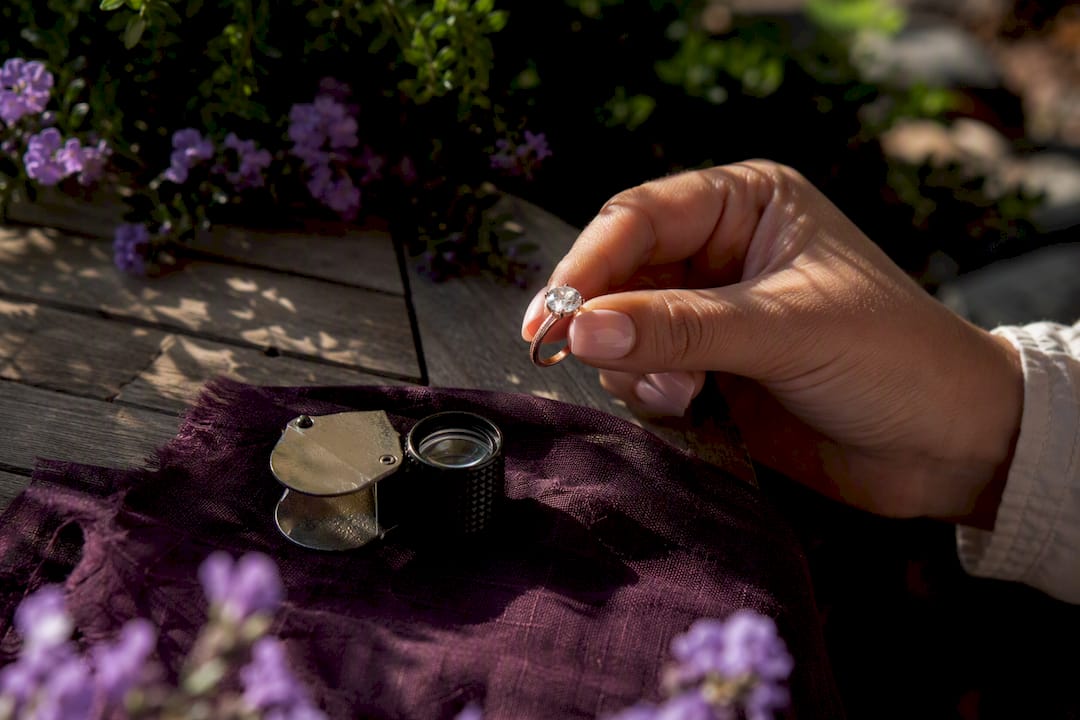
Good product photography matters more than most shoppers realize. Honest listings show the ring from multiple angles in natural light, often including a macro shot of the stone’s facets. If every image is an artificially bright studio render with no true-to-life comparison shot, treat that as a reason to ask more questions, not fewer. For more on separating genuine quality signals from marketing polish, this buyer’s guide to affordable jewelry walks through the details worth checking before you commit.
What Payment and Return Terms Should You Expect?
Most online jewelers now offer more than one way to pay. Credit cards and PayPal remain the default, and both typically include chargeback protection if a ring never arrives or arrives damaged. Buy-now-pay-later services like Klarna have become common for jewelry purchases specifically because ring prices sit high enough that splitting payments into installments makes sense for a lot of buyers. That flexibility is real, but it comes with financing terms worth reading closely, since fees and interest structures vary by provider and by how many installments you choose.
On warranties, expect language like “lifetime warranty” or “limited lifetime warranty,” which usually covers manufacturing defects and sometimes free resizing or replating over the life of the ring. Read the fine print, because “lifetime” doesn’t always mean “unlimited” resizing or replacement. Some sellers offer extended care plans as a paid add-on, which cover accidental damage rather than just defects.
Return windows commonly run 14 to 30 days from delivery.
Before you commit, check the merchant’s page for a few trust signals: clear contact information (a real address or phone number, not just a form), visible customer reviews on an independent platform, and photos or documentation of any lab certification. Trustpilot reviews are a practical way to see how a merchant handles shipping delays or return disputes in practice, not just in policy language.
Pro Tip: If a seller offers installment financing, calculate the total cost including any service fee before you compare it to paying upfront.
Is Moissanite Tough Enough for Everyday Wear?
Moissanite scores about 9.25 on the Mohs hardness scale, just below diamond’s 10. That puts it well above sapphire (9) and far above softer stones like opal or emerald, meaning it resists scratches from nearly everything you’ll encounter day to day, including sand, keys, and most countertops.

That hardness makes moissanite genuinely suitable for daily wear, including on an engagement ring worn continuously. It won’t chip or scratch under normal conditions the way softer gemstones can. Care is straightforward: clean it periodically with warm water, mild soap, and a soft brush to clear away lotion or soap buildup that dulls sparkle over time. Avoid harsh chemical cleaners and remove the ring before heavy manual work, gym sessions, or swimming in chlorinated water, less because the stone is fragile and more to protect the metal setting and prongs.
One quirk worth knowing: moissanite’s high thermal conductivity means it can register as a “diamond” on cheap thermal-only testers, a detail explained further in the sourcing note below. It doesn’t affect wearability at all, but it’s a useful fact if anyone ever questions your stone.
What to Know Before You Check Out
Beyond price and hardness, a few practical details separate a smooth purchase from a frustrating one. Confirm the metal stamp (925, 14k, 18k, PT950) matches what’s advertised, since this affects both durability and resale expectations. Check whether the listed price includes the setting and stone together or just the stone, a distinction some listings blur.
Payment flexibility now extends beyond simple credit card charges. Alongside standard checkout, many sellers support installment plans through providers like Klarna, letting you spread a $900 ring into smaller monthly payments. That’s genuinely useful for a purchase this size, but always confirm whether the plan charges interest or a flat service fee.
On the returns side, treat the return window as a real deadline, not a suggestion. Photograph the ring and its packaging on arrival, and if anything looks off, whether it’s stone quality, sizing, or a scratch, contact the seller immediately rather than waiting. Most reputable sellers resolve issues fast when you reach out within the window; issues raised after 30 days become much harder to resolve regardless of the original policy.
Author’s perspective: what we learned comparing prices
The pattern that stood out most: shoppers overpay for color grade far more often than they overpay for size. Our take is simple: choose a slightly larger, well-cut stone over a marginally “whiter” one, since the size difference is visible and the color difference at high grades rarely is.
Where to see this pricing in action
Every price band above assumes a straightforward transaction, but the easiest way to test what you actually get for your budget is to browse a catalog built around exactly this pricing logic. Merijaan’s lab-grown moissanite rings are priced within the typical and premium bands outlined here, and every piece ships with a lifetime warranty plus resizing support, so the “hidden fee” problem described earlier simply doesn’t apply.
Club members also get unlimited exchanges, which matters if you’re buying an engagement ring sight-unseen and want room to adjust size or setting after the fact without a restocking fee eating into your budget. If you’ve been comparing the bands above against listings elsewhere, view Merijaan’s moissanite ring collection and check a few pieces against the size and metal combination you landed on. Pricing and promotional terms can shift with season and stone availability, so confirm current details on the product page before you check out.
Sources
Recommended
- Moissanite vs. Diamond 2026: Hardness, Brilliance, Price & Ethics – The Meri Jaan
- Why Moissanite Is the Future of Ethical Jewelry in 2026 – The Meri Jaan
- Moissanite Beginner’s Guide: Dazzling, Ethical Diamond Alternative 2026 – The Meri Jaan
- Eco-Friendly Elegance: Why Moissanite Is the Sustainable Jewelry Choice – The Meri Jaan

