

The minimalist jewelry movement is defined by its commitment to simplicity, intentionality, and craftsmanship, stripping adornment down to its most essential elements. Rather than a passing trend, it represents a genuine cultural shift. Wearers are choosing pieces that speak quietly but carry real weight. The movement draws from deep design traditions and reflects a broader turn toward mindfulness in modern life. Understanding its origins, principles, and appeal reveals why minimalism in jewelry is one of the most enduring forces in contemporary accessory culture.
How did the minimalist jewelry movement originate and evolve?
The minimalist jewelry movement did not emerge from fashion alone. Its roots run through three major design traditions: Bauhaus, Japanese wabi-sabi, and Scandinavian functionalism, each emphasizing function, proportion, and material honesty. These philosophies share a common belief: that beauty lives in restraint, not excess.
Bauhaus, the German design school active from 1919 to 1933, rejected ornament as decoration for its own sake. It insisted that form must follow function. Japanese wabi-sabi taught that imperfection and simplicity hold their own quiet beauty. Scandinavian functionalism, practiced across Sweden, Denmark, and Finland, prioritized clean lines and honest materials in everyday objects. All three traditions fed directly into what we now recognize as minimalist design thinking.
The jewelry world absorbed these ideas slowly, then all at once. For most of the 20th century, jewelry culture rewarded scale, sparkle, and status. Maximalist pieces signaled wealth and social position. The reaction against this began in the 1990s and accelerated through the 2000s as consumers grew tired of visual excess in every area of life.
The cultural pivot toward mindfulness played a decisive role. As digital media filled every waking moment with stimulation, many people began seeking calm through simplicity. Jewelry became one expression of that search. Pieces that drew attention to a subtle curve, a clean line, or the natural fall of a chain felt more honest than pieces designed to shout.
Key cultural forces that shaped the movement’s evolution:
- The rise of mindfulness culture and intentional living as mainstream values
- A reaction against status-driven, ornate jewelry that prioritized scale over meaning
- Growing consumer interest in quality over quantity, driven by sustainability concerns
- The influence of minimalist architecture and fashion on accessory design
- Social media aesthetics favoring clean, uncluttered visual storytelling
What are the key design principles of minimalist jewelry?
Minimalism is often misunderstood as absence. True minimalist design is about careful selection and purposeful inclusion, not simply removing elements until nothing remains. This distinction matters enormously when evaluating jewelry.
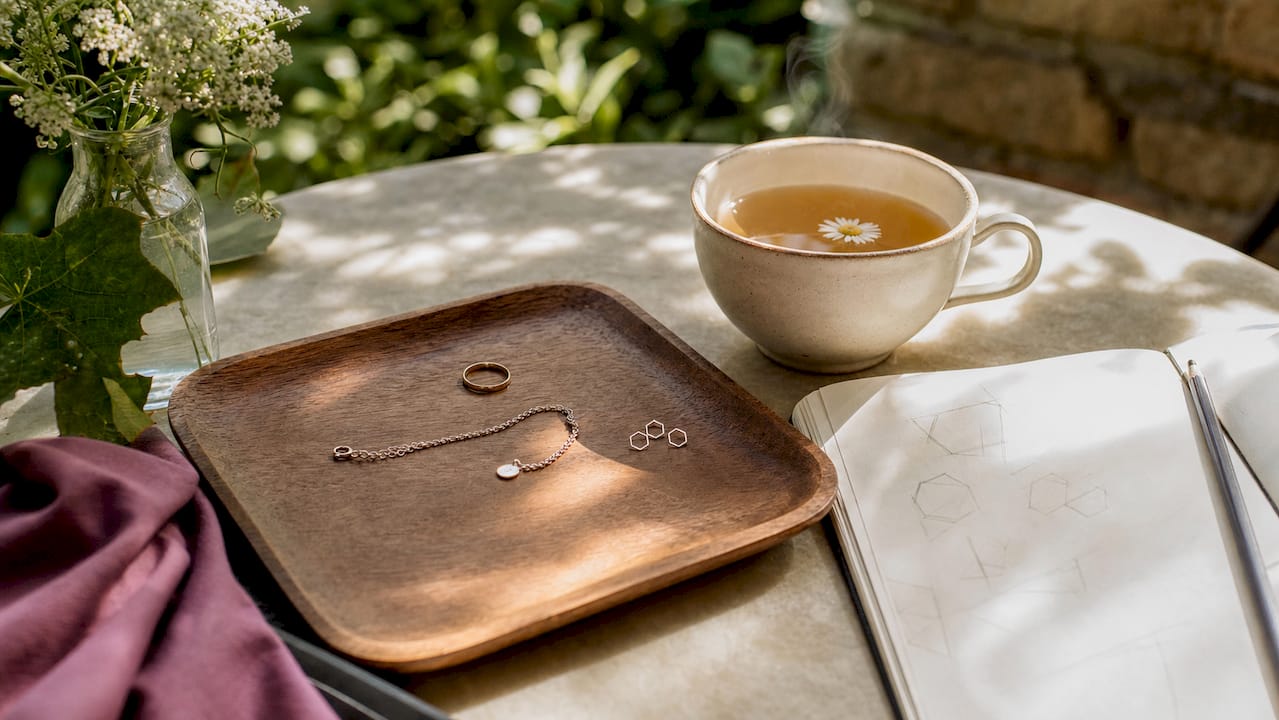
The guiding framework comes from industrial designer Dieter Rams, whose principle “good design is as little design as possible” has shaped everything from consumer electronics to fine jewelry. Applied to accessories, this means every curve, weight, and finish must earn its place. Nothing is accidental. Nothing is decorative without purpose.
Negative space is one of the most powerful tools in minimalist jewelry design. A thin gold band gains visual power precisely because of the empty space around it. A single small pendant on a delicate chain draws the eye because nothing competes with it. Negative space controls hierarchy and visual comfort, guiding the viewer’s attention without force.
Material quality becomes non-negotiable in minimalist work. Ornate jewelry can hide flaws behind complexity. Minimalist pieces cannot. Flaws are more visible without ornate covering, which means the discipline required to produce clean minimalist jewelry is actually higher than for heavily decorated pieces. This is why well-made minimalist jewelry tends to last. The craftsmanship has nowhere to hide.
Pro Tip: When evaluating a minimalist piece, turn it over and examine the back. The quality of finishing on the underside reveals whether a maker truly commits to craftsmanship or simply performs minimalism on the surface.
The table below shows how minimalist jewelry design differs from generic or decorative approaches across key criteria.
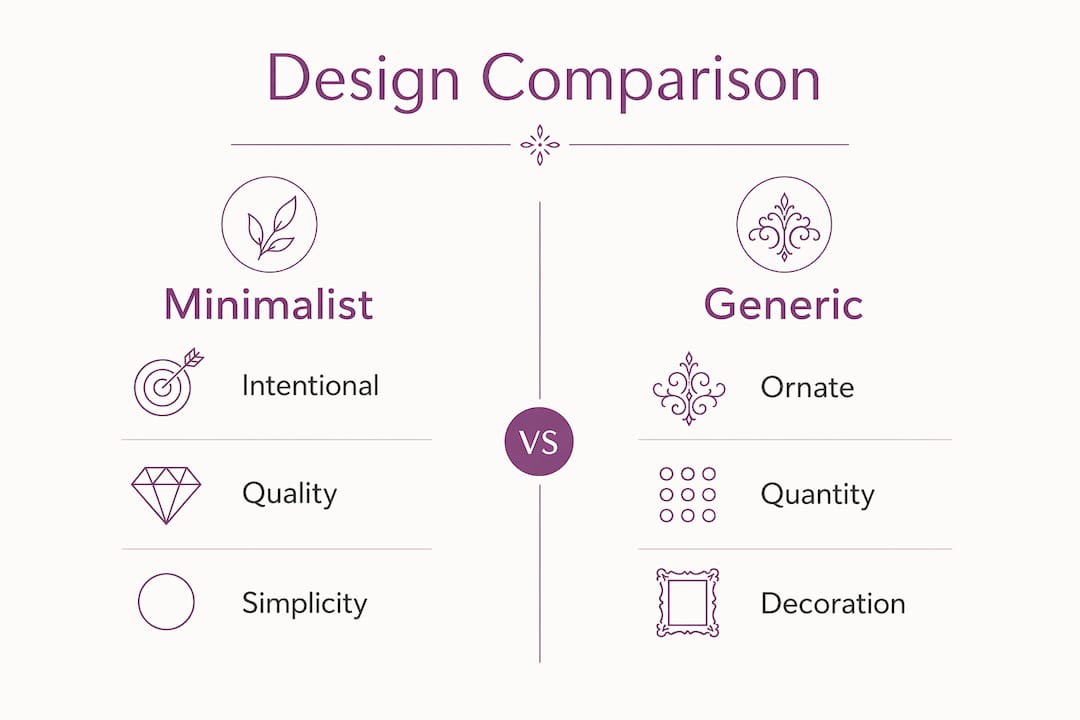
| Design criterion | Minimalist approach | Generic decorative approach |
|---|---|---|
| Element inclusion | Every detail serves a purpose | Elements added for visual fullness |
| Material quality | High grade; flaws are visible | Can be masked by ornamentation |
| Negative space | Used deliberately to guide focus | Filled to avoid emptiness |
| Finish and precision | Consistent on all surfaces | May vary on hidden surfaces |
| Longevity of appeal | Timeless; resists trend cycles | Often tied to seasonal trends |
Why has minimalist jewelry become so popular?
Minimalist jewelry signals confidence through restraint. This is its most counterintuitive appeal. In a culture saturated with visual noise, choosing a single thin chain or a plain band communicates that the wearer does not need decoration to make a statement. Wearers shift focus inward toward individuality, away from status display.
The practical benefits are equally real. Minimalist pieces are lightweight, comfortable for all-day wear, and versatile enough to move from a morning meeting to an evening dinner without adjustment. A simple gold ring works with a linen shirt and with a silk dress. That range of use is something ornate statement pieces rarely offer.
The benefits of minimalist jewelry that wearers consistently report:
- Versatility. One piece works across multiple outfits, occasions, and seasons without looking out of place.
- Comfort. Lightweight designs cause no fatigue during extended wear, making them practical for daily use.
- Emotional resonance. Simplicity leaves room for personal interpretation. A plain band can represent a commitment, a milestone, or a quiet reminder.
- Sustainability. Buying fewer, better pieces reduces consumption and waste over time.
- Timelessness. Minimalist pieces resist trend cycles, meaning they remain relevant across years and decades.
Minimalist jewelry also functions as a quiet rebellion against constant consumption. Choosing one carefully made piece over a drawer full of disposable accessories is itself a values statement. This alignment between personal ethics and aesthetic choice is a major driver of the movement’s growth, particularly among younger buyers who prioritize authenticity.
The connection to ethical and sustainable luxury has made minimalist jewelry especially relevant in 2026, as consumers increasingly ask where their pieces come from and how they are made.
How does minimalist jewelry fit into personal style and fashion?
Minimalist jewelry works because it complements rather than competes. This is its core relationship with clothing and personal style. A thin chain necklace adds presence to a plain white shirt without overwhelming it. A small stacking ring adds texture to a hand without drawing attention away from the face. The piece supports the overall look rather than demanding to be its centerpiece.
The staple pieces of minimalist jewelry style follow a clear logic:
- Thin chain necklaces. Available in gold, silver, and rose gold, these sit close to the neck and add warmth without weight. They layer well with longer chains for a more textured look.
- Simple band rings. A plain band in a quality metal is the most versatile piece in any collection. It reads as intentional without being loud.
- Small stud earrings. A single pearl, a tiny geometric shape, or a small stone set flush in metal. These add polish without distraction.
- Single pendant necklaces. One meaningful shape, worn alone, carries more visual impact than a cluster of charms.
- Delicate bracelets. A fine chain or thin bangle worn alone or stacked with one other piece creates a finished look without excess.
Minimalist pieces serve as vessels for personal meaning, with their simplicity leaving room for individual interpretation. A plain band may represent strength. A single pendant may mark a memory or a relationship. This capacity for personal meaning is something ornate jewelry rarely achieves, because the decoration itself dominates the story.
The 2026 direction in minimalist jewelry trends moves toward warmer expressions of restraint. Modern minimalism embraces subtle warmth through rounded edges and softer finishes while keeping visual discipline intact. This shift makes minimalist pieces feel more human and less clinical, broadening their appeal without abandoning their core principles.
Pro Tip: When layering minimalist pieces, limit yourself to three items maximum and vary the chain length by at least two inches between each layer. This creates visual rhythm without creating clutter.
Pairing minimalist jewelry with minimalist outfits amplifies the effect of both. Clean clothing and clean jewelry reinforce each other, creating a look that reads as considered and calm. The relationship between the two is not accidental. It reflects the same underlying philosophy applied to different materials.
Key Takeaways
The minimalist jewelry movement is a design and cultural philosophy that prioritizes purposeful simplicity, quality craftsmanship, and personal meaning over decoration and status display.
| Point | Details |
|---|---|
| Rooted in design tradition | Bauhaus, wabi-sabi, and Scandinavian functionalism all shaped the movement’s core principles. |
| Minimalism requires discipline | Flaws are more visible in simple pieces, so craftsmanship standards are higher, not lower. |
| Signals confidence | Choosing restraint over excess communicates individuality and authenticity. |
| Versatile and timeless | Minimalist pieces work across occasions and resist trend cycles, making them lasting investments. |
| Carries personal meaning | Simple forms leave room for individual interpretation, making each piece emotionally resonant. |
Why minimalism in jewelry deserves more credit than it gets
Most people assume minimalist jewelry is the easy choice. Pick something plain, wear it, done. That assumption misses almost everything important about the movement. The pieces that look effortless are usually the hardest to make well. A thin band with a single flush-set stone demands perfect proportions, flawless finishing, and material integrity that a heavily decorated piece simply does not require.
What I find most compelling about minimalist jewelry is how it shifts the relationship between the wearer and the piece. Ornate jewelry tells a story loudly, on its own terms. A minimalist piece invites the wearer to complete the story. That self-expression through jewelry is quieter, but it runs deeper.
For anyone new to minimalist accessories, my advice is to start with one piece that genuinely means something to you. Not the most popular style or the most photographed shape. The piece that, when you put it on, feels like it belongs. Minimalism works best when it is personal, not performative.
— Ammar
Merijaan’s approach to minimalist jewelry
Merijaan builds its collections around the same principles that define the minimalist jewelry movement: purposeful design, quality materials, and pieces that carry meaning beyond their appearance.
Every piece in the Merijaan collection uses lab-grown moissanite, which delivers genuine sparkle without the ethical cost of mined stones. The women’s rings collection reflects a clear commitment to clean design and lasting craftsmanship, from the water-drop silhouette of the Monthey Ring to the precise geometry of the Emmetten Ring. Each piece is designed to be worn every day, not saved for occasions. And because 100% of Merijaan’s profits go directly back to the people who make the jewelry, every purchase supports the makers behind the craft.
FAQ
What is the minimalist jewelry movement?
The minimalist jewelry movement is a design and cultural philosophy that prioritizes simplicity, intentionality, and craftsmanship over ornament and status display. It draws from design traditions including Bauhaus, Japanese wabi-sabi, and Scandinavian functionalism.
Is minimalist jewelry lower quality than ornate jewelry?
Minimalist jewelry actually demands higher craftsmanship standards. Without decorative elements to mask flaws, every surface and proportion must be executed precisely, making quality more visible, not less.
What are the best minimalist jewelry pieces to start with?
Thin chain necklaces, simple band rings, and small stud earrings are the most versatile entry points. Each works across multiple outfits and occasions without requiring adjustment.
How does minimalist jewelry reflect personal values?
Minimalist pieces act as a quiet rebellion against constant consumption, signaling authenticity and restraint. Their simplicity also leaves room for personal meaning, allowing wearers to attach their own stories to each piece.
How does minimalist jewelry fit into 2026 fashion trends?
The 2026 direction moves toward warmer minimalism, with rounded edges and softer finishes replacing hyper-clean lines, while keeping the core principle of visual restraint fully intact.

