

Power jewelry for women is a category of symbolic accessories worn to communicate authority, confidence, and signature identity — both to the room and to yourself. It is not defined by price alone, but by intention, craft, and the visual weight a piece carries. A signet ring engraved with a personal motif, a structured cuff in recycled gold, a classic pearl strand, or a geometric moissanite pendant can each function as a power piece depending on how deliberately it is chosen and worn. Merijaan builds exactly this kind of jewelry: ethically crafted, lab-grown moissanite pieces designed to carry meaning without compromising on provenance. Look for certifications like GIA provenance statements or Responsible Jewellery Council (RJC) compliance when evaluating any piece in this category.
Quick examples of power pieces across the spectrum:
- Signet ring: a personal insignia, worn as a quiet declaration of identity
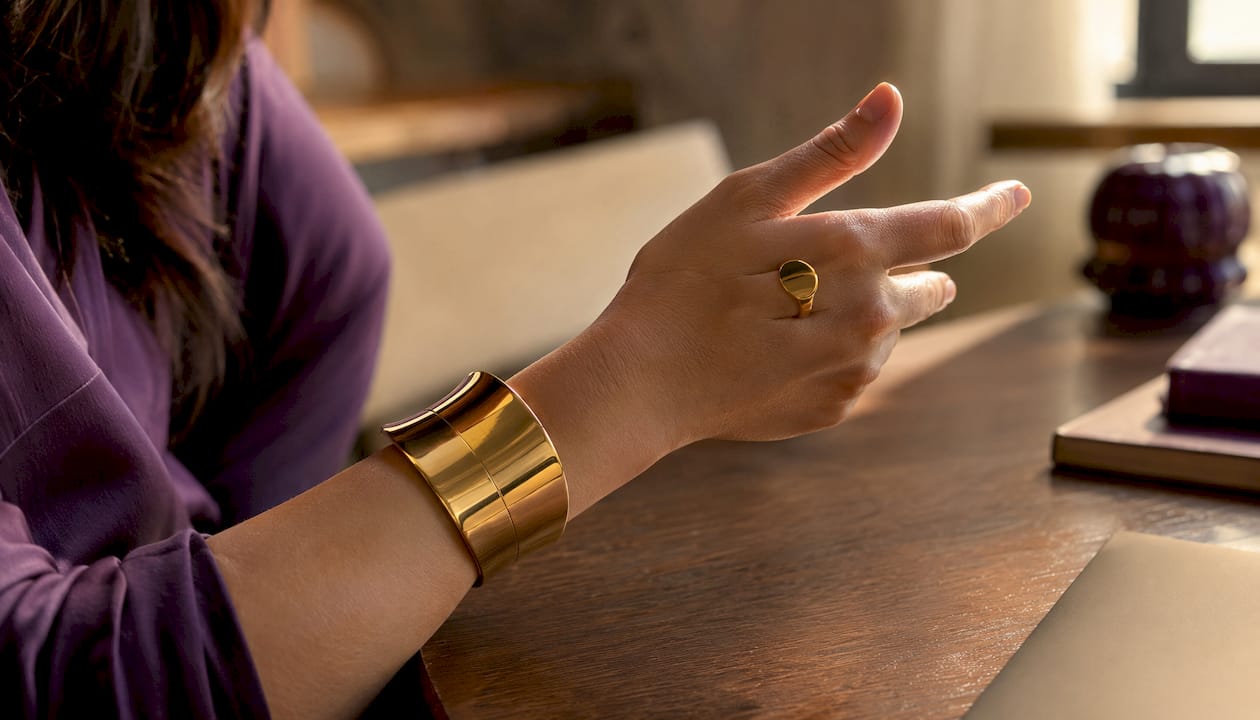
- Structured cuff: bold scale that commands visual attention at the wrist
- Classic pearl strand: poise and quiet authority in any professional setting
- Geometric moissanite pendant: modern radiance with traceable ethical sourcing
Table of Contents
- Why does jewelry read as power?
- Which signature pieces actually communicate authority?
- What materials and sourcing actually matter for ethical luxury?
- How do you choose the right power piece?
- How do you care for and protect a power piece long-term?
- What should you expect to pay, and where should you buy?
- Merijaan crafts ethical power pieces worth wearing every day
- Key Takeaways
- The real cost of ignoring provenance
- Useful sources and further reading
Why does jewelry read as power?
Jewelry functions as a portable social language that communicates status, belonging, and private confidence simultaneously. That is not a modern marketing idea. Across centuries and cultures, precious materials were hard to acquire, harder to fake, and instantly readable as signals of access — to trade routes, skilled makers, and elite circles.
The same mechanics operate today. A well-chosen piece does several things at once:
- Status signal: material quality and design recognition tell observers something about your access and taste
- Identity marker: a motif or silhouette you return to becomes a recognizable part of your personal brand
- Store of value: ethically sourced metals and certified stones hold intrinsic worth beyond the moment of purchase
- Private anchor: jewelry influences desire and behavior beyond pure ornamentation — the wearer feels different with it on, even when no one else notices
The visual cues that register as power are specific: scale relative to the body, contrast against clothing, the way a piece catches light, and tactile weight. A heavy gold band reads differently than a delicate chain, even at the same price point. Luxury houses understand this — signature pieces become modern insignia, wearable symbols that broadcast status and belonging to a particular world.
Pro Tip: In a meeting or presentation, one statement piece at the focal point (a bold earring near your face, a cuff at the wrist when you gesture) controls where attention lands. Wearing multiple competing pieces dilutes that effect.
Which signature pieces actually communicate authority?
Certain silhouettes reliably read as power across professional and social contexts. High-achieving women use classic motifs strategically to elevate their look without appearing overdressed — and the choices are more specific than “wear something nice.”
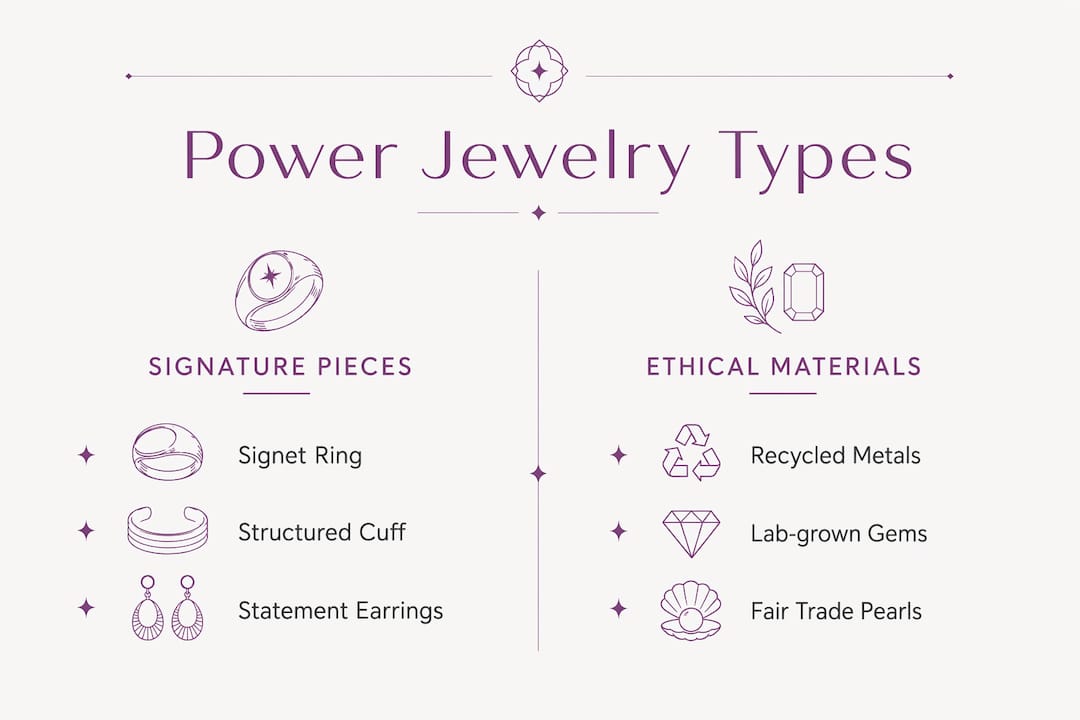
Signet ring: The oldest power piece in the Western canon. Its flat face invites personalization (initials, a crest, an abstract motif), and its solid weight signals permanence. Works best when the ring’s scale matches hand proportion — a wide band on a narrow finger reads as costume; a refined band on a larger hand can disappear.
Structured cuff: High visual impact at the wrist, especially effective when gesturing. A senior executive who reaches across a conference table with a polished gold cuff has already made a statement before speaking. Keep the rest of the wrist clear.
Statement earrings: The piece closest to your face, which means it shapes how people read your expression. Geometric or architectural styles in a single metal read as authoritative; chandelier styles work better in creative or social settings than in conservative boardrooms.
Pearls: Pearls communicate poise and quiet authority across industries, which is why they remain a workplace staple decades after their peak fashion moment. A single strand or pearl studs work in almost any professional context.
Brooch: Underused and underrated. A well-placed brooch on a lapel or collar reads as deliberate and confident — a creative director’s move, not a default choice.
Pendant necklace: Length matters. A pendant that sits at the collarbone draws the eye upward toward the face. Longer pendants work with open necklines; shorter ones suit crew or turtleneck silhouettes. Empowerment motifs — literal phrases or symbolic shapes — are a growing subcategory here.
Pro Tip: For professional settings, the rule of one applies: choose one statement piece and let everything else recede. Pair a bold earring with a minimal necklace, or a statement cuff with simple studs. Proportion and restraint are what separate power dressing from noise.
For detailed guidance on professional jewelry styling, the context of your industry matters as much as the piece itself.
What materials and sourcing actually matter for ethical luxury?
Prioritize traceable metals, recycled gold, and lab-grown gemstones for any piece you want to wear with genuine confidence. The material story is part of what the piece communicates — and provenance documentation is the practical mechanism that separates real ethical claims from marketing language.
Recommended materials and why they matter:
- 18K recycled gold: retains the warmth and durability of traditional gold with a lower environmental footprint; ask for an assay report confirming purity
- Platinum with hallmarking: the densest, most durable precious metal for settings; hallmarks confirm metal content independently
- Lab-grown moissanite: offers durable brilliance and a more traceable environmental profile compared with many mined stones, making it a strong candidate for ethical-luxury power pieces; Merijaan uses it as the core of their collection
- Sterling silver (925): accessible entry point with clear hallmarking standards; less durable for daily wear than gold or platinum
Trust signals to ask for before purchasing:
- Hallmarking on the metal (visible stamp confirming purity)
- RJC certification or equivalent supply-chain audit
- GIA provenance statement for any significant gemstone
- Metal assay report from an independent lab
- Detailed invoice showing maker name, material origin, and stone source
Understanding how jewelry sourcing impacts communities adds another dimension to what “ethical” actually means in practice.
Pro Tip: Ask three questions before buying: “Can you show me the hallmark or assay report?” “Who made this piece, and where?” “What is your repair and warranty policy?” A seller who hesitates on any of these three is a seller worth walking away from.
How do you choose the right power piece?
Use a repeatable checklist to judge fit, quality, ethics, and long-term value — whether you are shopping in a boutique or browsing online.
- Define the purpose. Daily wear demands durability (heavier gauge metals, secure settings). Event pieces can prioritize visual drama over resilience.
- Check scale and proportion. Hold the piece against your body before buying. A cuff that overwhelms a narrow wrist or a pendant that disappears against a busy print is not doing its job.
- Verify material and stone quality. Ask for the hallmark, assay report, or gemstone certificate. Lab-grown moissanite should come with a grading report.
- Confirm maker credentials. Who designed it? Who made it? Ethical ateliers can answer both questions.
- Review the return and warranty policy. A maker confident in their work offers clear repair terms. Vague or absent policies are a warning sign.
- Assess price versus expected lifespan. A $300 piece you wear daily for ten years costs less per wear than a $150 piece that tarnishes in six months.
Red flags to walk away from:
- Vague provenance (“ethically sourced” with no documentation)
- No visible hallmarking on metal
- Unclear or absent return/repair policy
- Pressure to buy before you have reviewed the piece properly
- Stone certifications that cannot be verified independently
How do you care for and protect a power piece long-term?
Proper care preserves both appearance and monetary value. The routines are simple, but skipping them compounds over time.
Daily and storage habits:
- Remove pieces before applying perfume, lotion, or cleaning products — chemicals dull finishes and weaken settings
- Store each piece separately (a soft pouch or lined compartment) to prevent scratching
- Wipe metal surfaces with a lint-free cloth after wearing to remove skin oils
Seasonal maintenance:
- Have prongs checked by a jeweler every 12 months if you wear a stone-set piece daily
- Schedule a professional ultrasonic cleaning once a year for moissanite or diamond pieces
- Inspect clasps and hinges on cuffs and bracelets for wear
For practical guidance on durable daily wear, the metal gauge and setting style matter as much as the cleaning routine.
“A beautiful object that concentrates rarity, meaning, and craftsmanship doesn’t disappear. It becomes a legend.” — Luxyora
Keep your original invoice, any gemstone certificates, and the maker’s warranty document together in one place. For pieces above $1,000, a jewelry floater policy (added to your homeowner’s or renter’s insurance as a scheduled personal property endorsement) is worth the modest annual premium. Whether you plan to pass a piece down or eventually resell it, timeless design and documented provenance are what hold value across both paths.
What should you expect to pay, and where should you buy?
Ethical-luxury power pieces vary widely in price depending on materials, design complexity, and maker transparency. The table below shows realistic bands for the U.S. market.
| Price Range | What It Typically Buys |
|---|---|
| $150–$300 | Entry-level ethical pieces: sterling silver or gold-plated settings, lab-grown moissanite accent stones, hallmarked, from transparent DTC brands |
| $300–$1,000 | Mid-tier: solid 18K recycled gold, certified lab-grown center stones, custom sizing, maker documentation included |
| $1,000–$3,000 | Heirloom-grade: platinum or high-karat gold, larger certified stones, bespoke design, full provenance package, repair warranty |
Reputable buying channels and what to expect:
- Ethical direct-to-consumer ateliers: transparent pricing, maker documentation, and shorter supply chains; custom DTC models can shorten lead times while delivering hand-finished pieces at clear prices
- Certified independent jewelers: RJC-certified retailers can show supply-chain documentation on request
- Bespoke designers: higher cost, longer timelines (typically 6–12 weeks), but full control over design and materials
- Established ethical brands online: look for published sourcing policies, real return windows (30+ days), and accessible customer service
Signs of quality at the point of purchase: the piece feels substantial in hand, settings are flush and secure, finish is consistent with no rough edges, and the seller provides written documentation without being asked.
For ethically sourced styling options, the sourcing story should be as clear as the design.
Merijaan crafts ethical power pieces worth wearing every day
Merijaan is a direct-to-consumer ethical atelier built around one clear premise: every piece should carry genuine provenance, not just a marketing claim. The core collection uses lab-grown moissanite set in traceable metals, delivering the brilliance of a traditional luxury piece without the opacity of conventional supply chains. Every profit goes back to the makers — the artisans whose craft is the actual product.
The collection spans ready-to-wear women’s rings and women’s necklaces, including a lab-grown moissanite pendant that sits at the collarbone exactly where a power piece should. Each piece ships with maker documentation and a clear warranty policy. Browse the collection or reach out for a custom consult to find the signature piece that fits your professional and personal brand.
Key Takeaways
Power jewelry works because it operates on two levels at once: a public signal of authority and a private anchor of confidence, both concentrated in a single wearable object.
| Point | Details |
|---|---|
| Define it clearly | Power jewelry communicates authority, confidence, and signature identity — chosen deliberately, not worn by default. |
| Prioritize ethical materials | Lab-grown moissanite, recycled gold, and hallmarked platinum are the materials to ask for first. |
| Use the checklist | Verify purpose, proportion, hallmarking, maker credentials, and warranty before any purchase. |
| Protect your investment | Keep invoices and certificates; schedule annual prong checks; consider a jewelry floater policy for pieces above $1,000. |
| Merijaan’s approach | Merijaan offers lab-grown moissanite pieces with full maker documentation and a profit-back-to-makers model. |
The real cost of ignoring provenance
Most conversations about power jewelry focus on aesthetics — which silhouette reads as authoritative, which metal flatters which skin tone. Those questions matter. But the piece you reach for every morning also carries a supply-chain story, and that story either reinforces or quietly undermines what the jewelry is supposed to communicate.
A woman who wears a signet ring to signal integrity while wearing a piece with no traceable origin is working against herself, even if no one else knows it. The private-anchor function of jewelry — the internal shift in confidence it produces — depends partly on the wearer’s own relationship to the object. A piece you trust, whose provenance you can document, whose maker you can name, sits differently on the hand than one you bought because it looked good in a photograph.
The craftsmanship behind a piece is not a luxury add-on. It is the mechanism by which a piece earns its authority over time. And the fashion choices that signal identity are most powerful when they are consistent all the way through — from the design you choose to the values of the maker who built it.
Useful sources and further reading
- Why Jewellery Has Always Been a Symbol of Power | Luxyora — the strongest single overview of jewelry’s historical and psychological power mechanics; used throughout this article for the social-language and private-anchor arguments.
- Power Jewellery: Mediating Powers through Jewellery (academic paper) — qualitative research on how jewelry influences desire and behavior beyond ornamentation; supports the private-anchor claim.
- Power Jewelry: What Successful Women Wear to Work | Easyrest — practical workplace-focused overview of classic power motifs including pearls, cuffs, and signet rings.
- Power Jewelry: Custom Designs for Career Confidence | Alpha Jewelry — covers custom and DTC manufacturing models, CAD-driven fit, and why bespoke is rising among professional women.
- Tatty Devine — Strong Woman Necklace — example of a designer piece using explicit empowerment motifs; illustrates the literal end of the symbolic-jewelry spectrum.
Recommended
- What Is Ethical Jewelry? A Guide for Conscious Shoppers – The Meri Jaan
- How Ethical Jewelry Shapes South Asian Love Stories in 2026 – The Meri Jaan
- Professional Jewelry for Office Settings: A Career Woman’s Guide – The Meri Jaan
- Rising Ethical Jewelry in South Asian Love Stories | 2026 Trends – The Meri Jaan

