
The jewelry circular economy is a system that keeps precious materials continuously in use by applying reduce, reuse, and recycle principles across every stage of a piece’s life. Unlike the traditional “take, make, dispose” model, it treats gold, silver, and gemstones as resources to circulate indefinitely, not consume once. The goal is to extend product lifespan, cut resource consumption, and shrink the industry’s environmental footprint.
Key elements of this system:
- Reduce: Design pieces that require fewer raw materials and generate less production waste
- Reuse: Repair, refurbish, and resell existing jewelry rather than replacing it
- Recycle: Recover post-consumer recycled (PCR) metals and gems for use in new pieces
- Redesign operations: Shift from mass production to made-to-order and take-back programs
- Extend lifespan: Build for repairability and modularity so pieces last decades, not seasons
Table of Contents
- How do the principles of a circular jewelry economy actually work?
- What does circular economy adoption look like across the jewelry industry today?
- How Merijaan leads in ethical and circular jewelry craftsmanship
- How can you personally support the circular jewelry economy?
- What policies and regulations shape circular economy adoption in jewelry?
- What do real circular economy case studies in U.S. jewelry look like?
- Which technologies are making circular jewelry production more feasible?
- Key Takeaways
How do the principles of a circular jewelry economy actually work?
The 3R model in jewelry goes well beyond sorting scrap at the end of production. It demands operational redesign from the very first sketch.
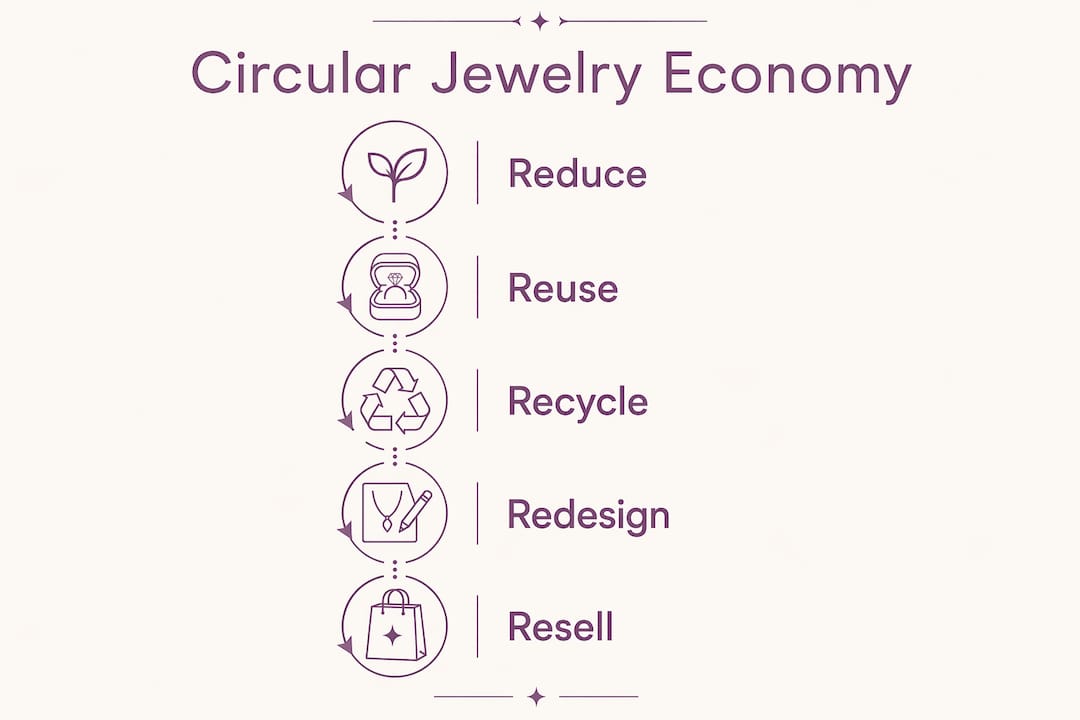
Reduce means restraint in material use and production volume. Made-to-order manufacturing is the clearest expression of this: a brand produces only what a customer has already purchased, eliminating overstock entirely. Reuse shows up as repair services, resizing, and redesigning inherited pieces into new forms. Recycle involves recovering metals and gems from worn or unwanted jewelry and feeding them back into production as post-consumer recycled inputs.
Design choices made at the creation stage determine whether a piece can be recycled or refurbished decades later. Modular jewelry structures with standardized fasteners and non-mixed metal compositions allow components to be separated, sorted, and recovered cleanly. Intricate, multi-alloy designs with adhesive bonding do the opposite.
- Certified responsible sourcing (Responsible Jewellery Council, LBMA standards) validates that recycled inputs are genuinely post-consumer
- Maintenance and repair services extend the product lifecycle without new material extraction
- Recovery mechanisms let customers return worn pieces for credit or refurbishment
Pro Tip: When evaluating a jewelry brand’s circularity, ask whether their pieces use snap or press-fit assembly rather than soldering or adhesive bonding. That single design choice determines whether the piece can be cleanly disassembled and recycled at end of life.
What does circular economy adoption look like across the jewelry industry today?
The pre-owned jewelry market is one of the clearest signals of where the industry is heading. The global secondhand luxury watch and jewelry market is worth about $24.4 billion and growing at 8% annually, outpacing the broader luxury sector. Brands and retailers that ignore pre-owned are leaving both revenue and sustainability credibility on the table.
$24.4 billion: The current size of the global secondhand luxury watch and jewelry market, growing at 8% per year and still described as being in its early stages.
Practical shifts happening across the industry right now:
- Integration of pre-owned materials into retail assortments as a formal product category
- 3D printing replacing cast-and-mold production, cutting material waste and energy use
- Virtual shopping platforms reducing the need for physical inventory and printed catalogs
- Take-back programs offering store credit for returned pieces, recovering materials directly
Circular models also deliver economic benefits including lower raw material costs, stronger corporate social responsibility positioning, and measurable brand value gains. The challenges are real too: limited recycling infrastructure, consumer skepticism about “recycled” luxury goods, and the absence of a coordinated international recovery system all slow adoption. The Federal Trade Commission’s Green Guides (16 CFR Part 260.13) add a compliance layer, requiring brands to substantiate any recycled content claim with documented evidence before they can advertise it.
How Merijaan leads in ethical and circular jewelry craftsmanship
Merijaan’s approach to sustainable jewelry practices is built around two material choices that define circular jewelry: lab-grown moissanite and recycled silver. Lab-grown moissanite delivers the same optical brilliance as mined gemstones without the land disruption, water pollution, or community displacement that conventional mining causes. Recycled silver closes the material loop, keeping a precious metal in circulation rather than extracting new ore.

That commitment extends beyond materials. Merijaan’s business model returns all profits to the artisans who craft each piece, addressing the social dimension of sustainability that purely material-focused brands often miss. Customer feedback consistently highlights the sparkle and craftsmanship of pieces like the Naters Necklace, which combines certified lab-grown moissanite with 18K gold-plated 925 silver chain construction.
Merijaan’s circular practices in practice:
- Lab-grown moissanite eliminates demand for newly mined gemstones
- Recycled silver as a primary metal input reduces virgin resource extraction
- Made-to-order production prevents overstock and excess waste
- Consumer education through blog content builds awareness of ethical sourcing standards
How can you personally support the circular jewelry economy?
Your purchasing decisions are the most direct lever you have. Choosing brands that use certified PCR metals and lab-grown stones removes demand from extraction-heavy supply chains. Asking a retailer whether their recycled content claim is verified by SCS Global Services, the Responsible Jewellery Council, or the LBMA tells you immediately whether the claim is substantiated or marketing copy.
Pro Tip: Before buying new, check whether the brand offers repair or resizing services. A jeweler who will fix what they sell is one who designed for longevity, not planned obsolescence.
Practical ways to contribute:
- Support made-to-order brands to avoid fueling overproduction
- Participate in take-back or buy-back programs when pieces are no longer worn
- Resell or donate unwanted jewelry rather than storing it indefinitely
- Communicate sustainability preferences directly to retailers, since consumer demand shapes assortment decisions faster than regulation does
- Care for pieces properly to extend their life, following guidance on jewelry maintenance
The same circular principles reshaping jewelry are also gaining ground in adjacent sectors. Sustainability in beauty now follows a nearly identical framework, with PCR packaging, refillable formats, and take-back programs becoming standard expectations rather than differentiators.
What policies and regulations shape circular economy adoption in jewelry?
Governments have not yet built a unified regulatory framework specifically for jewelry circularity, but several existing mechanisms create real pressure. The European Commission’s Circular Economy Action Plan sets expectations for product design, waste reduction, and material recovery across industries, including luxury goods sold into EU markets. In the United States, the FTC’s Green Guides govern how brands can make recycled content and eco-friendly claims, creating legal accountability for greenwashing. The UN’s Sustainable Development Goal 12 (SDG12) targets resource and energy efficiency broadly, providing the international policy anchor that advocacy groups use to push sector-specific action. What’s missing is data: credible, market-level circularity metrics for major jewelry markets including the United States, which would give policymakers the evidence base to prioritize investment and legislation.
What do real circular economy case studies in U.S. jewelry look like?
Taiwan-based Chyhjiun Jewelry offers the most documented case study in the research literature. The brand built a full recovery mechanism allowing customers to return worn silver pieces for store credit, then redirected recovered silver into craft competitions rather than remelting it into jewelry, since production processes affect purity. Their repair and maintenance services extended product lifecycles across eight stores nationwide. In the United States, suppliers like Hoover and Strong and Stuller have earned SCS-verified recycled content certification for 100% recycled gold, silver, platinum, and palladium, giving U.S. jewelers a domestic supply chain for certified PCR metals. Tiffany & Co.'s 2025 sustainability commitments include over 81% recycled content across paper-based packaging and supplier commitments to 100% renewable electricity by 2030, demonstrating that circularity can scale to a global luxury brand without sacrificing the product experience.
Which technologies are making circular jewelry production more feasible?
3D printing is the most consequential technology shift in circular jewelry production. It replaces cast-and-mold manufacturing, which requires large production runs to be cost-competitive, with distributed, on-demand fabrication that produces only what is ordered. That alone cuts overproduction waste at the source. Blockchain integration into supply chains enables long-term tracking of materials and components across multiple product lifecycles, making it possible to verify that a piece’s gold genuinely came from a certified recycled source rather than newly mined ore. Lifecycle assessment tools let designers quantify the environmental impact of different material compositions before production begins, turning sustainability from a post-hoc claim into a design input. Alkali hydrolysis techniques are also being researched to separate alloys formed through galvanic processes, which would allow worn pieces to be fully disassembled into pure elements and reintegrated into manufacturing.
Key Takeaways
The jewelry circular economy keeps precious materials in continuous use through reduce, reuse, and recycle principles, supported by design for longevity and operational models like made-to-order production.
| Point | Details |
|---|---|
| PCR materials are the foundation | Post-consumer recycled metals and gems are critical because they carry none of the emissions associated with virgin mining. |
| Design determines recyclability | Modular, standardized designs with snap-fit assembly can be disassembled and recovered; adhesive-bonded multi-alloy pieces cannot. |
| Pre-owned market is growing fast | The global secondhand luxury watch and jewelry market is worth $24.4 billion and growing at 8% annually. |
| Circular models cut costs and build brand value | Circular business models reduce raw material input costs and strengthen corporate social responsibility positioning. |
| Merijaan embeds circularity by design | Lab-grown moissanite, recycled silver, and made-to-order production make Merijaan’s model circular from the first step. |

