

Brilliance is the amount of white light a faceted, transparent gemstone returns to the viewer’s eye. It happens when incoming light refracts as it enters the stone, bounces off internal facets through a process called total internal reflection (TIR), and exits back through the crown toward you. Fire is different: it describes the splitting of white light into spectral colors (dispersion). Scintillation is the flash-and-dark sparkle pattern you see when the stone or the light source moves. All three contribute to what people loosely call “sparkle,” but they are driven by different physics and respond differently to cut and material.
Key Takeaways
Brilliance is white light returned through a gemstone’s crown via total internal reflection, and cut proportions, especially pavilion angle, are the primary lever controlling how much light actually reaches your eye.
| Point | Details |
|---|---|
| Brilliance defined | White light returned to the viewer’s eye through TIR inside a faceted, transparent gemstone. |
| TIR and critical angle | For RI 1.5, the critical angle is approximately 41.81°; diamond’s RI of approximately 2.417 makes TIR far easier to achieve. |
| Pavilion angle is decisive | Too shallow or too deep causes leakage and a dark center, regardless of material quality. |
| Moissanite’s RI advantage | Moissanite (RI approximately 2.65–2.69) has a higher RI than diamond, producing strong white return and pronounced fire. |
| Test in multiple lights | A stone that performs well under both spotlight and diffuse daylight is genuinely well-cut; one condition alone is not enough. |
Table of Contents
- What is gemstone brilliance, and how does the physics work?
- Brilliance, fire, and scintillation: what’s the actual difference?
- How cut, facet angles, and proportions control brilliance
- How gemstone material affects brilliance: refractive index and real examples
- How labs and tools measure and report light performance
- Why lighting conditions change what you see
- How to evaluate brilliance when buying in-store or online
- Why moissanite often appears exceptionally bright
- A practical recommendation for everyday jewelry wearers
- Sources
What is gemstone brilliance, and how does the physics work?
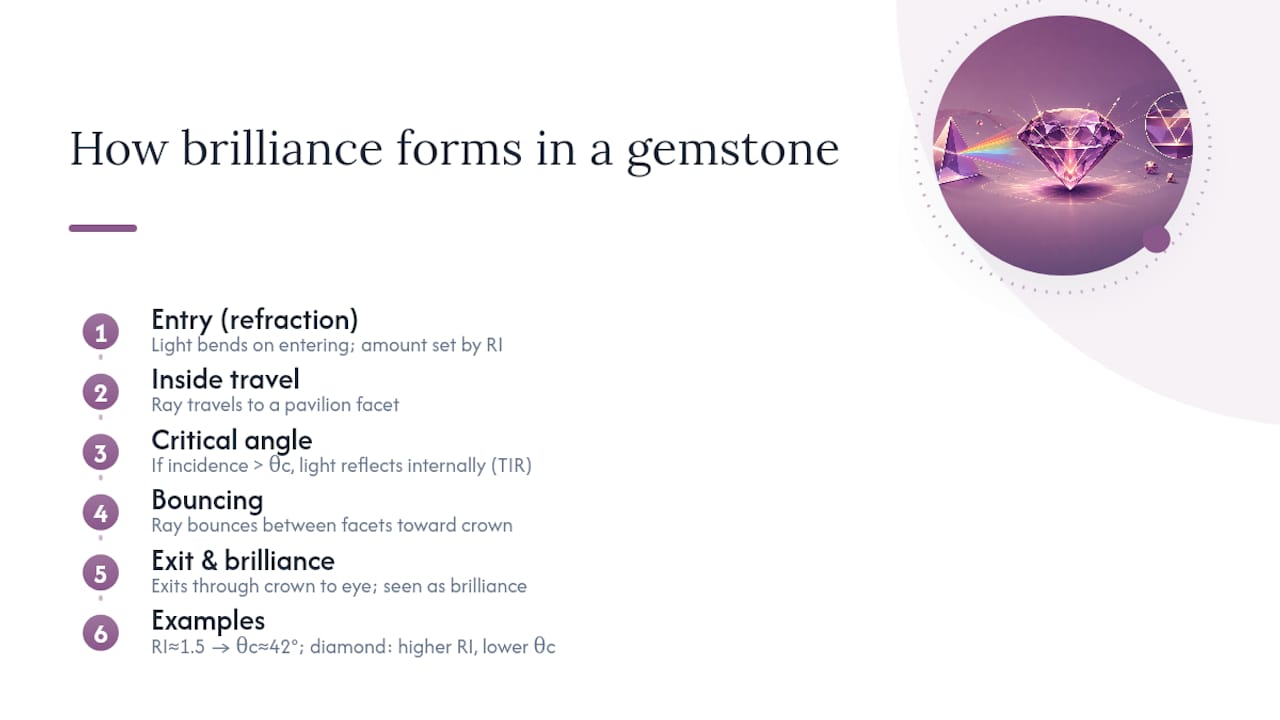
Light slows down when it moves from air into a denser material like a gemstone. That slowing causes it to bend, which is refraction. How sharply it bends depends on the material’s refractive index (RI): the higher the RI, the more the light bends on entry.
Once inside the stone, the light travels until it hits a facet from the inside. Here is where the critical angle matters. If the light strikes that facet at an angle greater than the critical angle for that material, it cannot escape through the facet. Instead, it reflects completely back into the stone. That is total internal reflection. The ray bounces again, hits another facet, and if the cut is right, exits through the crown table directly toward your eye. That exit is what you perceive as brilliance.
The critical angle is mathematically tied to RI. For a typical gemstone with an RI around 1.5, the critical angle is about 42 degrees. Diamond, with a much higher RI, has a noticeably lower critical angle, which means light is trapped and redirected more easily. A higher RI gives the cutter more room to work with: light hits facets at steeper angles relative to the critical threshold, so more rays reflect internally rather than leaking out.
Designer note: a simple diagram showing an incident ray entering the table, refracting, reflecting off the pavilion via TIR, and exiting through the crown would reinforce this section clearly.
Brilliance, fire, and scintillation: what’s the actual difference?
These three terms appear constantly in gem descriptions, and they are often used interchangeably. They should not be.
- Brilliance refers specifically to internal light return: the white light that travels through the stone and exits toward the viewer. It is exclusive to transparent, faceted gems. Surface reflection from an opaque or polished material is luster, a separate technical term entirely.
- Fire describes dispersion: white light separates into its spectral components (red, orange, yellow, green, blue, violet) as it passes through the stone at different angles. You see it as colored flashes.
- Scintillation is the pattern of bright and dark areas that shifts as the stone, the light, or the viewer moves. It depends on facet arrangement and the contrast between lit and shadowed facets.
A gem can have strong fire but modest brilliance. Zircon, for example, has high dispersion but its RI, while respectable, is lower than diamond’s, so the balance tips toward colored flashes rather than pure white return. Conversely, a well-cut stone with very high RI can flood the eye with white light while its fire reads as secondary. The factors controlling each are distinct: brilliance tracks with RI and pavilion geometry; fire tracks with the material’s dispersion value; scintillation tracks with facet count, size, and arrangement.
Pro Tip: When reading a gem description online, check whether “sparkle” refers to white return (brilliance) or colored flashes (fire). A stone described as “fiery” may look spectacular under a spotlight but appear quieter in diffuse daylight. This difference is not a flaw, but a variation in optical character.
How cut, facet angles, and proportions control brilliance
Cut is where physics meets craft. The cutter’s choices determine whether light rays inside the stone meet facets above or below the critical angle, and therefore whether they reflect back toward you or escape through the pavilion and disappear.
Pavilion angle: the most sensitive variable
Pavilion angle precision is the single most consequential cutter decision for brilliance. A pavilion cut too shallow lets light exit through the bottom of the stone rather than reflecting back up. A pavilion cut too deep sends light out through the opposite pavilion wall at an angle that misses the crown entirely. Both produce a dark, lifeless center, sometimes called a “fish-eye” or “nail-head” effect, even in otherwise high-quality rough material.
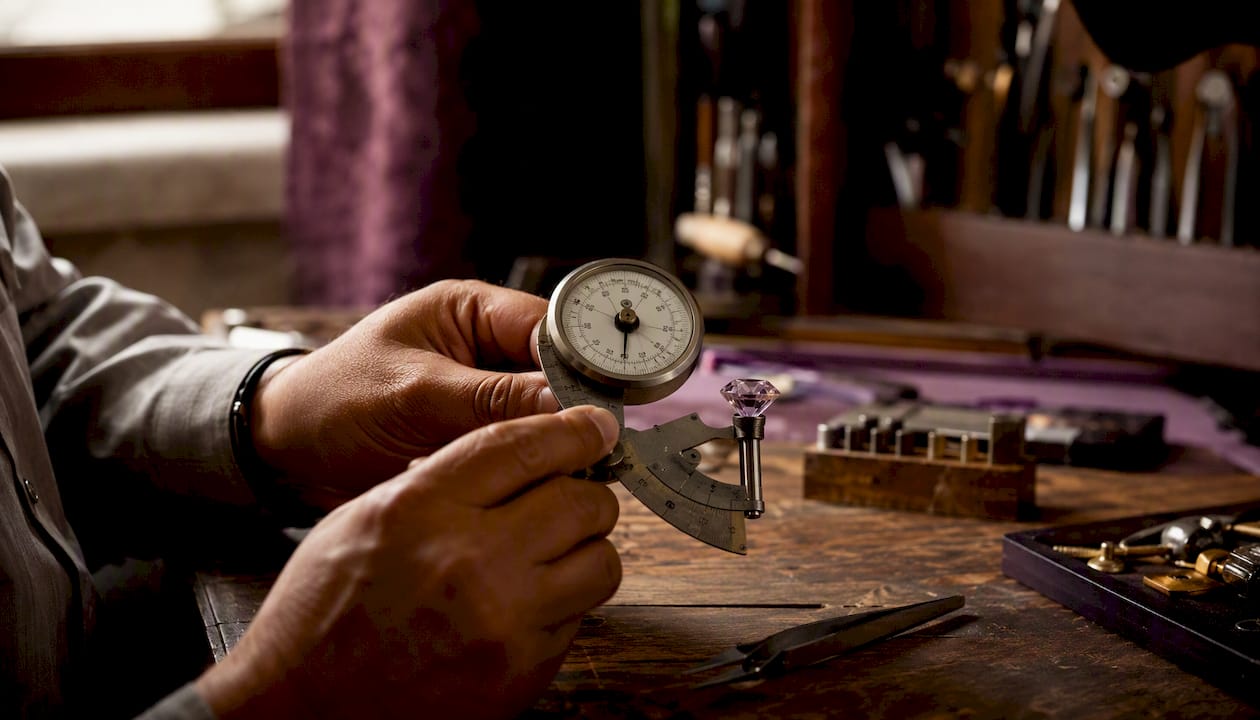
Crown angle and table size work in tandem with the pavilion. A larger table lets more light in but reduces the crown facets available to redirect dispersed light. Crown angle affects the exit angle of reflected rays and therefore how much of the returned light actually reaches the viewer at typical viewing distances.
Shape families and their trade-offs
Round brilliant cuts are engineered specifically to maximize brilliance. The 58-facet arrangement, refined over decades, is designed so that a high proportion of entering rays hit pavilion facets above the critical angle and exit through the crown. Step cuts like the emerald cut prioritize a different visual: long, parallel facets create a “hall of mirrors” effect with strong luster and depth, but they return less white light than a round brilliant. Mixed cuts sit between the two, often combining a brilliant-style pavilion with a modified crown to balance brightness and fire.
Pro Tip: On a grading certificate, check the pavilion angle carefully. For round brilliant diamonds, certain pavilion angle ranges are associated with stronger light return. That single number often tells you more about expected brightness than marketing descriptions.
How gemstone material affects brilliance: refractive index and real examples
Cut determines whether a stone achieves its potential brilliance. Material determines what that potential ceiling actually is.
Two material properties govern optical performance: refractive index (which controls the critical angle and therefore how efficiently TIR operates) and dispersion (which controls fire). They are independent. A stone can have high RI and low dispersion, or moderate RI and high dispersion.
| Material type | Cut sensitivity | Typical visual character |
|---|---|---|
| High-RI stones (RI above 2.4) | Very high: small angle deviations can cause noticeable leakage | Strong white return, intense brightness across many lighting conditions |
| Medium-RI stones (RI around 1.76 to 2.4) | Moderate sensitivity: proportions still matter but the margin for error is somewhat wider | Balanced brightness and color depth; fire varies by dispersion |
| Lower-RI stones (RI below about 1.76) | Lower sensitivity: cutters often prioritize color saturation over brilliance optimization | Rich color is primary; brilliance less pronounced; sometimes cut deeper to emphasize hue |
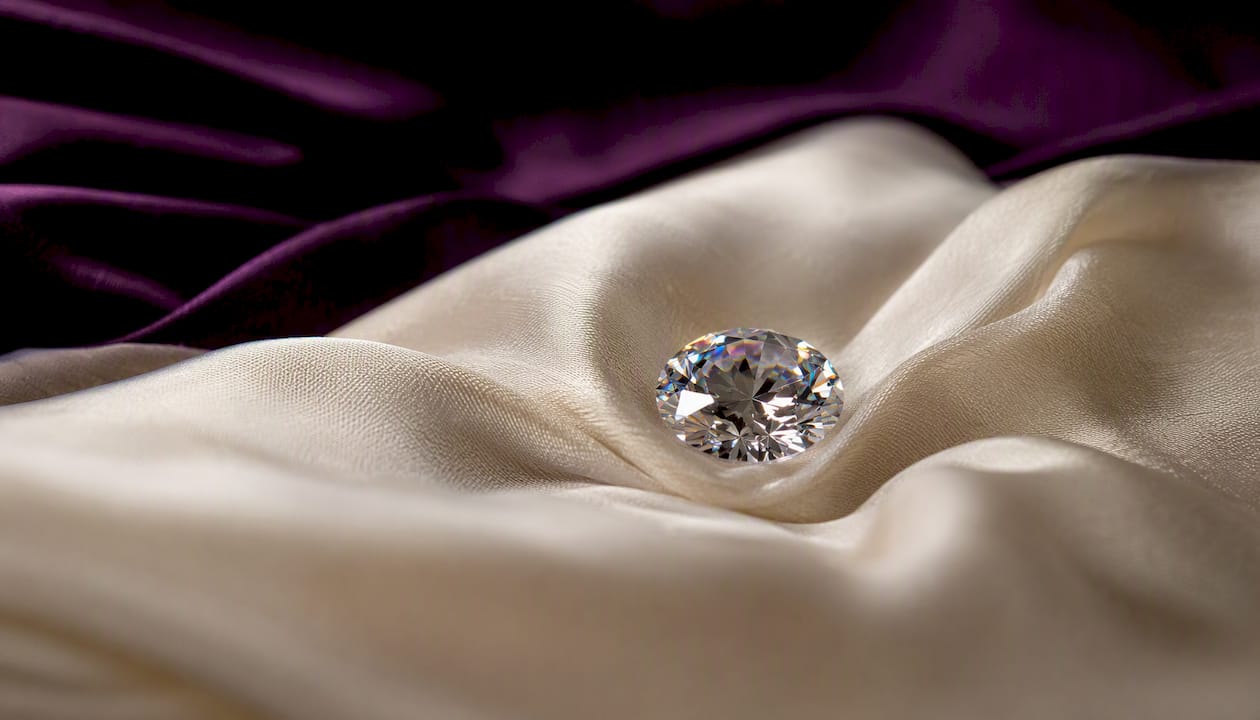
Diamond has a high RI around 2.4, placing it near the top of the RI range for natural gems. This high RI combined with moderate dispersion produces the classic bright-white return with subtle fire that many associate with the “diamond look.”
Moissanite has a higher RI than diamond, around 2.65 to 2.7, which translates to an even lower critical angle and, when cut well, very strong white light return. It also has higher dispersion than diamond, producing more pronounced fire with vivid colored flashes under direct light. For buyers seeking maximum optical intensity, moissanite’s optical properties are notably impressive.
Sapphire (RI approximately 1.76–1.77) lands in the medium range. Cutters often prioritize color saturation over brilliance optimization, which is why sapphires are typically cut to show the richest blue rather than the most white return. High-RI gems like diamond and moissanite are cut to maximize brightness; lower-RI gems like quartz are sometimes cut to favor color because a brilliance-optimized cut would require very deep pavilions that distort the stone’s proportions.
Which gemstone has the highest brilliance? Among commonly available gems, moissanite and diamond consistently produce the strongest white light return due to their high RI values combined with well-developed cutting standards. Moissanite’s slightly higher RI gives it a marginal edge in raw light-return potential when both are cut to ideal proportions.
How labs and tools measure and report light performance
Knowing the physics is one thing. Knowing how to read a report is what actually helps you at the point of purchase.
GIA cut grade
The GIA evaluates cut on three components: polish (surface smoothness of each facet), symmetry (alignment and shape consistency of facets), and proportions (the actual angles and ratios). A GIA Excellent cut grade means all three components meet the highest standard. Proportions directly govern whether light paths inside the stone hit pavilion facets above the critical angle. Polish affects how cleanly light enters and exits. Symmetry affects whether reflected rays exit through the intended crown facets or scatter off-axis.
IGI Light Performance Report
The IGI Light Performance Report goes a step further. Using ray-tracing software and environment renderings, IGI calculates a Light Performance Score that quantifies overall light return versus leakage. Stones in the “Exceptional” range sit at the top of the scale: optimal overall light return with negligible leakage. The report breaks performance into sub-components, so you can see where a stone performs well and where it loses light.
Reading ideal-scope and ASET images
Ideal-scope and ASET (Angular Spectrum Evaluation Tool) images use colored overlays to map where light returns and where it leaks. In a typical ASET image, red areas indicate light returning from high-angle sources (strong return), green areas show light from lower angles (moderate return), and black or white areas indicate leakage or obstruction. A stone with a strong return pattern shows mostly red across the pavilion with minimal dark patches. A stone with leakage shows white or black voids in the center, which correspond to the “dead” look you see with the naked eye.
How to use these reports when buying:
- Find the cut or proportions section and note the pavilion angle specifically.
- Request ideal-scope or ASET images and look for minimal dark or white areas in the pavilion zone.
- Check whether the report includes a light-performance grade or score, and note whether it falls in the top tier (“Exceptional” for IGI, “Excellent” for GIA cut grade).
Why lighting conditions change what you see
A stone that blazes under a jewelry store spotlight may look quieter on your desk at home. That is not a defect in the stone. It is physics responding to a different light environment.
Spotlights are small, directional, and high-contrast. They create the sharp shadow-and-light contrast that makes scintillation pop and fire flash. Diffuse lighting, like overcast daylight or a softbox, spreads light from many directions simultaneously. That softens contrast, reduces scintillation, and makes brilliance the dominant visual property. Under diffuse light, a well-cut high-RI stone still looks bright; a poorly cut stone looks flat.
Color temperature matters too. Warm incandescent light (around 2700K) tends to suppress blue wavelengths and enhance warm tones in fire. Daylight-balanced light (5500–6500K) shows a stone’s true color and gives a more neutral read of brilliance. Smartphone flash is typically small and harsh, which exaggerates scintillation and fire in photos but can also overexpose the table and wash out subtleties.
GIA research confirms that perceived brilliance shifts with the size and position of light sources, which is exactly why standardized light-performance tests and structured renderings exist. A stone that performs well across multiple lighting conditions, from direct spot to diffuse daylight, is genuinely well-cut. Testing in only one environment gives you one data point.
How to evaluate brilliance when buying in-store or online
In-store
- Ask to view the stone under at least two light sources: the store’s spotlight and a diffuse or daylight-balanced source if available.
- Tilt the stone slowly while watching the center. A well-cut stone stays bright across a range of tilt angles; a poorly cut one goes dark in the center as you tilt.
- Request ideal-scope or ASET images if the retailer has them. Many independent jewelers and lab-grown stone specialists carry these for their inventory.
- Look at the pavilion from below if the setting allows. Visible leakage (a transparent “window” through the stone) is a clear sign of shallow-cut proportions.
Online
- Check the certificate for pavilion angle and table percentage. For round brilliants, these numbers tell you more than any marketing copy.
- Ask for video under multiple light sources, not just a single rotating video under a spotlight. A short clip in diffuse light reveals how the stone performs outside ideal conditions.
- Request ideal-scope, ASET, or light-scope imagery before purchasing. A seller who cannot provide these for a premium stone is a red flag.
- Treat overly generic cut claims (“excellent sparkle,” “maximum brilliance”) with skepticism unless backed by a graded certificate from GIA or IGI.
Red flags: inability to share light-performance images, inconsistency between the certificate grade and the video appearance, and photos taken only under harsh flash with no diffuse-light alternative.
Why moissanite often appears exceptionally bright
Merijaan works with lab-grown moissanite, and the optical case for it is straightforward. Moissanite’s RI of approximately 2.65–2.69 is higher than diamond’s approximately 2.417. A lower critical angle means more light rays inside the stone meet pavilion facets above that threshold, triggering TIR and returning toward the crown. The result is a very strong white light return, often perceived as brighter than diamond under equivalent conditions, paired with higher dispersion that produces more visible colored fire.
For buyers who care about ethical sourcing, lab-grown moissanite removes the supply-chain concerns associated with mined stones entirely. The moissanite vs. diamond comparison on the Merijaan site covers the optical and ethical dimensions in detail for readers who want to go deeper on that decision.
The Gemology Project defines brilliance as the degree of brightness from light reflected and refracted off crown and pavilion facets, which maps directly to why high-RI materials like moissanite perform so well: more facet interactions result in TIR rather than leakage, and the cumulative effect is a stone that reads as genuinely bright across a wide range of lighting conditions.
A practical recommendation for everyday jewelry wearers
When I advise someone shopping for a stone that will look alive in real-world conditions, not just under a jeweler’s spotlight, I come back to two variables every time: cut proportions and refractive index. Get those right and the stone works for you whether you are in a Swiss mountain restaurant with warm candlelight or stepping out into the crisp, diffuse daylight that characterizes so much of daily life here. For buyers who want maximum brightness with a clear ethical story, lab-grown moissanite is worth serious consideration. Its optical properties are not a compromise. They are genuinely competitive with the finest cut diamonds, and in some lighting conditions, they exceed them.
Sources
- 7.07: Brilliance - Geosciences LibreTexts
- IGI Light Performance Manual
- GIA (Gemological Institute of America)
- Brilliance, Luster and Fire - GemSelect
- Brilliance - The Gemology Project

