

The most common jewelry finishes are high-polish (mirror), matte, satin, brushed, hammered, sandblasted, antiqued/oxidized, and plated/coated. The single rule for choosing: match the finish to how often you wear the piece and how much upkeep you’re willing to do. A finish that looks stunning in a display case can look tired on your finger within weeks if it’s wrong for your lifestyle.
Here’s the quick verdict on each:
- High-polish: Maximum sparkle, shows every scratch and fingerprint, needs regular cleaning and periodic re-polishing. Best for special-occasion pieces or engagement rings you’re committed to maintaining.
- Matte: Soft, velvety, non-reflective. Hides small marks well. Best for modern minimalist styles and lower-maintenance daily wear.
- Satin: Gentle sheen between matte and polished. Smooth to the touch, flatters most skin tones. Great for everyday rings and necklaces.
- Brushed: Fine directional lines, semi-matte look. Hides wear naturally. A go-to for daily professional wear and men’s bands.
- Hammered: Organic faceted texture, one-of-a-kind. Among the most forgiving finishes for active wearers.
- Sandblasted/stipple: Grainy or dotted matte surface. Contemporary and forgiving, but restoration needs a specialist.
- Antiqued/oxidized: High-contrast, vintage character. Surface treatment that wears off in high-contact areas over time.
- Plated/coated (rhodium, vermeil, PVD): Adds color, protection, or brightness. Lifespan depends heavily on wear and environment.
Table of Contents
- How do the main jewelry finishes compare at a glance?
- What makes high-polish the most demanding finish to own?
- Why do matte finishes age better than you’d expect?
- Satin and brushed finishes: what’s the actual difference?
- Hammered finishes: the most forgiving option for active wearers
- Sandblasted, stipple, and engine-turned finishes explained
- Antiqued and oxidized finishes: vintage character with a care caveat
- Rhodium, vermeil, and PVD coatings: protection and lifespan
- Mixed and specialty finishes: mokume, florentine, and satin-polish hybrids
- How do you choose the right finish for your lifestyle?
- Which finishes actually hide wear best, according to wear tests?
- Do finishing processes have environmental or ethical implications?
- Key Takeaways
- The finish conversation most jewelers skip
- Merijaan’s finish options for lab-grown moissanite pieces
- Further reading and trusted sources
How do the main jewelry finishes compare at a glance?
| Finish | Shine level | Scratch visibility | Maintenance frequency | Best for |
|---|---|---|---|---|
| High-polish | Mirror-bright | High | Frequent cleaning + periodic re-polish | Engagement rings, formal pieces |
| Matte | None | Low | Occasional gentle clean | Minimalist, modern daily wear |
| Satin | Soft glow | Low–medium | Occasional gentle clean | Everyday rings, necklaces |
| Brushed | Semi-matte | Low | Occasional clean + rare refinish | Professional wear, men’s bands |
| Hammered | Faceted glitter | Very low | Minimal | Active wearers, artisan pieces |
| Sandblasted | Frosted matte | Low | Specialist restoration if needed | Contemporary, nature-inspired |
| Antiqued/oxidized | High contrast | Medium | Touch-ups in high-contact areas | Vintage, decorative, statement |
| Rhodium/vermeil/PVD | Bright to colored | Medium | Re-plate or re-coat as needed | White gold, colored metal looks |
Quick picks:
- Best for daily wear: Brushed or hammered
- Best for events: High-polish
- Best for low maintenance: Matte or satin
What makes high-polish the most demanding finish to own?
High-polish is created by progressively sanding and buffing metal to a mirror surface, removing all texture until the piece reflects like glass. It’s the default finish for engagement rings and classic statement pieces, and for good reason: nothing catches light the way a true mirror finish does.
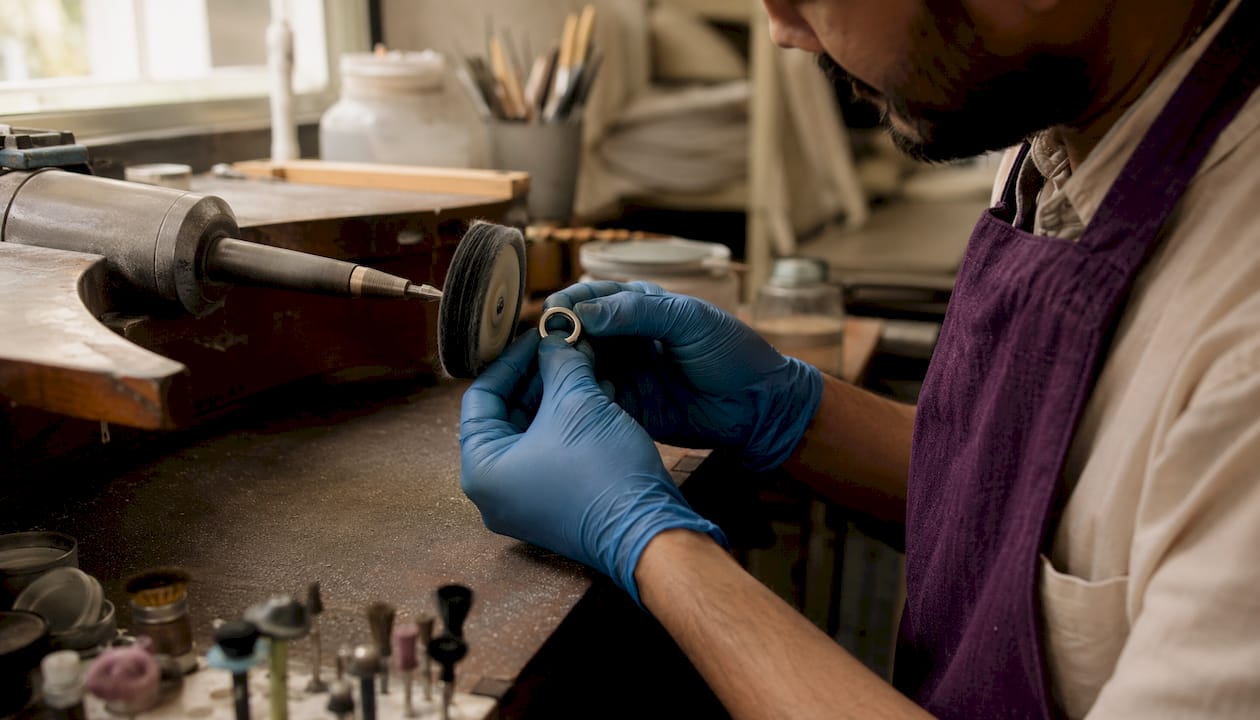
The tradeoff is real. High-polish requires regular cleaning and frequent professional re-polishing, while textured options naturally hide everyday wear. Fingerprints show within hours. Micro-scratches appear within weeks of daily wear. Without periodic professional re-polishing, the surface gradually softens into a patina rather than staying mirror-bright.
Cost-wise, the initial finishing is standard. The ongoing maintenance is the actual expense. Budget for professional re-polishing every one to two years if you wear the piece daily.
Pro Tip: For at-home care, a soft lint-free cloth and warm water with a drop of mild dish soap is enough for weekly cleaning. Avoid ultrasonic cleaners on plated high-polish pieces.
Why do matte finishes age better than you’d expect?
Matte finishes are produced through abrasion, sandblasting, or micro-bead treatment that scatters light instead of reflecting it. The result is a flat, non-reflective surface with a slightly sandy or velvety texture. No gloss, no shine — just clean form and rich color.
What surprises most buyers: matte finishes hide small scratches and fingerprints far better than polished surfaces. Because the surface already diffuses light, a new micro-scratch doesn’t stand out. The one caveat is that high-contact areas (the inside of a ring shank, for example) can develop a slight sheen over time as friction smooths the texture.
Restoring a matte surface is more specialized than re-polishing. A jeweler needs to re-apply the abrasion treatment rather than simply buff the piece, so ask about that option before you buy.
Pro Tip: If you love the matte look but wear your ring constantly, ask your jeweler specifically about re-finishing costs and whether they can restore the original texture in-house or need to send it out.
- Appearance: flat, soft, modern
- Durability: excellent at hiding daily marks
- Maintenance: low day-to-day; specialized when refinishing is needed
- Best for: minimalist styles, modern daily wear, buyers who dislike frequent polishing
Satin and brushed finishes: what’s the actual difference?
These two are often used interchangeably, but they’re not the same thing. Satin is smoother, produced by rubbing the metal with a fine abrasive to create a uniform, very fine grain. The result is a gentle luminous sheen — somewhere between matte and polished, smooth to the touch. Brushed, by contrast, uses directional strokes with a wire brush or abrasive tool, leaving visible parallel lines and a slightly more textured surface.
Satin, brushed, and matte finishes are often recommended for daily wear because they reduce the visibility of small marks while retaining a refined look. The directional grain of a brushed finish is particularly good at camouflaging scratches because new marks tend to follow the same direction as the existing texture.
Both finishes work for casual and professional settings; see our guide on how to create your style statement with made in Italy women’s clothing for professional styling inspiration. Satin reads slightly more formal; brushed reads more contemporary. For professional styling, brushed metal pairs well with structured clothing and clean lines.
Pro Tip: When maintaining a brushed finish, always clean in the direction of the grain — cross-grain wiping can create visible marks that break the uniform texture.
- Satin: smooth, gentle sheen, versatile for most occasions
- Brushed: directional texture, semi-matte, excellent scratch camouflage
- Both: good for daily wear, occasional gentle cleaning, rare professional refinishing
Hammered finishes: the most forgiving option for active wearers
Hammered finishes are created by striking the metal surface with a specialized hammer or tooling instrument, leaving small overlapping facets and irregularities across the piece. No two hammered pieces look exactly alike. Each facet catches light from a slightly different angle, creating a dynamic, almost glittering effect that’s entirely different from the flat brilliance of high-polish.
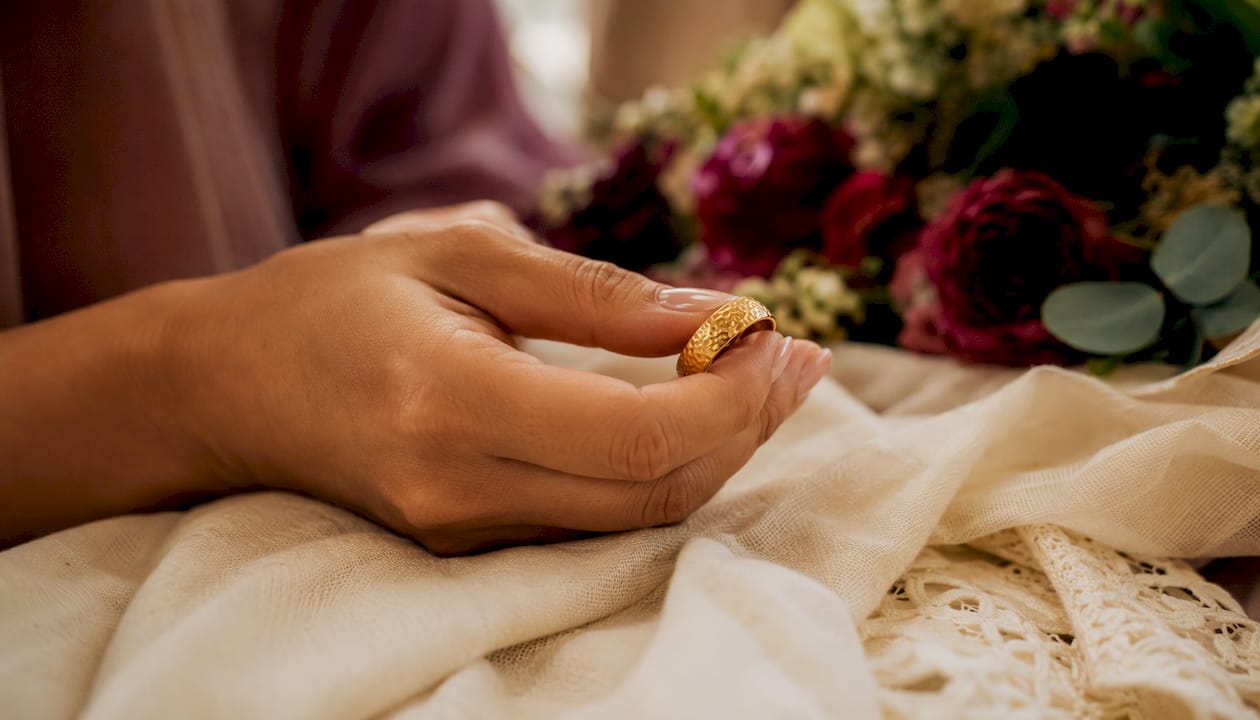
From a durability standpoint, hammered and brushed finishes age well because new marks blend into existing texture. A small ding on a hammered ring simply looks like another intentional facet. This makes hammered finishes genuinely practical for people who work with their hands, exercise regularly, or just don’t want to think about their jewelry.
Small repairs integrate naturally into the texture rather than standing out, which is a meaningful advantage over polished surfaces where any repair work is visible.
Pro Tip: If you’re drawn to hammered pieces for an engagement ring or daily band, ask whether the piece was hand-hammered or machine-textured — hand-hammered has more variation and tends to look richer as it ages.
Sandblasted, stipple, and engine-turned finishes explained
These three finishes fall into the “technical texturing” category, each produced by a distinct method.
- Sandblasted/bead-blast: Abrasive media (sand, glass beads) is blasted at the metal surface under controlled pressure, creating a grainy matte surface that’s contemporary and forgiving of wear. Often used in nature-inspired designs and pairs well with polished edges.
- Stipple: A pointed tool punches small dots or marks into the surface, creating a fine dotted texture. Think of it as pointillism applied to metal — each dot contributes to a subtle, dimensional look.
- Engine-turned: A precision machine cuts repeating geometric patterns (guilloché) into the surface. The result is precise, decorative, and historically associated with fine watchmaking and luxury goods.
All three hide everyday scratches reasonably well, but restoration is the challenge. Sandblasted and bead-blast surfaces need the original blasting process to be properly restored; engine-turned patterns require a specialist with the right equipment. Ask about restoration options before committing to any of these finishes on a piece you plan to wear daily.
Antiqued and oxidized finishes: vintage character with a care caveat
Antiqued and oxidized finishes are created through controlled chemical patination, heat treatment, or the application of liver of sulfur to darken the recesses of a textured or engraved surface. The effect is high-contrast: raised areas stay bright while recessed areas turn dark, making detail work pop visually. The result reads as vintage, artisan, or decorative depending on the piece.
The care caveat is important. Many antiqued surfaces are surface treatments, not structural changes to the metal. High-contact areas — the inside of a ring, the clasp of a bracelet — will wear through the darkened layer over time, revealing the base metal beneath. Re-oxidation or touch-up treatments can restore the look, but not every jeweler offers this service.
Pro Tip: Avoid polishing cloths on antiqued pieces — they’re designed to remove oxidation, which is exactly what gives the finish its character. Use a soft damp cloth instead, and keep the piece away from harsh cleaning agents.
- Appearance: high-contrast, detail-enhancing, vintage or decorative
- Durability: surface treatment; wears in high-contact areas
- Maintenance: gentle cleaning only; periodic touch-ups for worn areas
Rhodium, vermeil, and PVD coatings: protection and lifespan
Plated and coated finishes add a layer of material over the base metal to change its color, brightness, or wear resistance.
- Rhodium plating: Applied over white gold or platinum to enhance brightness and add a hard, reflective surface. Rhodium plating and vermeil alter appearance and provide short-term protection, with replating timelines that should be disclosed at purchase. For daily-wear rings, expect to re-plate every one to three years depending on skin chemistry and activity level.
- Vermeil: Gold plating over sterling silver, with a minimum gold thickness required by U.S. Federal Trade Commission standards. Warmer in tone than rhodium, but similarly subject to wear.
- PVD (Physical Vapor Deposition): A ceramic-like coating applied in a vacuum chamber, available in a range of colors (black, rose gold, gunmetal). Generally more durable than traditional plating, but still subject to wear at high-contact points.
Hypoallergenic considerations matter here. A rhodium or PVD coating can make a piece wearable for people sensitive to the base metal — until the coating wears through. If skin sensitivity is a concern, ask about coating thickness and expected lifespan before purchasing.
Pro Tip: Avoid harsh chemicals, chlorine, and abrasive cleaners on any plated piece. These strip coatings faster than normal wear does.
Mixed and specialty finishes: mokume, florentine, and satin-polish hybrids
Florentine, mokume, and mixed-finish techniques are specialty options that combine textures for contrast; they work best when the finish is a design feature rather than purely functional.
- Mokume-gane: A Japanese metalworking technique that layers different metals and works them to reveal a wood-grain pattern. Each piece is genuinely unique.
- Florentine/cross-hatched: Fine cross-hatched lines cut into the surface, creating a matte, almost fabric-like texture. Classic on yellow gold.
- Satin-polish hybrids: A single piece uses both polished and satin or brushed areas to create visual contrast — polished edges with a satin center, for example, or a polished stone setting against a brushed band.
Before ordering a mixed-finish piece, ask your jeweler: How are the two finishes maintained separately? Can both be restored if one wears faster than the other? Mixed finishes add visual interest but can complicate long-term care.
How do you choose the right finish for your lifestyle?
Professional jewelers advise that there is no single best finish, only the best finish for a lifestyle. Here’s how to work through the decision.
Decision checklist:
- Activity level: Active daily wearer? Go brushed, hammered, or matte. Occasional wearer? High-polish is fine.
- Skin tone and lighting: Polished surfaces can appear harsh in bright artificial lighting on very fair skin; matte and brushed finishes give a soft-focus effect that flatters a wider range of skin tones.
- Maintenance tolerance: Willing to clean weekly and re-polish annually? High-polish works. Prefer set-and-forget? Brushed or matte.
- Style goal: Classic formal luxury? High-polish. Modern minimalist? Matte or satin. Artisan character? Hammered or mokume.
- Budget for upkeep: Factor in re-polishing, re-plating, or specialist restoration costs over the life of the piece.
- Metal choice: Some finishes (rhodium plating, vermeil) are tied to specific metal types. Confirm compatibility.
Questions to ask your jeweler:
- What finish do you recommend for daily wear on this specific piece?
- How is this finish applied, and can it be refreshed in-house?
- What are the re-plating or refinishing costs and typical timelines?
Red flags: Vague descriptions like “matte-like” without specifying the method, no clear care instructions, or a finish that can’t be locally refreshed.
Which finishes actually hide wear best, according to wear tests?
Wear tests show hammered and brushed finishes age well because new marks blend into existing texture, while high-polish shows scratches within weeks and needs re-polishing to regain a mirror finish. The practical ranking:
| Finish | Scratch visibility | Long-term appearance |
|---|---|---|
| Hammered | Very low | Improves with age |
| Brushed | Low | Stays consistent |
| Matte/satin | Low | Minor sheen develops in contact areas |
| Sandblasted | Low | Consistent; specialist to restore |
| Antiqued | Medium | Wears in high-contact areas |
| Plated/coated | Medium | Depends on coating thickness |
| High-polish | High | Softens to patina without re-polishing |
Pro Tip: Don’t assume “shiny” means “durable.” High-polish looks the most luxurious in a store, but textured finishes often outperform shiny finishes for active daily wear — a counterintuitive truth that surprises most first-time buyers.
The lifestyle rule holds across all wear data: match finish to how the piece will actually be worn, not how it looks under store lighting.
Do finishing processes have environmental or ethical implications?
Some do, and it’s worth knowing before you buy. Traditional electroplating (rhodium, gold vermeil) uses chemical baths that generate hazardous waste, including heavy metals and acids. Responsible jewelers use closed-loop systems that recover and recycle these chemicals rather than releasing them. PVD coating is generally considered cleaner because it’s a dry process that produces minimal chemical waste.
Oxidation and patination treatments use chemicals like liver of sulfur or ammonia compounds. In small-scale jewelry studios, these are manageable with proper ventilation and disposal. At industrial scale, oversight matters more.
Sandblasting and mechanical texturing are among the lower-impact processes, using abrasive media rather than chemicals. The main concern is silica dust in sandblasting operations, which is a worker safety issue rather than an environmental one.
For buyers who care about sustainable jewelry choices, asking about a brand’s finishing processes is as valid as asking about metal sourcing. Merijaan’s commitment to ethical sourcing extends to its production approach, with lab-grown moissanite as the foundation of pieces designed to last rather than be replaced. That long-term durability angle matters: a well-chosen finish on a quality piece reduces the need for replacement, which is its own form of sustainability. For more on how finish choices connect to ethical sourcing values, Merijaan’s editorial resources cover the topic in depth.
Key Takeaways
Finish choice is a lifestyle decision first and an aesthetic one second — match your finish to how often you wear the piece and how much maintenance you’ll actually do.
| Point | Details |
|---|---|
| Lifestyle over looks | Choose by activity level and maintenance tolerance, not by what looks best in a store. |
| Hammered and brushed hide wear best | Wear tests confirm these two finishes age the most gracefully for daily wearers. |
| High-polish needs ongoing care | Mirror finishes show scratches quickly and require periodic professional re-polishing. |
| Plated finishes have a lifespan | Rhodium, vermeil, and PVD coatings wear through; ask about re-coating timelines before buying. |
| Merijaan’s approach | Merijaan matches finish to piece type and lifestyle on its lab-grown moissanite collection, backed by a lifetime warranty and unlimited exchanges for club members. |
The finish conversation most jewelers skip
There’s a gap between how finishes are sold and how they actually perform. Walk into most jewelry stores and the conversation is almost entirely visual: “This one has a mirror polish, this one has a brushed look.” What rarely gets discussed is the maintenance contract you’re implicitly signing when you choose a finish.
High-polish is the most obvious example. It’s the default for engagement rings because it photographs beautifully and looks undeniably luxurious under store lighting. But for someone who works with their hands, types all day, or simply doesn’t want to think about jewelry upkeep, it’s often the wrong choice. The finish that looks best at purchase is frequently the one that looks worst six months later.
The counterintuitive truth is that textured finishes — hammered especially — can look better as they age. New marks don’t stand out; they become part of the surface. That’s not a consolation prize for choosing a “less glamorous” finish. It’s a genuine design advantage that most buyers don’t hear about until after they’ve already committed to a mirror polish.
The other underrated factor is skin tone and lighting. A high-polish white gold ring under fluorescent office lighting can look almost clinical on fair skin. A satin or brushed finish on the same metal reads warmer and softer. Finish isn’t just about the jewelry — it’s about how the jewelry interacts with the person wearing it.
When Merijaan advises customers on finish choices for lab-grown moissanite pieces, the conversation starts with lifestyle, not aesthetics. That order matters.
Merijaan’s finish options for lab-grown moissanite pieces
Every finish decision is easier when the piece itself is built to last. Merijaan’s lab-grown moissanite jewelry is designed for exactly that: pieces you wear every day, not just on special occasions, with finishes chosen to match how you actually live.
Merijaan offers finish options across its rings, necklaces, bracelets, and stacking sets, with guidance on which surface treatments work best for each piece type. Every purchase comes with a lifetime warranty, and club members get unlimited exchanges — so if your finish preference changes or a piece needs refreshing, you’re covered. That’s a meaningful difference from buying a plated piece with no re-coating support.
Browse Merijaan’s moissanite jewelry collection to see current finish options, or check the care guides for maintenance tips specific to each piece. If you’re weighing finish choices for a daily ring or a gift, the collection pages include finish details alongside stone and metal specifications.
Further reading and trusted sources
- Jewelry Finishes Explained: Matte, Brushed, Hammered & High Polish (With Wear Tests) — primary wear-test data on finish durability and aging
- Bridal Jewelry Metal Finish Comparison | StoneBridge Jewelry — style and lifestyle guidance from industry editors
- Matte Finish vs High Polish Jewelry: Know Before You Buy — detailed comparison of maintenance needs and appearance tradeoffs
- Types of Jewelry Finishes Explained: From Matte to Mirror Polish — sandblasted and bead-blast process details
- 8 Jewelry Finishes Guide | Lukas Casting House — plating and coating timelines, daily-wear recommendations
- Merijaan care and product pages — finish options, lifetime warranty details, and care guides for lab-grown moissanite pieces
- Caring for your ethical jewelry — Merijaan’s maintenance guidance for long-term piece care
- How to choose sustainable jewelry — finish longevity in the context of sustainable buying decisions

