

Sustainable jewelry means pieces produced with reduced environmental harm, verified social safeguards, and designs built to last — not just worn once and forgotten. The most credible pieces carry third-party backing from bodies like the Responsible Jewellery Council (RJC) or use gold certified through Fairmined or Fairtrade standards. Your single most useful first move: ask any brand for their chain-of-custody documentation and repair policy before you buy.
Top takeaways:
- Traceability beats labels. A named mine or cooperative beats a vague “ethically sourced” sticker every time.
- Longevity is sustainability. A piece worn for 30 years outperforms a “green” piece replaced in three.
- Circularity closes the loop. Repair programs, buy-back options, and resale partnerships matter as much as the original material.
- Certifications have limits. The Kimberley Process, for example, covers conflict diamonds but not labor conditions or environmental damage.
- Vintage is often the greenest choice. No new extraction, no new manufacturing emissions.
Table of Contents
- What “sustainable jewelry” actually means — and how it differs from “ethical”
- Materials and sourcing options worth understanding
- How jewelry production harms the environment
- Social risks in the jewelry supply chain
- Certifications and transparency mechanisms: what they cover and where they fall short
- How to evaluate and buy sustainable jewelry
- Alternatives compared: lab-grown, recycled, vintage, and certified natural
- Care, repair, and circular practices that extend a piece’s life
- Common myths about sustainable jewelry
- How Merijaan applies these principles in practice
- How sustainable jewelry evolved — and why it matters now
- How sustainable jewelry affects local and indigenous communities
- How technology is changing sustainable jewelry
- Key Takeaways
- The gap between the label and the practice
- Merijaan: lab-grown sparkle with a social commitment built in
- Useful sources for further reading
What “sustainable jewelry” actually means — and how it differs from “ethical”
These two terms overlap but they are not the same thing, and brands often use them interchangeably to blur the distinction.
Sustainable jewelry focuses on the full lifecycle of a piece: where materials come from, how they are processed, how long the piece lasts, and what happens at end of life. It covers recycled metals, low-impact manufacturing, minimal packaging waste, and circular services like repair and resale. Sustainability is primarily an environmental and systems question.
Ethical jewelry focuses on the human side: fair wages, safe working conditions, no child labor, community consent, and equitable profit-sharing with miners and artisans. A piece can use recycled metal (sustainable) while still being made in a factory with poor labor conditions (not ethical). The best brands address both.
Key standards that span both categories:
- Responsible Jewellery Council (RJC): Covers environmental, social, and governance standards across the supply chain. Members are audited against a code of practices.
- Fairmined / Fairtrade Gold: Certifies artisanal and small-scale mining operations for fair pay, safe conditions, and environmental practices. Fairmined focuses on Latin America; Fairtrade Gold operates primarily in Africa and Latin America.
- Kimberley Process: Tracks rough diamonds to prevent conflict financing. Widely criticized for covering only a narrow definition of “conflict” and ignoring labor or environmental conditions.
- B Corp: A broader business certification covering social and environmental performance across the whole company, not just the supply chain.
Why definitions vary so much comes down to one thing: transparency. A brand that publishes supplier names, audit results, and material percentages is more trustworthy than one that simply claims the label. The label is a starting point, not a finish line. For a deeper look at what ethical sourcing actually requires from a brand, the distinction matters practically when you are comparing two pieces at similar price points.
Materials and sourcing options worth understanding
The material a piece is made from determines most of its environmental and social footprint. Here is what each major category actually implies.
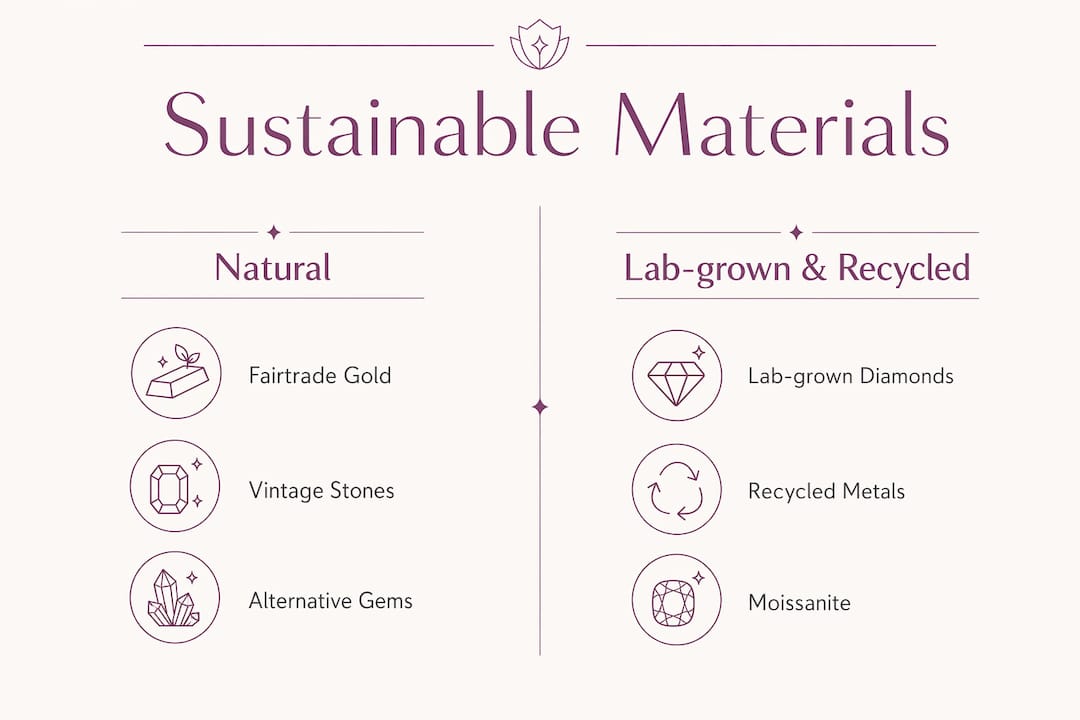
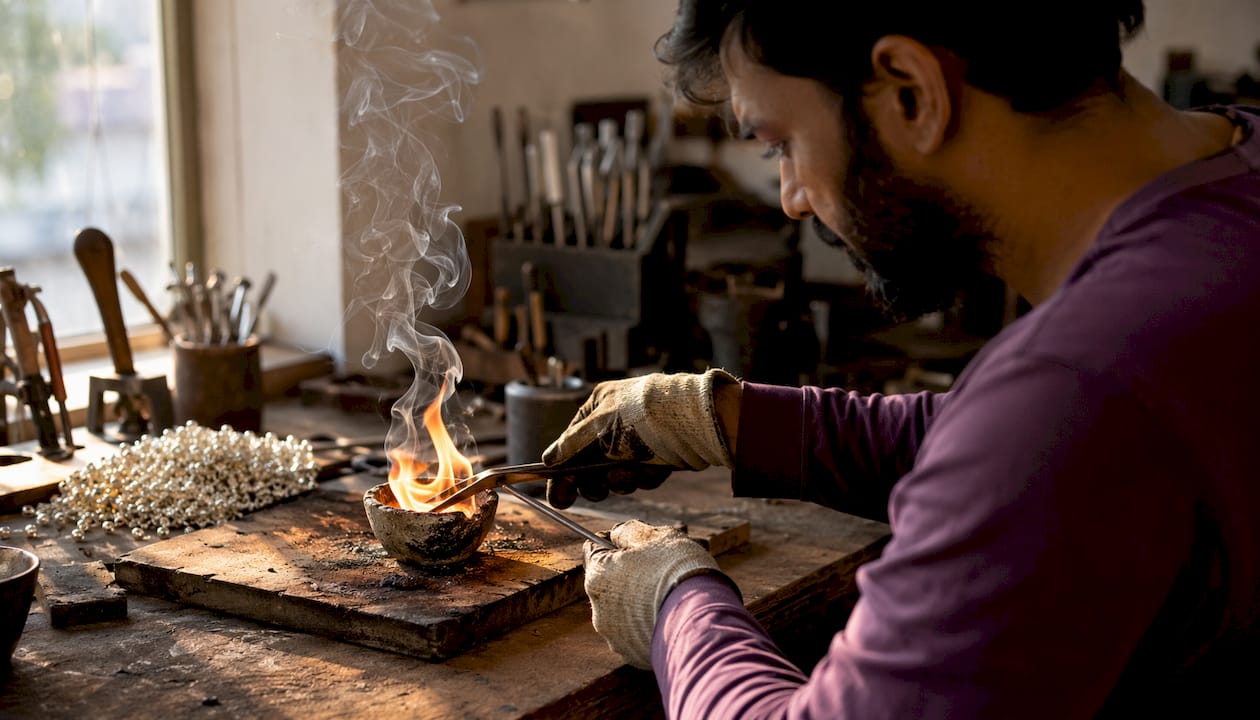
Recycled metals (gold, silver, platinum) are melted down from existing jewelry, electronics, or industrial scrap. Recycled gold and silver can be re-smelted indefinitely without losing quality, which makes them a strong choice for reducing mining pressure. Look for hallmarks (925 for sterling silver, 14k or 18k for gold) combined with a percentage-recycled disclosure from the brand.
Fairmined / Fairtrade gold comes from certified artisanal mines where workers receive fair pay, operate in safe conditions, and follow environmental standards. It is newly mined gold, so extraction still occurs, but the social and environmental controls are independently verified. This matters most when you want to support mining communities rather than eliminate mining entirely.
Lab-grown diamonds and gemstones are chemically identical to their mined counterparts. The key variable is energy. Lab-grown stones avoid most mining harms, but their carbon footprint depends heavily on whether the production facility runs on renewable energy. Always ask.
Moissanite is a lab-created silicon carbide gemstone with a refractive index higher than diamond. It requires no mining, costs significantly less than a mined diamond of comparable size, and is one of the most durable gemstones available. Merijaan’s core offering is built around moissanite for exactly these reasons. For a detailed breakdown of why moissanite stands out as a sustainable alternative, the environmental case is straightforward.
Alternative natural gemstones — sapphires, emeralds, pearls, tourmalines — are seeing rising consumer demand as buyers move away from traditional diamonds. Their sustainability depends entirely on sourcing: a responsibly mined Montana sapphire is a very different product from one with an unknown origin. Ask for the mine name or region.
Vintage and reclaimed stones carry no new extraction footprint at all. A stone reset into a new setting is circular by definition. For bridal jewelry alternatives to diamonds, a family heirloom reset is often the most sustainable option available, and frequently the most meaningful.
Pro Tip: When evaluating lab-grown stones, ask the brand specifically whether their production facility uses renewable energy. “Lab-grown” alone does not guarantee a low carbon footprint — the energy source is what determines it.
How jewelry production harms the environment
Mining is where most of the damage happens. Gold mining in particular disturbs large areas of land, generates toxic tailings, and uses chemicals like cyanide and mercury that contaminate waterways. Illegal mining operations compound these harms by operating outside any regulatory framework.
The primary environmental impacts across the jewelry lifecycle:
- Land disturbance: Open-pit and alluvial mining strips topsoil and destroys habitat. Rehabilitation is slow and expensive.
- Water contamination: Cyanide leaching and mercury amalgamation used in gold processing can poison rivers and groundwater for decades.
- Carbon emissions: Mining, refining, and transport are energy-intensive. The carbon footprint of a single mined diamond varies widely by operation.
- Waste from finishing: Electroplating and surface treatments generate chemical waste that requires careful disposal.
Lab-grown stones avoid most of these extraction harms, but their sustainability varies by producer energy source. A lab running on coal-heavy grid power may produce more lifecycle emissions than a responsibly managed mine. Some producers have achieved carbon neutrality by switching to renewable energy, which closes that gap significantly.
Practical steps brands can take: sourcing recycled metals, using renewable energy in production, manufacturing locally to reduce transport emissions, and offering recycling programs for old pieces. When a brand publishes a public impact report with specific figures, that is a meaningful signal. When they only say “we care about the planet,” it is not.
Social risks in the jewelry supply chain
The human cost of jewelry production is documented and serious. Human Rights Watch’s 2018 investigation into jewelry supply chains found unsafe working conditions, child labor, and inadequate protections for workers across multiple producing countries. These are not edge cases.
Key social risks to understand:
- Unsafe conditions: Miners face cave-ins, toxic chemical exposure, and respiratory disease. Black lung disease from silica dust is a documented occupational hazard in mining communities.
- Child labor: Artisanal and small-scale mining (ASM) operations are particularly vulnerable, especially in regions with weak regulatory enforcement.
- Conflict financing: Diamonds and colored stones have both been used to fund armed conflict, as documented in reporting on Angola and other producing regions.
- Community displacement: Large industrial mines have displaced indigenous and local communities without adequate consultation or compensation.
- Unfair pay: Artisanal miners often receive a fraction of a stone’s retail value, with most profit captured at the trading and retail level.
Small-scale and artisanal mining (ASM) is where Fairmined and Fairtrade Gold certifications make the most direct difference. These certifications require living wage commitments, safe working conditions, and community investment. When a brand names the cooperative or mine it sources from, that specificity is a genuine trust signal — not just a marketing line. For more on how jewelry affects local communities, the picture includes both harm and opportunity depending on how sourcing is structured.
Certifications and transparency mechanisms: what they cover and where they fall short
No single certification covers everything. Understanding what each one actually verifies helps you weigh claims accurately.
| Certification | Scope | What it verifies | Key limitations |
|---|---|---|---|
| Responsible Jewellery Council (RJC) | Metals and diamonds across the supply chain | Environmental, social, and governance practices; third-party audited | Membership does not guarantee perfection; audit frequency varies |
| Fairmined / Fairtrade Gold | Artisanal and small-scale gold mining | Fair pay, safe conditions, environmental standards | Covers gold only; limited geographic reach |
| Kimberley Process (KP) | Rough diamonds | Prevents trade in diamonds financing rebel movements | Narrow conflict definition; excludes labor and environmental standards |
| B Corp | Whole company | Social and environmental performance across all operations | Self-reported elements; recertification every three years |
| Gemological lab reports (GIA, IGI) | Individual stones | Physical and quality characteristics | Does not address sourcing, labor, or environmental conditions |
The Kimberley Process is the most widely cited and the most widely misunderstood. It was designed to stop conflict diamonds from entering the market, and it does that narrowly. It does not address child labor, environmental damage, or fair wages. A KP certificate tells you a diamond did not fund a rebel army. It tells you nothing else.
Blockchain and chain-of-custody reporting are emerging as stronger traceability tools. Brands using named suppliers and published audit results give you more to work with than any single label.
Trust signals worth looking for: independent third-party audits (not self-assessments), public impact reports with specific figures, named suppliers or cooperatives, and material origin disclosures with percentage recycled. For a full breakdown of what fair trade jewelry standards actually require, the detail matters when you are comparing two certified brands.
How to evaluate and buy sustainable jewelry
A practical checklist cuts through marketing language fast. Use this when shopping online or in-store.
Buying checklist:
- Materials disclosure: Does the brand state the metal type, recycled percentage, and stone origin?
- Certifications: Are certifications named and linked to the certifying body? Can you verify membership?
- Supplier transparency: Does the brand name the mine, cooperative, or supplier?
- Repair policy: Is repair offered, and on what terms? Is there a warranty?
- Resale or buy-back: Does the brand support resale or offer a trade-in program?
- Packaging: Is packaging recycled, recyclable, or minimal? Avoid excessive single-use plastic.
- Impact reporting: Does the brand publish an annual impact report with specific figures?
Questions to ask a jeweler or brand directly:
- Where does your gold or silver come from, and what percentage is recycled?
- Which certifications do you hold, and when were you last audited?
- What is your repair policy, and do you offer a warranty?
- How is your packaging sourced, and can I return it?
- Do you have a buy-back or resale program?
Red flags:
- Vague claims like “eco-friendly” or “responsibly sourced” with no supporting detail
- No named suppliers or mine regions
- No repair policy or warranty
- Heavy single-use plastic packaging on a brand claiming sustainability
- Certifications listed without links to the certifying body
A reliable checklist includes named suppliers, certifications, repair and resale policies, impact reporting, and recyclable packaging. When a brand checks all five, you have something real to work with. When they check one and wave at the others, that is a pattern worth noting.
Pro Tip: When budget is tight, prioritize durability and traceability over novelty. A vintage piece or a well-made recycled-metal ring with a repair warranty will outlast and outperform a cheap “green” piece with no after-sale support. Longevity is the most underrated sustainability metric in jewelry.
Alternatives compared: lab-grown, recycled, vintage, and certified natural
Each option involves real trade-offs. Here is how they stack up across the dimensions that matter most.
Lab-grown diamonds and gemstones
- Pros: No mining footprint, chemically identical to mined stones, often lower cost, rising market share confirms buyer acceptance.
- Cons: Energy-intensive production; carbon footprint depends on the lab’s electricity source. Ask about renewable energy before assuming low impact.
- Best when: You want a new stone with no mining harm and the brand can confirm renewable energy use.
Recycled metals
- Pros: Recycled gold and silver retain full quality through re-smelting, reduce extraction pressure, and are widely available.
- Cons: Recycled metal alone does not address stone sourcing or labor conditions in manufacturing.
- Best when: You want to reduce mining impact without paying a premium for certified-origin metal.
Ethically mined / certified natural stones
- Pros: Supports mining communities when done right; Fairmined certification provides verified social and environmental standards.
- Cons: Certification coverage is limited geographically; higher cost; traceability is harder to verify for colored stones.
- Best when: Supporting artisanal mining communities is a priority and you can verify the certification.
Vintage and upcycled jewelry
- Pros: Vintage pieces avoid all new extraction and manufacturing emissions; often emotionally durable and kept longer.
- Cons: Condition varies; resizing or resetting adds some new material and labor.
- Best when: Lowest possible new-material footprint is the goal, or when a family heirloom can be reset. For bridal jewelry alternatives to diamonds, this is frequently the strongest sustainability choice available.
Alternative materials (moissanite, sapphire, pearl)
- Pros: Moissanite requires no mining and costs a fraction of a comparable diamond. Colored stones like sapphires and emeralds are seeing growing demand as buyers seek meaningful alternatives.
- Cons: Provenance still matters for natural colored stones; lab-created versions vary in quality by producer.
- Best when: You want sparkle and durability without the diamond price or footprint.
For a side-by-side look at lab-grown versus mined diamond footprints, the energy variable is the decisive factor in most comparisons.
Care, repair, and circular practices that extend a piece’s life
The most sustainable piece is the one you keep. Maintenance and repair reduce lifecycle impact more than almost any material choice.
Practical care habits:
- Clean gold and silver regularly with mild soap and a soft brush to prevent buildup that weakens settings.
- Store pieces separately in soft pouches to prevent scratching and tangling.
- Have prong settings checked annually by a jeweler — a loose prong is how stones get lost.
- Remove rings before heavy manual work, swimming, or applying lotions and chemicals.
Circular services to look for from brands:
- Repair programs with transparent pricing
- Stone replacement or resetting services
- Buy-back or trade-in programs that keep metal in circulation
- Resale partnerships or authenticated secondhand platforms
The Ellen MacArthur Foundation’s circular economy principles apply directly here: design for longevity, keep materials in use, and recover value at end of life. Brands that offer lifetime warranties or modular designs (where a stone can be swapped into a new setting) are demonstrating a deeper sustainability commitment than brands that only talk about their materials.
Pro Tip: When choosing a new piece, favor bezel settings over prong settings for everyday wear. Bezels fully encircle the stone, making it far harder to lose and reducing the chance of damage that leads to replacement. Solid chain links and thicker metal gauge also dramatically extend wearable life.
Common myths about sustainable jewelry
A few misconceptions make this category harder to navigate than it needs to be.
Myth: Sustainable jewelry is cheap. The opposite is usually true. Certified materials, fair wages, and quality construction cost more upfront. The value is in longevity and reduced harm, not a lower price tag.
Myth: Lab-grown always means lower carbon. Lab-grown stones avoid mining impacts, but their carbon footprint depends entirely on the energy source powering production. A lab running on fossil fuels can have a higher lifecycle footprint than a responsibly managed mine. Renewable energy certification from the producer is what actually matters.
Myth: Certified means perfect. Certifications set floors, not ceilings. RJC membership means a brand met a minimum standard at the time of audit. B Corp certification means a company scored above a threshold across multiple categories. Neither means every practice is ideal. Treat certifications as a starting point for evaluation, not a final verdict.
Realistic trade-offs to expect:
- Higher upfront cost for certified or recycled materials
- Limited availability of Fairmined gold outside specialty retailers
- Repair services that take time and cost money (but extend life significantly)
- Vintage pieces that may need resizing or resetting before wearing
The practical guidance: invest in durability and traceability first. A piece with a clear material origin and a repair policy will serve you better over a decade than a cheaper piece with a green label and no after-sale support.
How Merijaan applies these principles in practice
Merijaan’s model is built around lab-grown moissanite, which sidesteps the extraction harms of mined diamonds while delivering a stone with higher brilliance and a fraction of the cost. The brand’s stated commitment is direct: 100% of profits go back to the people who make the jewelry. That is a social commitment with a specific claim attached, not a vague mission statement.
The brand publishes educational content on sourcing, sustainability, and ethical jewelry practices, which supports the kind of informed buying this article describes. For buyers working through the checklist above, Merijaan addresses the lab-grown stone criterion, the social profit-allocation criterion, and the educational transparency criterion. Repair and resale policies are worth verifying directly on the site before purchase.

Merijaan’s approach reflects what the sustainable jewelry category looks like when a brand builds around a specific material choice (moissanite) and a specific social commitment (profit return to makers) rather than collecting certifications as marketing assets.
How sustainable jewelry evolved — and why it matters now
The modern sustainable jewelry movement has roots in the early 2000s, when the Kimberley Process was established in 2003 following international pressure over conflict diamonds in Sierra Leone and Angola. That moment marked the first time the industry accepted that sourcing had a public accountability dimension.
Fairtrade Gold launched in the United Kingdom in 2011, extending the fair trade model from food and textiles into precious metals. Fairmined certification followed a parallel track through the Alliance for Responsible Mining, focusing on Latin American artisanal operations. The Responsible Jewellery Council, founded in 2005, brought a broader multi-stakeholder framework that included environmental and governance standards alongside social ones.
Consumer pressure accelerated the shift. Investigative journalism, including Human Rights Watch’s 2018 supply chain report, brought labor conditions in jewelry production into mainstream awareness. Social media made it easier for buyers to ask brands direct questions and share answers publicly. Brands that could not answer basic sourcing questions began losing ground to those that could.
The current moment is defined by two converging trends: rising demand for lab-grown stones (particularly among younger buyers and those seeking bridal jewelry alternatives to diamonds) and growing sophistication among consumers who can distinguish between a genuine certification and a marketing claim. The category has moved from niche to mainstream, which means greenwashing has also become more common. Knowing the history helps you read current claims with appropriate skepticism.
How sustainable jewelry affects local and indigenous communities
The relationship between jewelry production and local communities is not simple. Mining can devastate communities through displacement, pollution, and unsafe conditions. It can also be the primary source of income for entire regions where few alternatives exist.
Artisanal and small-scale mining supports the livelihoods of an estimated tens of millions of people globally, many of them in rural communities with limited economic alternatives. When certification programs like Fairmined reach these operations, the benefits are concrete: safer working conditions, higher and more stable incomes, environmental remediation requirements, and community investment funds.
The challenges are equally real. Industrial mining operations have displaced indigenous communities in Latin America, Africa, and Southeast Asia without adequate consultation or compensation. The Fairtrade Federation and allied organizations have documented cases where communities near large mines bear environmental costs while receiving little economic benefit.
Indigenous communities face a specific tension: their lands often sit above mineral deposits, making them targets for extraction while their legal land rights remain contested in many jurisdictions. Sustainable jewelry brands that source from indigenous-owned cooperatives or that explicitly commit to free, prior, and informed consent (FPIC) standards are addressing this directly. When a brand names its sourcing cooperative and that cooperative is indigenous-owned, that is a meaningful distinction from a brand that simply claims “community benefit.”
For consumers, the practical implication is this: ask not just where a stone comes from, but who controls the operation and how profit flows. The difference between a mine that employs community members and one that is owned by and benefits the community is significant.
How technology is changing sustainable jewelry
Technology is reshaping both what is possible and what is verifiable in sustainable jewelry.
Lab-grown stone production has improved dramatically in quality and efficiency over the past decade. Chemical vapor deposition (CVD) and high-pressure, high-temperature (HPHT) processes now produce diamonds and colored stones that are indistinguishable from mined equivalents under standard gemological testing. The gemological standards applied to lab-grown stones are the same as those applied to mined ones, which means quality verification is reliable.
Blockchain-based traceability is moving from pilot programs to practical deployment. Several brands now use distributed ledger systems to record a stone’s journey from origin to retail, creating a tamper-resistant chain of custody that buyers can verify independently. This addresses one of the oldest problems in the industry: the ease with which stones and metals can be misrepresented at the trading stage.
3D printing and CAD design are reducing material waste in manufacturing. Traditional casting loses metal in sprues and runners; precision printing and milling can reduce that waste significantly. Some designers are also using 3D printing to create modular settings where a stone can be transferred to a new setting without damage, extending the life of both the stone and the metal.
Recycling technology for precious metals has also improved. Hydrometallurgical processes can recover gold and silver from electronic waste and old jewelry at higher purity levels than older smelting methods, making the recycled metal supply chain more efficient. The broader sustainable fashion context shows how material recovery technology is advancing across the accessories and apparel industries simultaneously.
Key Takeaways
Sustainable jewelry requires traceability, longevity, and circularity — not just a green label or a single certified material.
| Point | Details |
|---|---|
| Ask for chain-of-custody | Named suppliers and audit evidence outweigh any single certification label. |
| Prioritize repairability | A piece with a repair policy and durable construction outlasts and outperforms cheaper “green” alternatives. |
| Vintage is often the greenest | No new extraction, no new manufacturing emissions — vintage or heirloom reset is the lowest-footprint option. |
| Lab-grown needs an energy check | Ask whether the production facility uses renewable energy; the stone type alone does not determine carbon footprint. |
| Merijaan’s model | Lab-grown moissanite with 100% of profits returned to makers — a specific social commitment, not a vague mission. |
The gap between the label and the practice
Most sustainable jewelry coverage focuses on what to buy. The harder question is what to believe.
The certification ecosystem is genuinely useful but genuinely limited. RJC membership means a brand cleared an audit. It does not mean every practice is ideal, and audit frequency varies. The Kimberley Process is the most cited credential in diamond retail and the least informative about actual conditions. Fairmined and Fairtrade Gold are the most rigorous for what they cover, but they cover a narrow slice of the supply chain.
What I find more telling than any label is how a brand responds when you ask a direct question. Can they name the mine or cooperative? Do they publish an impact report with specific figures? Do they offer repair? The brands that answer those questions confidently are the ones doing the actual work. The ones that redirect to a certification logo are often relying on the logo to do work it was not designed to do.
The other thing worth saying plainly: perfection is not available. Every material choice involves trade-offs. Lab-grown stones avoid mining but require energy. Recycled metal reduces extraction but does not address labor in manufacturing. Vintage is the cleanest option environmentally but may not fit every occasion or preference. The goal is not a perfect purchase. It is a more informed one, made with eyes open to the trade-offs rather than reassured by a label.
Merijaan’s approach of centering on moissanite and returning profits to makers is a clear, specific commitment. That specificity is what makes it credible.
Merijaan: lab-grown sparkle with a social commitment built in
If you have worked through this checklist and want a starting point that checks the core boxes, Merijaan is worth a look. The brand’s focus on lab-grown moissanite means no mining footprint on the stone side, and the commitment to return 100% of profits to the people who make the jewelry is a social claim with a specific structure behind it, not a vague “we give back” line.

Merijaan also publishes educational content on sourcing and sustainability, which supports the kind of informed buying this article describes. For buyers seeking sustainable gemstone jewelry alternatives — particularly for engagement rings or meaningful gifts — the combination of a traceable lab-grown stone, transparent social commitment, and quality craftsmanship covers the most important checklist items. Browse the full collection at merijaan.co and ask the team directly about repair policy and material sourcing before you decide.
Useful sources for further reading
- Human Rights Watch — Hidden Cost of Jewelry (2018): The most thorough investigative report on labor conditions in jewelry supply chains. Essential reading for understanding the human-rights dimension.
- Fairtrade Federation: The U.S.-based federation for fair trade organizations. Useful for understanding how fair trade standards apply to jewelry and crafts.
- Ellen MacArthur Foundation — Circular Economy: The foundational framework for circular design principles that apply directly to jewelry longevity and end-of-life recovery.
- UNODC — Illegal Mining: Documents the scale and impact of illegal mining operations, including their connection to organized crime and environmental harm.
- American Lung Association — Black Lung: Explains the occupational respiratory disease that affects miners exposed to silica dust — relevant context for understanding health risks in mining communities.
- Sustainable Jungle — Ethical and Sustainable Jewelry Guide: A thorough consumer-facing guide covering lab-grown stones, certifications, and supply chain transparency.
- Sustainoverse — Sustainable Jewelry Complete Guide: Covers recycled metals, buying checklists, and certification comparisons in practical detail.
- Merijaan Blog: Merijaan’s own editorial content on sustainable jewelry trends, moissanite, and ethical sourcing — useful for understanding how one brand applies these principles in practice.
- Earth.org — Fast Fashion Waste Statistics: Broader context on the fashion and accessories industry’s environmental footprint, useful for situating jewelry within the larger consumer goods picture.

