
Lab-grown moissanite is a durable, ethical choice for Swiss jewelry buyers, and Meri Jaan is a fitting Swiss-relevant source for it. Keep your purchase paperwork, clean each piece monthly at home, and book a professional inspection twice a year. Resale value will land well under retail, so documentation matters more than most buyers expect.
TL;DR:
- Resale value in Switzerland typically ranges from 20% to 50% of the original retail price, heavily influenced by documentation, setting, and condition.
- Proper documentation, including invoices, certificates, and timestamped photos, significantly enhances resale prospects and insurability.
- Moissanite’s durability at 9.25 on the Mohs scale makes it suitable for daily wear, with minimal wear compared to sapphires or topaz.
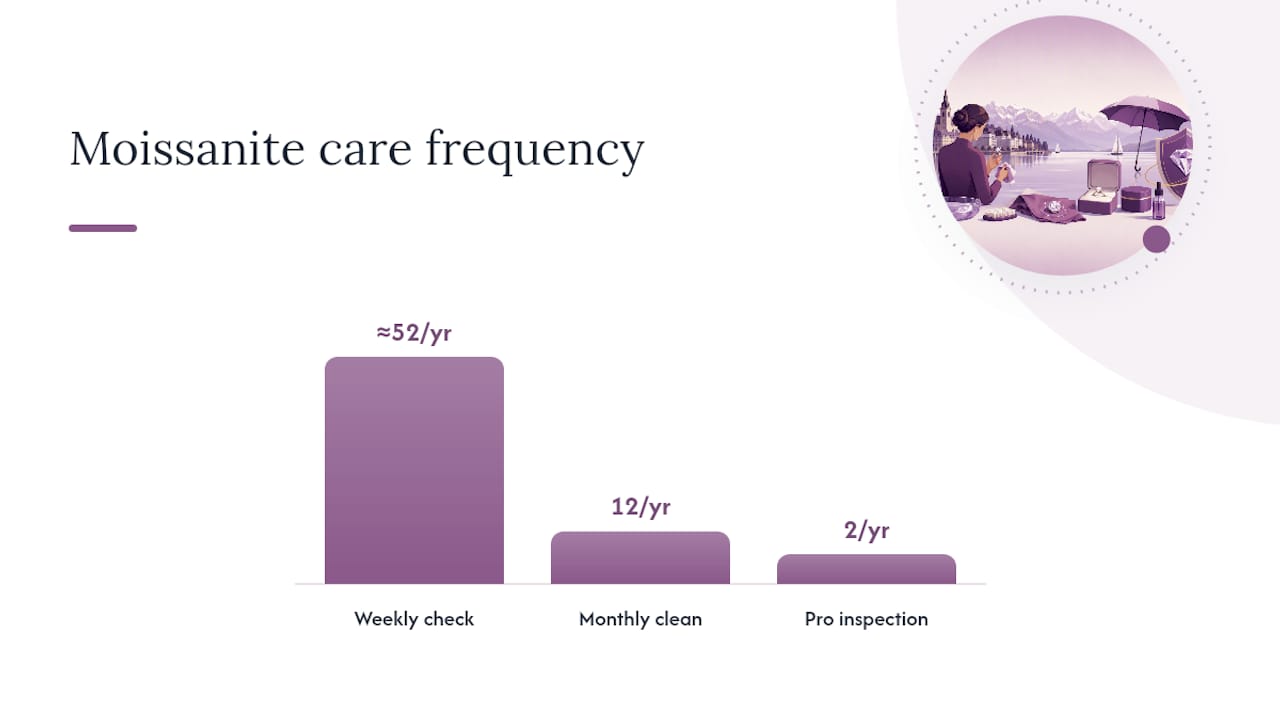
- Regular cleaning with warm water, mild soap, and gentle brushing, combined with professional inspections twice a year, keeps moissanite jewelry in optimal condition.
- Insurance coverage usually depends on declared value and documentation, with no special policy distinctions for lab-grown moissanite over other stones.
Table of Contents
- Schmuck Versichern Schweiz: What Moissanite Actually Is
- Cleaning and Maintenance for Everyday Wear
- What Resale Actually Looks Like in Switzerland
- Your Buying Checklist: What Paperwork to Get and Keep
- How Meri Jaan Approaches Ethical Moissanite
- Common Misconceptions That Undersell Moissanite
- How to Tell Moissanite Apart From Diamonds and Other Stones
- Buying Moissanite Elsewhere in Switzerland
- Insurance Considerations Specific to Moissanite
- What Swiss Buyers Should Actually Prioritize
- Browse Meri Jaan’s Collections and Plan Your Next Step
- Sources
- FAQ
Schmuck Versichern Schweiz: What Moissanite Actually Is
Before anyone asks how to protect a piece of jewelry in Switzerland, worth understanding what’s actually on the finger or around the neck. Moissanite is silicon carbide, grown in a lab rather than mined or synthesized to mimic a diamond’s carbon structure. That distinction matters more than marketing copy usually admits: it isn’t a diamond simulant trying to pass as something else. It’s its own gemstone, with its own optical signature.
On the Mohs scale, moissanite sits at roughly 9.25, just below diamond’s 10. That gap is small enough that moissanite handles daily wear, knocks against doorframes, and years of handshakes without meaningful wear. It won’t scratch as easily as quartz or topaz, and for most Swiss buyers wearing a ring or bracelet daily, the practical durability difference from diamond is negligible.
Where moissanite actually diverges from diamond is optics. It has higher dispersion and a higher refractive index than diamond, which means more visible “fire,” those flashes of rainbow color you catch under direct light. Some buyers love this. Others find it a bit busier than a diamond’s cooler white sparkle. There’s no wrong answer, but it’s worth knowing before you buy.
The price gap is the part that changes buying behavior most. Moissanite typically costs a fraction of a comparable diamond, which means the same budget buys a noticeably larger stone. A buyer choosing between a 1-carat diamond and a comparable moissanite at the same price point can often step up to 1.5 or even 2 carats in moissanite instead.
A few things to check before buying, regardless of retailer:
- Cut quality (a well-cut stone controls that extra fire so it flatters rather than overwhelms)
- Setting metal and craftsmanship (this affects both daily comfort and future resale)
- Whether the stone is graded or comes with any documentation
- How the piece looks under different lighting, not just the retailer’s photos
That last point matters more than it sounds. Seeing stones in person under varied lighting is the only reliable way to judge whether moissanite’s extra sparkle suits your taste, since product photography tends to either flatten it or exaggerate it.
Cleaning and Maintenance for Everyday Wear
Moissanite doesn’t need special products or a jeweler’s toolkit. Warm water, a few drops of mild dish soap, and a soft-bristled brush handle nearly everything.
- Soak the piece for 10 to 15 minutes in warm water mixed with a small amount of dish soap.
- Gently brush around the setting and underneath the stone with a soft toothbrush, focusing on where lotion and dust collect.
- Rinse thoroughly under warm running water.
- Pat dry with a lint-free cloth and let it air-dry fully before storing.
Monthly cleaning is enough for regular wear, and this simple routine restores sparkle that dulls from everyday oils, lotion, and soap residue, not from any flaw in the stone itself.
Daily habits matter as much as the monthly clean. Put jewelry on last, after makeup, perfume, and hairspray, since those products build a film on the stone and settle into the setting. Take rings off before heavy cleaning, gardening, or gym sessions. None of this is about protecting the moissanite from damage. It’s about keeping the metal prongs from loosening and the surface from clouding with residue that a quick rinse won’t fully clear.
Chlorine and abrasive cleaners are the two things worth actively avoiding. They won’t damage moissanite the way they can etch softer stones, but they degrade certain metal alloys and can dull rhodium plating over time.
Twice a year, take the piece to a professional. Jewelers can deep clean with ultrasonic or steam equipment and, more importantly, inspect the setting. A loose prong is invisible to most owners until the stone is gone. Catching it early is a five-minute fix; catching it late means a lost stone.
For storage between wears, keep pieces separated so stones don’t scratch each other’s metal settings, and away from direct sunlight or humidity swings. Meri Jaan’s guide to Swiss jewelry storage covers this in more depth, including display options that work for smaller Swiss apartments.
Pro Tip: Once a week, hold the piece up to a window and look at the setting from the side. If a stone wiggles even slightly when you press it gently with a fingernail, that’s your cue to book a jeweler visit before your next scheduled inspection.
What Resale Actually Looks Like in Switzerland
Retail price and resale price are two different numbers, and moissanite buyers should go in with realistic expectations. In the Swiss market, resale commonly lands somewhere between 20% and 50% of original retail, depending heavily on condition, setting quality, and how well the piece is documented.
That range isn’t unique to moissanite. Most fine jewelry, including diamond pieces, depreciates sharply the moment it leaves the store. What moves a piece toward the higher end of that range in Switzerland is documentation and craftsmanship, not just the stone.
Keep these on hand, ideally both physically and as digital scans:
- Original invoice with date and price paid
- Any certification or lab report that came with the piece
- Clear photos taken at time of purchase
- The original box or presentation packaging
- Independent appraisal, if one was ever done
Setting quality carries real weight in Swiss resale. A recognized precious metal hallmark, and a maker with a traceable reputation, can matter as much as the stone itself when a buyer or dealer is assessing value.
If you want a formal number, get an independent appraisal from a certified gemologist rather than relying on the original retailer’s estimate. It’s worth knowing that appraisals typically state replacement value, not resale value, so getting a second opinion before selling is smart if resale is your actual goal.
For selling, Swiss owners generally have three routes: consignment through a jeweler (slower, often better price), private sale (fastest cash but more legwork and risk), or trade-in credit toward a new piece (convenient but usually the lowest return).
Your Buying Checklist: What Paperwork to Get and Keep
Buying in-store or online, the checklist is the same. Before you hand over payment, confirm these details are documented somewhere, not just told to you verbally:
- Metal type and hallmark stamp (looks for 750 gold, 925 silver, or platinum markings)
- Maker or brand identity clearly stated on the invoice
- Moissanite grade or quality description
- Warranty terms and any exchange or return policy in writing
- A certificate or lab report, if the retailer offers one
Provenance matters more in Swiss secondary markets than many first-time buyers expect. Solid documentation, receipts, certificates, and maker statements, materially improves buyer confidence when a piece changes hands later, whether that’s a private sale, consignment, or trade-in.
Store both a physical folder and a digital backup. A phone photo of the receipt, saved to cloud storage the same day you buy, costs nothing and solves the “I can’t find the paperwork” problem years later.
If a lab report isn’t offered automatically, ask. A minimal report should confirm the stone type, approximate measurements, and cut grade. It doesn’t need to be exhaustive, but it should exist in writing, not just as a sales claim.
Pro Tip: The moment you get home, photograph the piece against a plain background with your phone’s date stamp visible in a corner shot of the receipt. That single habit does more for future resale than almost anything else on this list.
How Meri Jaan Approaches Ethical Moissanite
Meri Jaan builds its collections around lab-grown moissanite specifically because it sidesteps the sourcing questions that follow mined stones. Moissanite’s fully lab-created origin gives it one of the most transparent stories among common fine-stone choices, which is precisely why it resonates with buyers who want sparkle without an unclear supply chain behind it.
That transparency extends to how the business runs.
For Swiss buyers browsing specific pieces, the Vintage Rings collection and Women’s Rings collection cover most everyday and occasion needs, while the Engelberg Bracelet and pieces like the Classic Necklace and Naters Necklace round out the necklace and layering options.
Ethical sourcing only means something when it’s checkable. A buyer should be able to trace where a stone came from, how a piece was made, and where the money goes after the sale, without having to take a brand’s word for it.
Meri Jaan’s own blog on jewelry care covers maintenance routines in more depth than any single article can, and it’s written specifically for owners of lab-grown pieces rather than adapted from generic diamond advice.
Common Misconceptions That Undersell Moissanite
The biggest misconception is that moissanite is a “fake diamond.” It isn’t trying to be a diamond at all. It’s a distinct gemstone with its own crystal structure, its own optical behavior, and its own hardness profile. Calling it fake is like calling a sapphire a fake ruby because both are corundum. The comparison misses the point.
A second misconception: that moissanite is fragile because it’s cheaper. Price and durability aren’t linked here. At 9.25 on the Mohs scale, moissanite outperforms most gemstones people wear daily, including sapphire in some cuts, and sits close enough to diamond that daily wear differences are barely noticeable in practice.
Third, some buyers assume moissanite “looks fake” because of its extra sparkle. That’s a matter of personal taste, not a flaw. The fire comes from genuine optical properties, not a coating or treatment. Under bright, direct light it throws more color than a diamond does; under soft indoor lighting, that difference often disappears entirely.
Last, there’s a lingering idea that lab-grown automatically means lower quality. Lab-grown simply describes origin, not grade. A well-cut moissanite from a reputable maker will outperform a poorly cut mined stone of any type, on sparkle, symmetry, and wearability. Origin and craftsmanship are separate questions, and conflating them leads buyers to undervalue pieces that are, by any objective measure, well made.
How to Tell Moissanite Apart From Diamonds and Other Stones
Visually, the clearest tell is the fire. Hold a moissanite piece under a single direct light source, a desk lamp or bright sun, and tilt it slowly. You’ll see distinct flashes of color, greens, oranges, blues, scattered across the stone. Diamonds throw sparkle too, but it reads whiter and more uniform, less like a prism and more like a bright point of light.
A jeweler’s loupe reveals a second clue. Moissanite is doubly refractive, meaning light splits into two paths as it passes through the stone. Looking through the table (the flat top facet) at an angle, you may notice a faint doubling of the facet lines on the opposite side of the stone. Diamonds don’t do this; they’re singly refractive, so facet lines stay crisp and single no matter the angle.
Weight offers a subtler clue for anyone comparing loose stones. Moissanite is less dense than diamond, so a moissanite and a diamond of identical millimeter size won’t weigh the same in carats. This is mostly useful to jewelers with a scale, not something you’d judge by hand.
Compared to cubic zirconia, the other common diamond alternative, moissanite holds up far better over time. Cubic zirconia clouds and scratches within a few years of regular wear; moissanite’s hardness keeps it clear and sharp for decades. If you’re comparing a piece you already own against something new, cloudiness and surface scratching are the fastest way to know which stone you’re looking at.
Buying Moissanite Elsewhere in Switzerland
Meri Jaan isn’t the only place a Swiss buyer might look for lab-grown moissanite, and comparison shopping is reasonable before a purchase this personal. Local jewelers in cities like Zurich, Geneva, and Basel increasingly stock lab-grown alternatives alongside traditional diamond lines, particularly shops that have leaned into sustainable sourcing as a selling point.
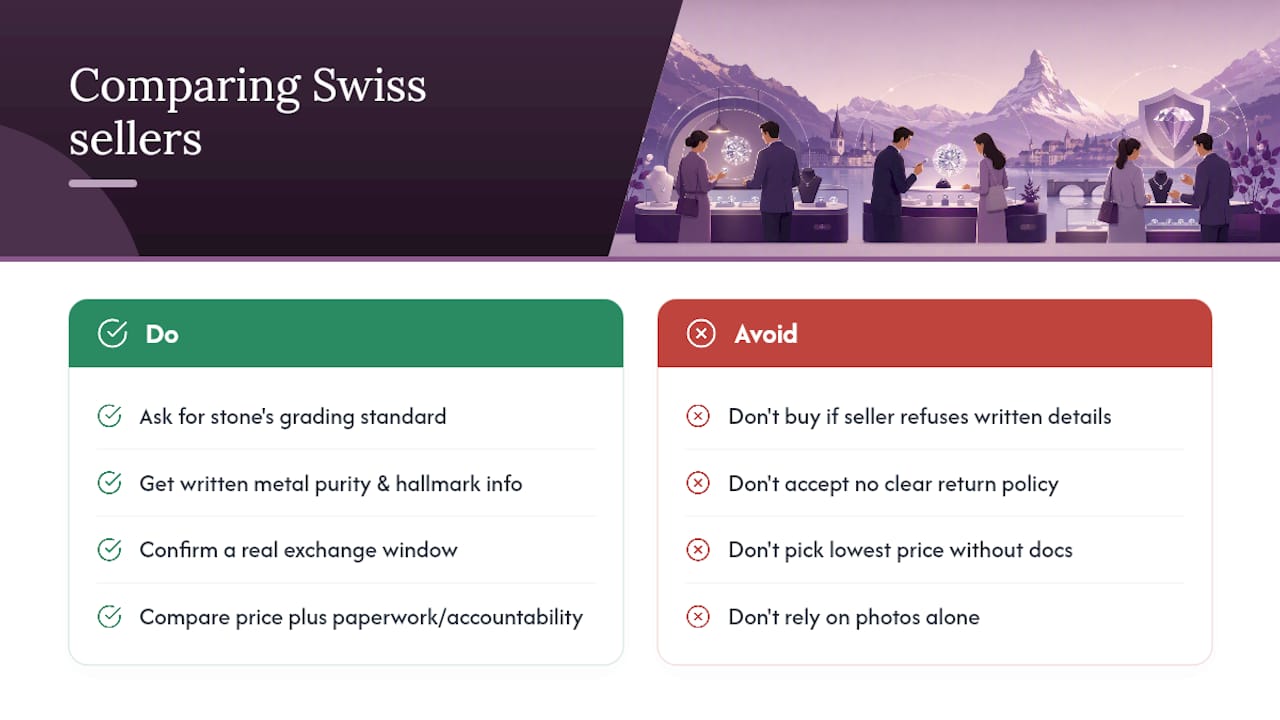
When comparing sellers, a few checks apply regardless of where you’re standing. Ask whether the retailer can name the stone’s grading standard and whether they provide anything in writing about metal purity and hallmarking, Switzerland’s precious metal control laws require accurate hallmarking on gold and silver pieces sold domestically. A seller unwilling to put basic details on paper is a signal to keep looking, no matter how good the piece looks under the store’s lighting.
Online, the same rules apply with an added layer of caution: check return policies before buying, since assessing a stone’s fire and a setting’s comfort from photos alone is unreliable. A retailer offering a real exchange window, not just store credit, gives you room to correct a decision made from a screen.
Price comparison is worth doing, but not in isolation. A lower price with no documentation, no clear return policy, and no maker accountability isn’t actually cheaper once you factor in resale difficulty and the risk of an unverifiable stone. Weigh price against the paperwork and policies that protect the purchase long after the sale closes.
Insurance Considerations Specific to Moissanite
Standard homeowner or renter policies in Switzerland typically bundle personal jewelry under general contents coverage, often with a fairly low per-item cap that a piece of fine jewelry can exceed easily. Whether moissanite qualifies the same way a diamond would generally comes down to how the policy defines “jewelry” and whether it distinguishes by stone type at all. Most policies don’t discriminate between diamond and moissanite explicitly. They insure the item’s declared or appraised value, not the specific gemstone inside it.
That makes your appraisal and documentation the actual point of leverage, not the stone’s identity. An insurer will typically want a replacement value figure, and as noted earlier, that figure comes from a formal appraisal rather than the original retail receipt alone. Without documentation, you’re relying on the insurer’s own estimate, which tends to run conservative for lab-grown stones simply because appraisers see fewer of them.
If a piece is valuable enough to warrant a standalone policy or rider beyond standard contents coverage, insurers generally ask for the same paperwork that supports resale: invoice, certification, and photos. There’s no separate “moissanite clause” to worry about, but there’s also no shortcut around providing real documentation. The stone’s lab-grown origin doesn’t complicate coverage; missing paperwork does.
What Swiss Buyers Should Actually Prioritize
Most advice about jewelry ownership focuses on the wrong thing first: the stone. The stone is the easy part. Moissanite performs well, wears well, and costs a fraction of a comparable diamond. That’s settled.
What actually determines whether a piece holds value, insures cleanly, or sells well later comes down to paper, not carats. A buyer who keeps a receipt, a certificate, and a few timestamped photos will always be in a stronger position than one who bought a “better” stone with no documentation at all.
Conventional buying advice spends most of its energy on cut and clarity, and almost none on what happens five years later. That’s backwards for anyone thinking beyond the purchase moment. Prioritize the paper trail first, the setting quality second, and treat the stone choice as the part you’ll actually enjoy least anxiously, because moissanite’s durability means you’re not gambling on daily wear.
If there’s one habit worth building immediately, it’s photographing and filing documentation the same day you buy. Everything else, cleaning, inspections, eventual resale, gets easier when that step is already done.
— Ammar
Browse Meri Jaan’s Collections and Plan Your Next Step
If you’re ready to see what ethical, lab-grown moissanite actually looks like in person, Meri Jaan’s collections are built around exactly the qualities covered here: transparent sourcing, solid craftsmanship, and pieces designed for daily wear rather than display-case-only occasions.
The Vintage Rings collection and Women’s Rings collection are the best starting points if you’re shopping for a ring, while the Classic Necklace and Naters Necklace cover everyday and layering styles.
Whatever you buy, keep the habits from this guide going: save your documentation the day it arrives, clean monthly at home, and put a professional inspection twice a year on your calendar. If you’re comparing pieces or sizes before deciding, browsing the current collections directly is the fastest way to see cut and setting quality up close before you commit.
Sources
- How to Clean Moissanite Rings and Jewelry | Jewelers Mutual
- Moissanite vs. Lab Grown Diamonds – Beyond Carat
- Moissanite or Diamond? Which Is Better for an Engagement Ring? – TJ Diamond
- Resale Value of Moissanite: Geneva Investor’s Guide 2026 | Datong Sarl
FAQ
How often should I clean moissanite jewelry?
Clean it at home once a month using warm water, mild dish soap, and a soft brush, which is enough to keep regular-wear pieces sparkling.
Is moissanite durable enough for daily wear?
Yes. It scores about 9.25 on the Mohs scale, just below diamond’s 10, making it suitable for rings, bracelets, and necklaces worn every day.
How often should I get my moissanite jewelry professionally inspected?
Twice a year is the standard recommendation, giving a jeweler the chance to check prongs and settings before a stone works loose.
What documents should I keep for resale or valuation?
Keep the original invoice, any certification or lab report, timestamped photos, and the original box, since these materially improve resale confidence in Swiss secondary markets.
What resale value can I expect for moissanite in Switzerland?
Resale commonly falls between 20% and 50% of original retail, depending on condition, setting quality, and how well the piece is documented.
Does regular home insurance cover moissanite jewelry?
Most Swiss contents policies don’t distinguish moissanite from other stones; coverage depends on the item’s declared or appraised value, so a formal appraisal and clear documentation matter more than the stone type itself.

