

Moissanite in 2026 stands as its own gemstone category rather than a diamond stand-in, and the trend direction reflects that shift. Expect elongated cuts like oval and pear, east-west settings, hidden halos, colored centers, and mixed metals dominating both bridal and fashion pieces this year. Meri Jaan, an ethical lab-grown moissanite maker, is a solid place to see these looks translated into wearable pieces.
TL;DR:
- Elongated cuts such as oval, pear, and emerald are now more popular than traditional round diamonds, emphasizing optical doubling and architectural sparkle.
- East-west orientation on rings is trending, favored for its modern look and influence from celebrity engagement rings, especially in bridal jewelry.
- Settings like hidden halos and bezel mounts are preferred for their protective qualities and subtle sparkle, complementing the longer, more exposed stone shapes.
- Colored moissanite centers and side stones are becoming central design features, aligning with the shift toward expressive, statement jewelry built around bold color and storytelling.
- Vintage detailing and stackable, mixed-metal rings are making a comeback, allowing for personalized, layered looks that reflect current fashion tastes.
Table of Contents
- Moissanite Trends 2026: What’s Actually Showing Up in Stores
- How to Choose a Moissanite Piece That Fits 2026’s Trends
- Why Meri Jaan’s Approach to Ethical Claims Holds Up
- A Stylist’s Take on Wearing 2026’s Moissanite Trends
- Where to Start Shopping the 2026 Moissanite Look
- Sources
- FAQ
Moissanite Trends 2026: What’s Actually Showing Up in Stores
Design forecasters are converging on a few clear signals for 2026, and moissanite happens to fit almost all of them better than mined diamonds do. Because lab-grown stones cost less per carat, designers can experiment with larger, more expressive cuts without the sticker shock that usually kills creative risk-taking.
Elongated shapes are winning. Oval, pear, emerald, radiant, and asscher cuts have pushed the round brilliant off its long-held pedestal. Stuller’s 2026 trend forecast points to elongated silhouettes and colorful centers as the leading design directions for the year, and jewelers are running with it. Part of the appeal is optical: moissanite has a higher dispersion (0.104) than diamond and shows optical doubling, a subtle double image visible in certain cuts. Emerald and asscher cuts, with their long open facets, actually show that doubling more clearly, giving the stone a distinct, almost architectural sparkle instead of a diamond copycat look.
East-west orientation keeps climbing. Instead of the point of an oval or pear facing up the finger, the stone runs sideways across it. Bridal coverage this year credits celebrity engagement rings for accelerating the look, and Prism News has tracked east-west placement as one of the defining bridal cues of the season. It reads as modern and a little unexpected, which is exactly why fashion-conscious buyers are drawn to it over a traditional north-south solitaire.
Settings are getting quieter, not louder. The solitaire is having a real moment again, but the supporting cast has changed. Hidden halos, thin decorative bands of small stones tucked underneath the center stone, add sparkle without competing with the main cut. Bezel settings and other low-profile mounts are trending too, largely because they protect the stone edge to edge, which matters more once the center stone gets an elongated, more exposed shape.
Color is no longer an accent, it’s the point. Colored moissanite centers, in champagne, gray, and soft green tones, along with colored side stones on a clear center, are showing up across both fine jewelry and costume pieces. Trade reporting from the Plumb Club describes a 2026 to 2027 move toward fewer, more substantial pieces built around expressive color and personal storytelling, a departure from the stack-everything approach of the past few years. Moissanite’s affordability makes it easier to commit to a colored center stone since a design misstep costs far less than it would in a colored diamond.
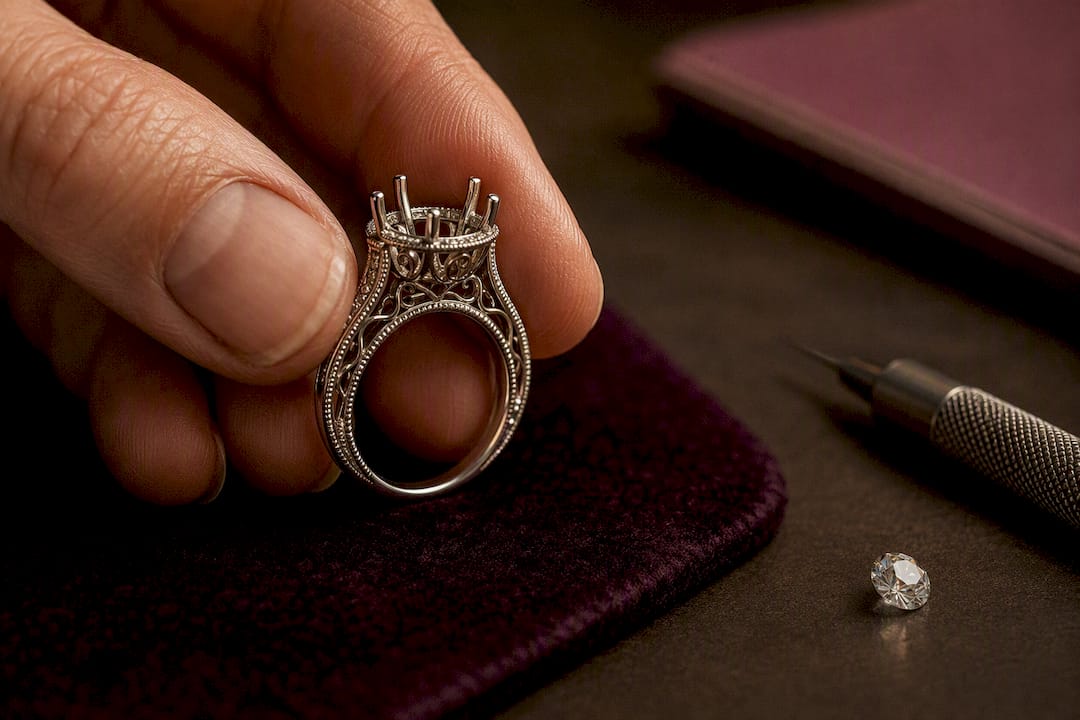
Vintage detailing is back for bridal. Filigree, milgrain edging, and sculptural shanks are showing up on engagement rings again, often paired with modern shapes like oval or pear rather than strictly period-accurate designs. It’s a hybrid look: old-world craftsmanship on a stone cut for 2026 tastes.
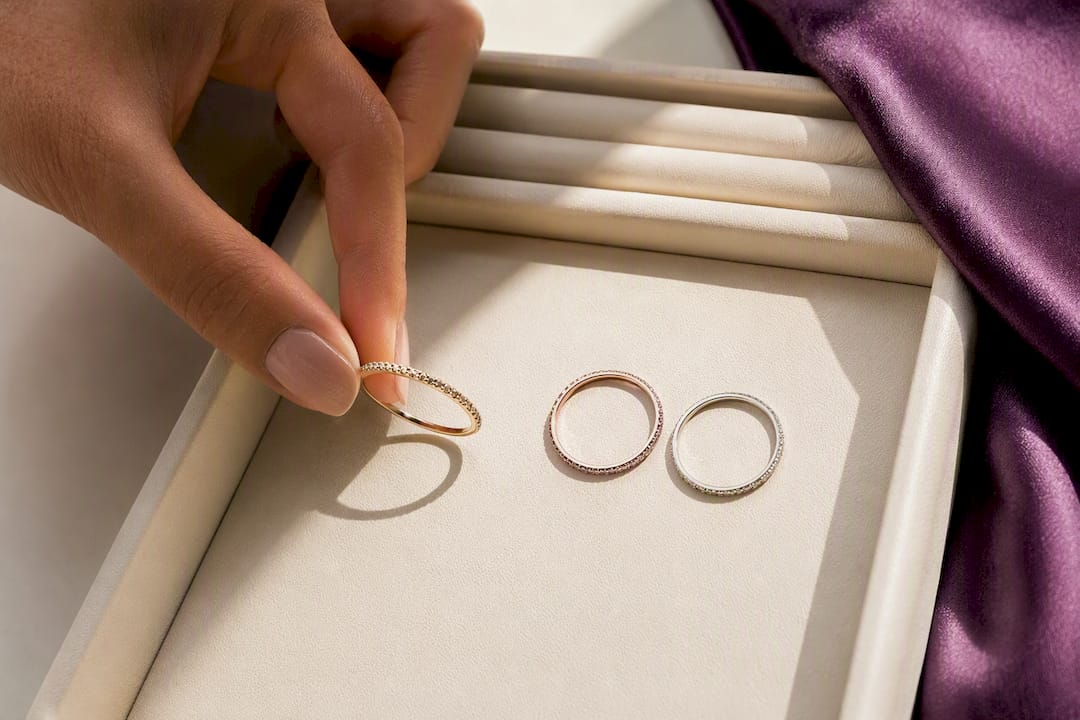
Stackable rings remain a wardrobe, not a single purchase. Buyers are curating three or four thin bands, mixing metals, and rotating them like accessories rather than committing to one heavy ring. This approach lets someone build a signature look gradually and swap pieces in and out depending on the outfit or occasion.
Statement earrings and menswear pieces are growing categories. Bold hoops and drop earrings with visible pave work are moving from red carpets into everyday wardrobes, and iced-out chains and mixed-metal minimalist pieces are gaining traction in menswear and streetwear circles. Industry analysis on moissanite market trends points to Gen Z and Millennial buyers driving much of this crossover, treating moissanite less as a diamond alternative and more as its own category of everyday luxury.
A few practical notes worth keeping in mind as you shop:
- Larger elongated cuts show more surface area, so cut quality matters more than it would on a smaller round stone.
- Bezel and low-profile settings tend to hold up better for daily wear than delicate prong-set halos.
- Mixed metals (yellow and white together) read as more current than a single matched-metal set right now.
- Colored centers photograph differently under warm versus cool light, so check both before committing.
Pro Tip: If you’re torn between a bigger stone and a better cut, choose the cut. A well-cut, mid-size oval in a bezel setting will catch more light and wear better than a larger stone in a flimsy prong mount.
How to Choose a Moissanite Piece That Fits 2026’s Trends
Buying trend-forward jewelry without regretting it in a year comes down to sequencing your decisions correctly. Here’s the order that actually works:
- Settle on your visual direction first. Decide whether you’re leaning vintage, modern minimalist, or bold and colorful before you look at a single ring. Shape and setting choices only make sense once you know the overall look you’re chasing.
- Pick the shape and orientation to match. An oval or pear in east-west orientation signals modern and a little unconventional; a classic north-south emerald cut leans more traditional even with a hidden halo underneath.
- Check cut quality in motion, not just under store lighting. Tilt the piece under different light sources. Because moissanite has refractive indices between roughly 2.648 and 2.691, well-cut stones throw noticeably more rainbow flash than diamond, and you want to see that fire before you buy, not after.
- Choose a setting built for how you actually live. Bezel and low-profile mounts protect an exposed elongated stone far better than a delicate prong halo, especially if you wear the piece daily.
- Verify documentation before you pay. Ask for the stone’s specific description, any laser inscription or gemological report, and confirm the return and warranty policy in writing. The FTC requires clear disclosure when a stone is lab-grown or simulated rather than a mined diamond, so a legitimate seller should have no problem stating this plainly on the product page.
One more thing worth knowing: a standard thermal diamond tester can give a false positive on moissanite because both materials conduct heat similarly. That’s why a written gemological description matters more than a jeweler waving a thermal probe at your ring and calling it settled.
Price-wise, buy for design and durability rather than resale value. Moissanite doesn’t carry the same secondary market or appreciation expectations that diamonds sometimes do, so treat the purchase as an investment in a piece you’ll wear, not a financial asset you’ll trade later.
Why Meri Jaan’s Approach to Ethical Claims Holds Up
That’s a specific, checkable claim rather than a vague sustainability slogan, and it’s the kind of detail worth looking for from any seller making ethical claims.
The FTC’s guidance on advertising gemstones is the practical tool for sorting real disclosures from marketing fluff. Sellers are expected to substantiate environmental and lab-grown claims clearly, not bury them in fine print or vague language like “eco-friendly” with nothing backing it up.
Before buying from any moissanite retailer, ask for or read through:
- A specific stone description (cut, color grade, dimensions), not just “moissanite” listed generically.
- Any laser inscription or gemological report tied to the piece.
- Written warranty terms and what they actually cover.
- Return and exchange policy details, including any conditions or time limits.
Meri Jaan’s educational content on ethical sourcing walks through these exact points, which is a reasonable signal that the brand expects to be checked, not just trusted.
A Stylist’s Take on Wearing 2026’s Moissanite Trends
Pick one trend-forward element and let everything else stay classic. An east-west oval solitaire paired with a plain thin stacking band reads as current without looking like you raided a mood board. Trying to combine a colored center, an east-west setting, vintage filigree, and a stack all at once usually looks busy instead of intentional.
If you’re buying for an engagement or a milestone gift, prioritize the workmanship and the paperwork over squeezing out the largest carat weight your budget allows. A smaller, cleanly cut stone in a well-made setting outlasts a bigger, poorly finished one, both in how it wears and how it looks five years from now.
— Ammar
Where to Start Shopping the 2026 Moissanite Look
Merijaan gives you a way to buy into these exact 2026 directions without the diamond markup or the guesswork about ethical sourcing, since every piece is lab-grown moissanite with 100% of profits going back to the makers who craft it.
If vintage bridal detailing caught your eye earlier, the Vintage Rings collection leans into filigree and sculptural shanks built around modern cuts. Want to build a curated stack instead of committing to one statement ring? The MJ Stack line is designed exactly for that rotate-and-mix approach. And for the colored-center or statement-earring looks covered above, the women’s necklace collection and full rings collection both carry pieces built around this year’s east-west and hidden-halo silhouettes.
Before you buy anywhere, confirm the warranty terms and exchange policy in writing, and check that the product page actually describes the stone specifics rather than just calling it “moissanite” and moving on. Browse the full Meri Jaan catalog to see which 2026 trend fits the piece you’ve been picturing.
Sources
- Stuller Trend Report: Colorful Gemstone Jewelry - Stuller Blog
- Synthetic Moissanite: A New Diamond Substitute | Gems & Gemology
- Loupe: Advertising diamonds, gemstones, pearls | Federal Trade Commission
- Color and Character: The New Jewelry Wardrobe 2026-27 - The Plumb Club
These sources were chosen for design forecasting, material science accuracy, and advertising compliance, not marketing copy.
FAQ
What jewelry is trending in 2026?
Elongated cuts (oval, pear, emerald, asscher), east-west settings, hidden halos, colored gemstone centers, and mixed-metal stacking rings are leading 2026 jewelry trends, according to Stuller’s trend forecast. Statement earrings and mixed-metal minimalist pieces for menswear are also gaining ground this year.
Is moissanite going up in value?
Moissanite isn’t typically bought or sold as an appreciating asset the way diamonds sometimes are, so its resale value doesn’t rise over time in a predictable way. It’s better to buy moissanite for its design, durability, and lower upfront cost than to expect financial return.
Is moissanite a poor man’s diamond?
No, moissanite is a distinct gemstone with its own optical profile, not a lesser diamond substitute. It has a higher dispersion (0.104) than diamond and shows optical doubling, which gives it a different, often more colorful sparkle rather than an inferior one.
Do wealthy people wear moissanite?
Yes, moissanite has moved beyond budget-driven purchases into mainstream fashion and bridal wear, with industry analysis pointing to Gen Z and Millennial buyers choosing it specifically for its ethical sourcing and design flexibility, not just its price. Brands like Meri Jaan build their entire collections around lab-grown moissanite as a deliberate choice rather than a compromise.

