

Lab-grown moissanite is silicon carbide (SiC), a lab-made gemstone with distinct optical and physical properties. It is not a lab-grown diamond, and the two materials behave differently under light, on a hardness scale, and on a price tag. If you’re comparing the two before you buy, here’s what actually matters:
- Fire over ice: moissanite bends light more aggressively than diamond, throwing off more colorful flashes rather than diamond’s whiter brilliance.
- Hardness: moissanite sits around 9.25 to 9.5 on the Mohs scale, just below diamond’s 10, which still makes it tough enough for daily wear.
- Price direction: a moissanite center stone typically costs significantly less than a comparable lab-grown diamond, which means more visible size for the same budget.
Key Takeaways
Lab-grown moissanite delivers more fire than diamond at a fraction of the price, provided buyers verify sourcing, warranty terms, and metal composition before purchase.
| Point | Details |
|---|---|
| Not a diamond | Moissanite is silicon carbide (SiC); lab-grown diamonds are carbon grown via HPHT or CVD, a different material entirely. |
| Optical fire | Moissanite’s dispersion is roughly 2.4 times diamond’s, producing more colorful flashes under most lighting. |
| Durability holds up | At 9.25 to 9.5 on the Mohs scale, moissanite resists everyday scratching despite sitting below diamond’s 10. |
| Price advantage | Moissanite typically costs significantly less than a comparable lab-grown diamond, allowing a larger visible stone for the same budget. |
| Buy from a transparent brand | Meri Jaan discloses moissanite clearly, backs every piece with a lifetime warranty, and returns 100% of profits to its makers. |
Table of Contents
- What Is Laborgezüchteter Moissanit, Chemically Speaking?
- Moissanite vs. Lab-Grown Diamonds: Which Wins Where?
- What Should You Check Before Buying Moissanite?
- How Do You Keep a Moissanite Ring Looking Its Best?
- Why Trust Meri Jaan on Moissanite?
- Where Does Moissanite Actually Come From?
- How Is Lab-Grown Moissanite Actually Made?
- Which Jewelry Styles Suit Moissanite Best?
- Can Moissanite Cause Skin Irritation?
- What Moissanite Buyers Consistently Get Wrong
- Find Your Moissanite Piece With Meri Jaan
- Sources
What Is Laborgezüchteter Moissanit, Chemically Speaking?
Moissanite is silicon carbide, not carbon. That single chemistry difference explains almost everything else you’ll read about it, from how it sparkles to how it survives forty years of wear.
Natural moissanite exists, but barely. It was first identified in fragments from a meteor crater and has never been found in gem-quality crystals large enough to cut and set. Because of that scarcity, virtually all moissanite sold in jewelry today is grown in a lab, engineered specifically to be a durable, affordable gem rather than mined from the ground.
The optics are where things get interesting. Moissanite has a refractive index higher than diamond’s, and its dispersion, the property responsible for “fire,” is more than twice that of diamond, which explains why moissanite throws noticeably more colorful flashes than a diamond of the same cut and size.
Here’s a property most buyers have never heard of: birefringence, or double refraction. Moissanite is optically anisotropic, meaning light splits into two rays as it passes through the crystal. Look at a moissanite stone through a jeweler’s 10x loupe, angled toward a facet junction, and you’ll often see a faint doubling of the lines where facets meet. Diamond doesn’t do this. It’s a genuinely reliable, low-cost way to confirm what you’re looking at.
Quick reference on the numbers that matter:
- Refractive index: ~2.65 to 2.69 (moissanite) vs. 2.42 (diamond)
- Dispersion: ~0.104 (moissanite) vs. ~0.044 (diamond)
- Mohs hardness: ~9.25 to 9.5 (moissanite) vs. 10 (diamond)
- Thermal conductivity: high in both, which is exactly the problem with old diamond testers
Statistic to remember: moissanite’s dispersion is roughly 2.4 times that of diamond, a gap large enough to see with the naked eye in the right light.
That thermal conductivity overlap deserves its own mention. Older handheld diamond testers work by measuring how fast heat moves through a stone, and moissanite conducts heat similarly enough to diamond that early testers routinely misidentified it. Modern jewelers correct for this using electrical conductivity probes (moissanite conducts electricity; diamond does not) or by checking for that optical doubling under magnification.
Moissanite vs. Lab-Grown Diamonds: Which Wins Where?
Neither stone “wins” outright. They win at different things, and the honest comparison depends on what you’re optimizing for: how it looks, how long it lasts, what it costs, or how it was made.
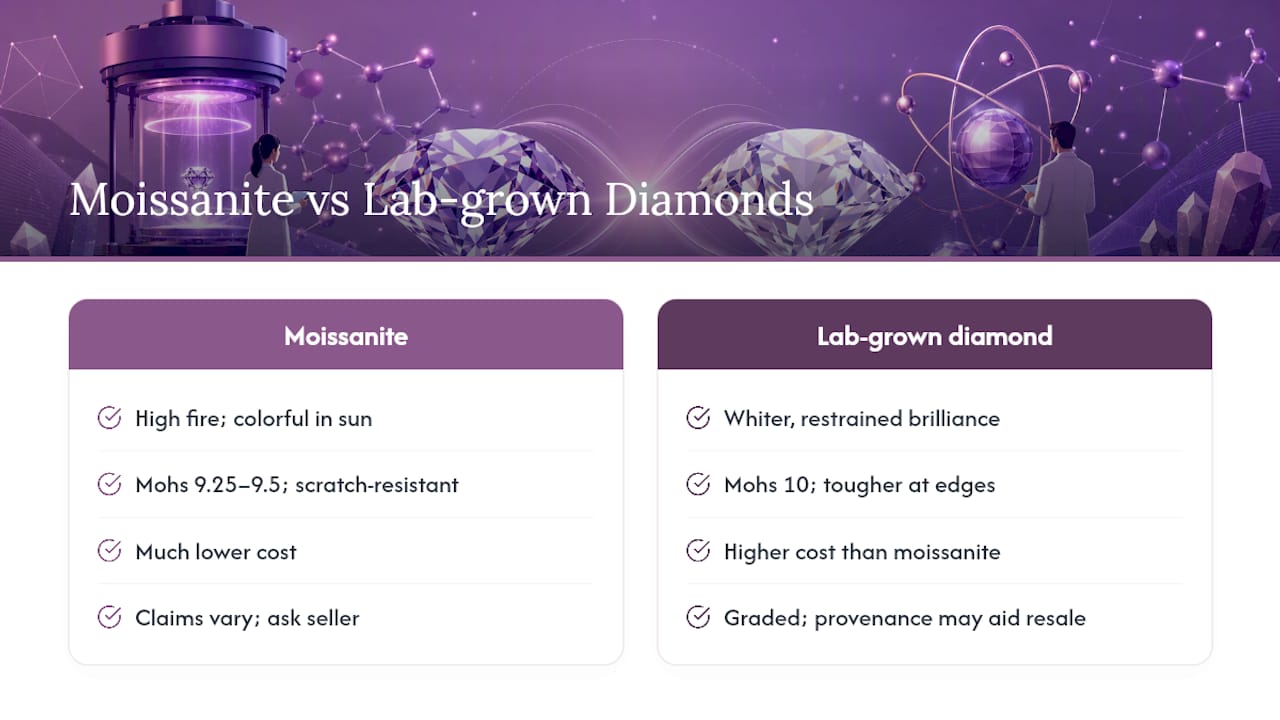
Appearance is the most personal call. Diamond produces a whiter, more restrained brilliance. Moissanite throws rainbow flashes that some people find magical and others find distracting, especially outdoors or under direct sun. Experts recommend viewing any moissanite stone under the lighting you’ll actually wear it in before deciding, since a stone that looks understated in a jewelry store’s soft lighting can look considerably more colorful under an office fluorescent or a bright restaurant chandelier.
Durability favors diamond by the numbers, but the gap matters less than people assume. Diamond’s 10 on the Mohs scale is the hardest natural material known; moissanite’s 9.25 to 9.5 still resists scratching from everything you’d realistically encounter, including sand, most metals, and other jewelry. Where diamond pulls ahead is toughness against chipping at sharp edges, which is a setting and wear-pattern issue more than a “which stone is better” issue.
Price is where moissanite’s case gets hard to argue against. Lab-grown diamonds already run well below mined diamond prices, but moissanite typically costs a further fraction of a comparable lab-grown diamond, which means a buyer can size up significantly, choosing a larger visible stone for the same budget instead of stretching for a smaller diamond.
Pro Tip: Bring your phone to any jewelry counter and photograph the stone under the store’s lighting, then step outside or near a window and photograph it again. The difference tells you more about how you’ll feel about it in daily life than any spec sheet.
Resale works differently for each. Lab-grown diamonds are graded against a global certification standard that some buyers use to justify resale value; moissanite isn’t priced or resold on that same secondary market, so most buyers should treat it as a piece to keep and enjoy rather than an investment to later liquidate.
On sustainability, ask sellers directly where and how the stone was grown, and treat vague answers as a red flag rather than accepting “eco-friendly” as a given. A more detailed look at what’s verifiable and what’s marketing spin lives in Meri Jaan’s sustainability deep dive.
What Should You Check Before Buying Moissanite?
Buying moissanite online or in a showroom comes down to a handful of concrete checks, not vague reassurance from a sales page.
Start with material identification. Any reputable seller should tell you plainly that the center stone is lab-created moissanite, not a diamond simulant of unclear origin, and should be willing to describe how they verify it.
- Confirm the material is disclosed clearly as moissanite, with the manufacturer or supplier named.
- Ask for real photos or video of the actual stone under at least two lighting types, not just a studio render.
- Check the return window and whether it’s a genuine no-questions policy or one loaded with restocking fees.
- Ask what warranty covers, specifically whether it includes the setting, the stone, and resizing.
- Request any accompanying grading or quality documentation the seller offers for the piece.
Pricing heuristics help you sanity check an offer without needing exact figures. If a moissanite ring is priced close to a lab-grown diamond of similar visual size, that’s worth a direct question about why, since moissanite’s whole value proposition rests on costing meaningfully less for a similar look.
Questions worth asking every seller:
- Is the stone treated or coated to alter color, and if so, how does that affect long-term durability?
- Can you trace the stone back to a specific grower or supplier?
- What test report or documentation, if any, comes with the piece?
- Is there a lifetime warranty, or does coverage expire after a set period?
Red flags that should make you walk away:
- No returns, or returns allowed only for store credit.
- Vague language like “ethically sourced” with no supplier detail behind it.
- Refusal to confirm in writing that the center stone is moissanite.
- Pressure tactics around limited time offers on a stone that isn’t actually limited.
A ring setting also affects how well a stone is protected day to day. Prong height, metal type, and band width all change how exposed the stone is to knocks; a three-stone setting with a properly secured center stone, for instance, spreads wear differently than a solitaire with high prongs.
How Do You Keep a Moissanite Ring Looking Its Best?
Moissanite is low-maintenance, but “low” isn’t “none.” A few minutes every few weeks keeps it looking the way it did on day one.
- Soak the piece in warm water with a drop of mild dish soap for five to ten minutes, then brush gently with a soft toothbrush around the setting.
- Rinse thoroughly and dry with a lint-free cloth; avoid harsh chemicals, bleach, or ultrasonic cleaners on delicate settings.
- Remove rings before swimming, gym workouts, gardening, or heavy cleaning, since impact and chemical exposure cause more damage than everyday wear.
- Check prongs every few months by gently pressing on the stone; any wobble means it’s time for a professional inspection.
Metal settings, not the stone itself, are usually what shows age first. Prongs wear thin, plating can fade on gold-plated pieces, and a professional jeweler can re-tip prongs or re-polish the band long before the moissanite itself shows any change. GIA’s general care guidelines, written for diamonds, apply just as well here since the cleaning risks come from the metal and setting, not the stone’s hardness.
Pro Tip: Set a recurring reminder every six months to check your ring under a bright light at home. Loose stones are far easier to catch early than after a prong finally gives way.
Why Trust Meri Jaan on Moissanite?
This guide was written by Ammar, drawing on gemological standards from GIA and industry reporting on moissanite’s optical and physical properties, alongside Meri Jaan’s own work sourcing and setting lab-grown moissanite for everyday jewelry buyers.
Meri Jaan builds its entire catalog around lab-grown moissanite rings, necklaces, bracelets, and stacking sets, and backs every piece with a lifetime warranty plus unlimited exchanges for club members.
Every piece is built to be worn, not just admired, which is why the warranty covers the life of the ring, not just the first year.
- 100% of profits go directly back to the artisans who make each piece.
- Every listing discloses the center stone as lab-grown moissanite, with no ambiguous “diamond alternative” language.
- Returns and exchanges are straightforward, without restocking fees buried in fine print.
Buyers can expect clear photography, honest grading language, and a warranty that actually means something years after checkout, not just at the register.
Where Does Moissanite Actually Come From?
Moissanite’s discovery reads almost like a footnote in a much bigger story. In 1893, French chemist Henri Moissan was examining fragments from the Canyon Diablo meteorite crater in Arizona when he found tiny crystals he initially mistook for diamond. Later analysis revealed the crystals were actually silicon carbide, a compound not previously known to occur naturally on Earth. The mineral was later named moissanite in his honor.
Natural moissanite has since turned up in a handful of other places, including certain meteorites, upper mantle rock formations, and even some kimberlite deposits alongside diamonds. But every documented natural find has been microscopic, far too small to cut into a wearable gem. There is no commercially viable natural moissanite mining industry, and there likely never will be.
That scarcity is precisely why the moissanite in jewelry today is synthetic. Scientists first grew silicon carbide crystals for industrial and electronic applications, since SiC has useful semiconductor properties, decades before anyone cut one for a ring. It wasn’t until the 1990s that a gem-quality version, engineered specifically for jewelry, hit the market under the moissanite name. In a strange twist, an industrial byproduct material became one of the more popular diamond alternatives in modern jewelry.
How Is Lab-Grown Moissanite Actually Made?
Producing gem-quality moissanite involves growing silicon carbide crystals under tightly controlled heat and pressure, typically using a seeded sublimation growth process. A small seed crystal is placed in a growth chamber, and silicon carbide vapor is deposited onto it layer by layer over many hours, gradually building a larger single crystal with the same atomic structure throughout.
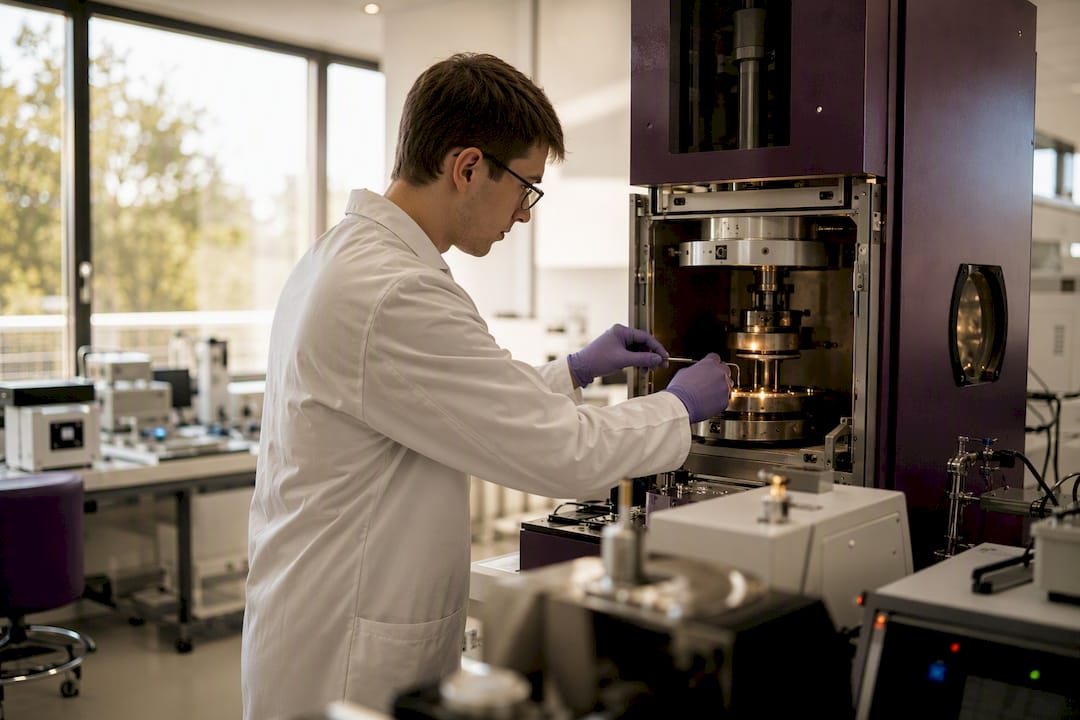
That controlled process is fundamentally different from how lab-grown diamonds are made. Diamonds are grown using either High Pressure High Temperature (HPHT) or Chemical Vapor Deposition (CVD) methods, both of which recreate carbon under the extreme conditions diamond needs to crystallize. Moissanite’s silicon carbide growth process runs at different temperatures and pressures entirely, since the two materials have completely different atomic requirements for crystallization.
Once grown, the raw moissanite boule is cut and faceted using standard gem-cutting techniques, similar to how a diamond or sapphire would be cut. The finished stone is then graded for color and clarity, though moissanite’s grading conventions differ from diamond’s, since near-colorless remains the standard for premium moissanite rather than the elaborate color-grading scale diamonds use.
This manufacturing distinction matters for buyers because it explains why moissanite and lab-grown diamonds, despite both being “lab-created,” are never interchangeable terms. They’re different materials made by different processes for different reasons.
Which Jewelry Styles Suit Moissanite Best?
Moissanite performs particularly well in settings and cuts that let its fire show off, which makes certain jewelry styles a more natural fit than others.
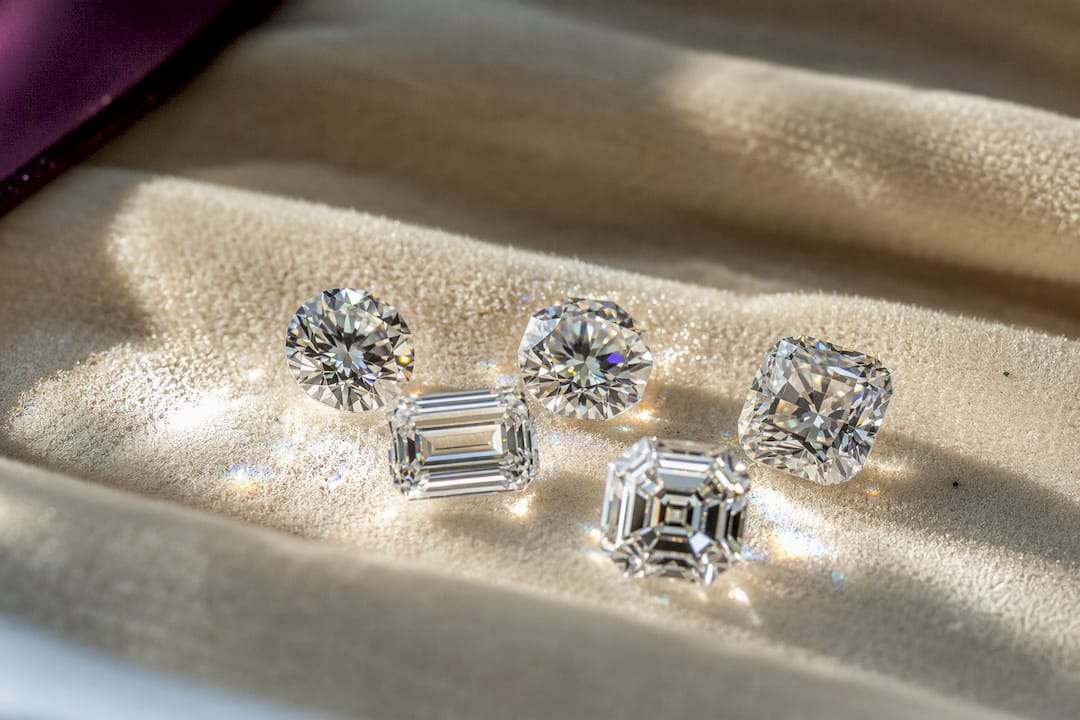
Round brilliant and cushion cuts tend to maximize moissanite’s dispersion, throwing off the most colorful flashes because those cuts are engineered to bounce light through the maximum number of facets. Emerald and asscher cuts, by contrast, show off clarity and line rather than fire, so they tend to mute moissanite’s signature sparkle somewhat, which some buyers actually prefer if they want a quieter look.
Engagement rings remain the most common application, largely because moissanite’s price lets buyers choose a larger center stone or add pavé accent stones without the budget strain of an equivalent diamond setup. Stacking rings and tennis bracelets benefit similarly, since multiple stones in a diamond equivalent would multiply cost fast, while moissanite keeps a multi-stone piece affordable.
Everyday earrings and pendants are another strong match, precisely because moissanite’s durability holds up to the friction and knocks of daily wear without the premium price tag that would make some buyers hesitant to wear diamond studs to the gym. A side-by-side look at how moissanite and diamond perform across different jewelry types can help if you’re weighing which stone fits a specific piece you have in mind.
Can Moissanite Cause Skin Irritation?
Moissanite itself, as a solid crystal of silicon carbide, is chemically inert and does not react with skin. It’s not a known allergen, and gemologists don’t classify it among materials associated with contact sensitivities.
Irritation reports tied to moissanite jewelry almost always trace back to the metal setting, not the stone. Nickel is the most common culprit in cheaper metal alloys, causing redness, itching, or a rash for people with nickel sensitivity, a reaction that’s well documented across costume jewelry generally, not specific to moissanite pieces. Sterling silver, gold (10 karat and above), platinum, and titanium settings are far less likely to trigger a reaction.
If you’ve had skin reactions to jewelry before, ask sellers directly what metal alloy is used in the setting and whether it’s nickel-free, rather than assuming a moissanite piece is automatically hypoallergenic just because the center stone is inert. Anyone with a documented metal allergy should also be cautious of gold-plated pieces, since plating can wear thin over months of contact, exposing the base metal underneath and triggering a reaction that wasn’t there when the ring was new.
What Moissanite Buyers Consistently Get Wrong
The conventional advice tells buyers to pick between moissanite and diamond based on hardness numbers alone, as if a single Mohs figure settles the question. It doesn’t. The research on how these stones actually perform points somewhere else entirely: the decision should hinge on how a stone looks under the lighting you actually live in, not on a lab spec you’ll never think about again once the ring is on your finger.
What’s underrated is the double refraction test. Most buyers never learn they can check a stone themselves with a cheap loupe, and instead rely entirely on a seller’s word. That’s backwards. A material fact you can verify in thirty seconds should matter more than a warranty promise you’re trusting blindly.
My honest read: durability concerns around moissanite are overstated for how people actually wear jewelry, while sourcing transparency is underexamined. Ask harder questions about where the stone came from before you ask whether it will scratch.
— Ammar
Find Your Moissanite Piece With Meri Jaan
If you’ve read this far, you already know moissanite’s fire and price point make it a genuinely compelling alternative to a lab-grown diamond. What you still need is a seller that treats the stone with the same transparency this article just walked through, disclosing material, backing it with a real warranty, and standing behind the piece for as long as you own it.

Meri Jaan builds its entire collection around lab-grown moissanite specifically because it delivers that fire and durability without the diamond-level price tag, and every ring, necklace, or stacking set ships with a lifetime warranty plus unlimited exchanges for club members. That combination of straightforward disclosure and long-term coverage is hard to find once you start comparing sellers who bury return policies in fine print.
Browse the full Meri Jaan collection to see current ring and necklace styles, check pricing against what you learned here, and find a piece that fits both your budget and the look you actually want to wear every day.
Sources
- Synthetic Moissanite: A New Diamond Substitute | Gems & Gemology (GIA)
- Synthetic Moissanite — Jeweller Magazine
- Moissanite gemstone information — Gemdat
Recommended
- Moissanite Beginner’s Guide: Dazzling, Ethical Diamond Alternative 2026 – The Meri Jaan
- How Lab-Grown Diamonds Are Made: A Complete Guide – The Meri Jaan
- Moissanite vs. Diamond 2026: Hardness, Brilliance, Price & Ethics – The Meri Jaan
- Why Ethical Gems Matter for Fashion: A Moissanite Guide – The Meri Jaan

