

Jewelry chains split into three practical families: open-link chains, solid or woven chains, and decorative variation finishes. The single biggest difference between them comes down to how the links connect and whether the surface stays continuous or segmented, and that one distinction decides how a chain drapes, how strong it is, and whether a jeweler can even fix it once it breaks.
The styles you’ll run into most often include:
- Cable
- Rolo/belcher
- Curb/Cuban
- Figaro
- Rope
- Box
- Snake
- Herringbone
- Mariner/marine
- Byzantine
- Wheat/spiga
- Bead/ball
- Singapore
- Foxtail
Open-link styles like cable and curb are usually the easiest to repair link by link, while solid or swaged chains like herringbone and snake resist damage less gracefully and often can’t be restored once kinked. That single fact should shape a lot of your buying decisions before you even look at price tags.
Key Takeaways
Chain link construction, specifically whether links are open, soldered, or fully swaged, determines a chain’s drape, strength, and whether it can ever be repaired.
| Point | Details |
|---|---|
| Three chain families | Open-link, solid/woven, and decorative-variation finishes each behave differently under weight and wear. |
| Repairability varies sharply | Open-link chains like cable and curb are fixable link by link; snake and herringbone often aren’t once kinked. |
| Soldered links for daily wear | Soldered construction holds heavier pendants securely; unsoldered links suit charm bracelets better. |
| Finish changes perceived value | Diamond-cut facets throw more light than plain polished links without altering the base structure. |
| Merijaan builds to match use | Meri Jaan pairs lab-grown moissanite pieces with chain constructions suited to daily wear or layering, backed by a lifetime warranty. |
Table of Contents
- Types of Chain Link Styles Explained: How They Actually Differ
- What Are the Most Common Chain Styles and How Do They Wear?
- How Do You Choose the Right Chain Style and Size?
- How Should You Clean and Store Different Chain Styles?
- What Does a Diamond-Cut Finish Actually Do to a Chain?
- Where Did These Chain Styles Come From?
- What Customization Options Change How a Chain Fits You?
- How Much Should You Expect to Pay for Each Chain Style?
- Design and Ethics Behind Choosing a Chain
- Ready to Find Your Chain Match?
- Sources
Types of Chain Link Styles Explained: How They Actually Differ
Before comparing individual styles, it helps to know what to actually look for in a product photo or spec sheet. Six things separate one chain from another in ways that matter for daily life: how it looks, how tough it is, what it’s meant for, how it feels against skin, how thick it runs, and how easy it is to fix.
Chain link designs generally split into open-link chains (cable, curb, rolo, rope), solid or woven chains (box, snake, herringbone, omega), and decorative variation finishes like diamond-cut or paperclip. Each family behaves differently under the same six axes.
| Axis | What to check |
|---|---|
| Visual appearance / pattern | Uniform round links, flattened links, braided strands, or a continuous woven surface |
| Strength & durability | Link thickness, whether links are soldered shut, metal purity |
| Best uses | Pendant support, standalone statement piece, layering, bracelet wear |
| Comfort / flexibility | How the chain lies against the collarbone or wrist, stiffness vs. fluidity |
| Typical thickness / weight | Ranges from hairline (under 1mm) to bold statement (4mm+) |
| Maintenance / repairability | Can a jeweler open and re-solder a link, or is the chain a sealed unit |
Pro Tip: If you’re buying a chain to carry a pendant you’ll wear daily, ask specifically for soldered links. Soldered construction adds security for chains carrying weight, while unsoldered links are handy for swapping charms but need closer attention to how much weight they’re holding.
What Are the Most Common Chain Styles and How Do They Wear?
Here’s how the styles you’ll see most often actually hold up, styled by style.
Cable chain links are uniform ovals or circles connected in a simple repeating loop. It reads as classic and unobtrusive, and it’s the baseline most other styles riff on. Best for everyday pendants and layering; individual links are easy to repair.
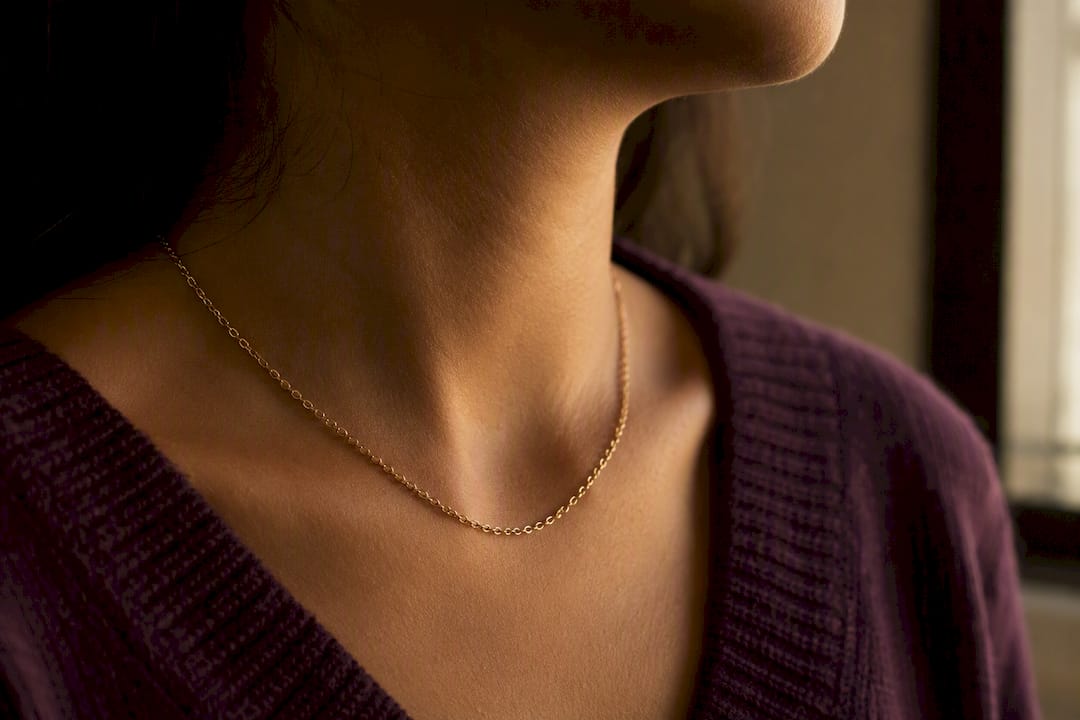
Rolo (belcher) chain uses rounder, slightly flattened links that catch light evenly. The look is a touch more polished than cable. Works well for delicate solo pieces or as a base for adding charms.
Curb (Cuban) chain twists each link so it lies flat, creating a dense, interlocking surface. Curb chains tend to be sturdy and are commonly flattened or soldered to stay put, which makes them a strong pick for statement pieces or menswear-inspired layering. Heavier gauges can get pricey and add real wrist or neck weight.
Figaro chain alternates one long oval link with several shorter ones, giving it a rhythmic, patterned look. It’s sturdy for its weight and reads as slightly more decorative than plain curb.
Rope chain braids smaller links into a twisted rope effect, throwing off more sparkle than flat styles because of all the angled surfaces. Rope chains can run heavy depending on how tight the braid is, and repairs are trickier since a break can unravel the twist.
Box chain uses square links stacked edge to edge for a sleek, almost seamless line. It photographs beautifully and layers cleanly, but a kink in a box chain is harder to work out than in a round-link style.
Snake chain is a fully solid, swaged tube that curves like, well, a snake. Herringbone and snake chains have a mirror-smooth continuous surface, and manufacturers recommend storing them flat and handling them gently because they kink easily and don’t come back once bent.
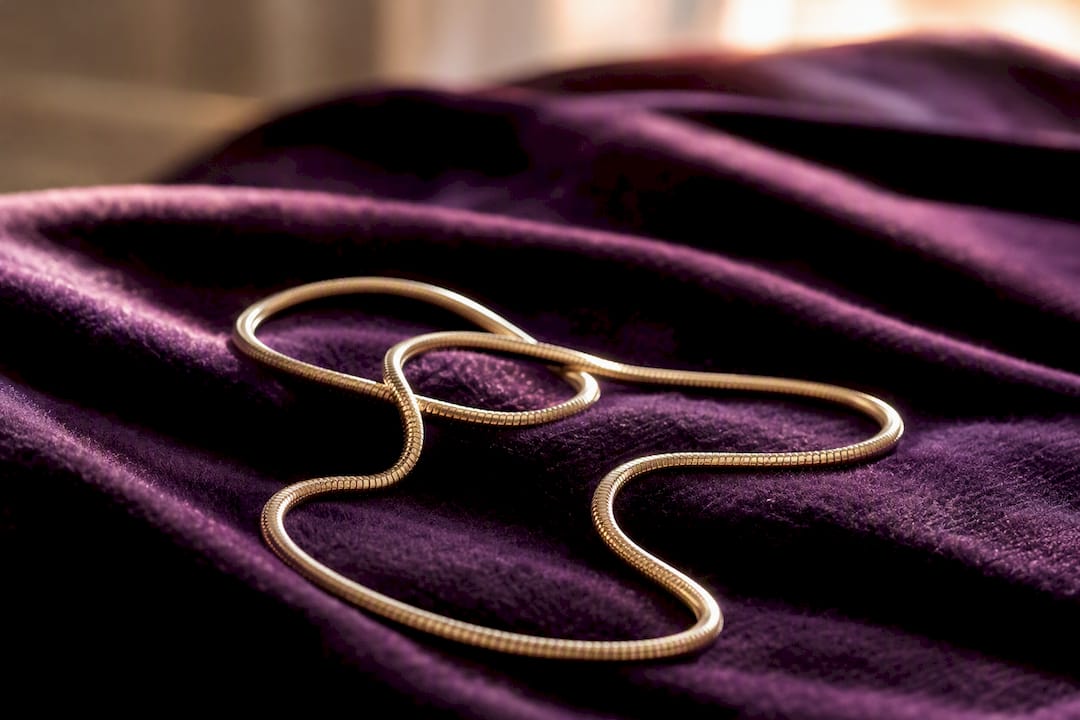
Herringbone chain flattens many tiny links into a ribbon-like, densely woven band. Nearly zero visible gaps, incredible drape, but it shares snake chain’s fragility.
Mariner (marine) chain features oval links with a bar across the center, echoing nautical rope. Sturdy and distinctive, it works as a solo statement piece more than a subtle layering chain.
Byzantine chain weaves multiple small links into an intricate, rope-like braid with real dimension. Gorgeous and substantial, but complex construction makes repairs slower and pricier.
Wheat (spiga) chain twists oval links in pairs for a texture that resembles a wheat stalk. Flexible and comfortable, a solid middle ground between delicate and bold.
Bead (ball) chain strings metal spheres on a wire, the same construction you’d find on old-school dog tags. Simple, casual, and inexpensive to repair since beads slide off and on.
Singapore chain twists rolo links into a rope-like sparkle pattern. Lightweight and shimmery, best suited to thin, dressy pieces rather than heavy pendants.
Foxtail chain braids fine links into a dense, textured rope. Durable for its slim profile, a good everyday option.
Finishes change all of this further. A diamond-cut version of any of these styles adds tiny angled facets that throw more light. A flat or hammered finish mutes shine for a more matte look. Drawn (paperclip) construction elongates the link itself, which is more a shape variation than a finish, but it changes the visual rhythm just as much.
How Do You Choose the Right Chain Style and Size?
Match the chain to the job before you fall for a photo. Run through this list:
- Match pendant weight to chain strength. A heavier pendant needs a thicker gauge and soldered links, not a delicate rolo.
- Choose soldered links for daily wear. Soldered construction resists the everyday tugging that eventually snaps open links.
- Match drape to the look you want. Flat styles like box and herringbone lie close and structured; fluid styles like rope and Byzantine move with the body.
- Consider width and gauge for proportion. A chain under 1.5mm reads delicate, 2 to 3mm reads medium, and anything past 4mm reads as a statement piece.
Before buying, ask the jeweler: What clasp does this use? Are the links soldered or open? Is the metal solid or plated? What’s the repair policy if a link breaks? And how was the chain finished (diamond-cut, polished, hammered)?
How Should You Clean and Store Different Chain Styles?
Warm water and mild soap handle most metals; skip harsh chemicals on plated finishes since they wear the plating thin faster than solid gold or silver. Store herringbone and snake chains flat in a lined box since they kink under their own weight if left hanging tangled. Open-link chains like cable and curb can hang or coil loosely without much risk.
When something snaps, open-link chains are generally repairable link by link, while woven or swaged chains are often impossible to restore once kinked. That’s the practical reason to think twice before choosing a snake chain for a piece you’ll wear constantly.
What Does a Diamond-Cut Finish Actually Do to a Chain?
Diamond-cutting shaves precise flat facets into each link, and those tiny angled surfaces throw far more light back at the eye than a plain rounded link ever could. The base chain structure doesn’t change at all. Only the way it catches light does.
Pro Tip: If two chains look identical in a listing photo but one costs noticeably more, check whether it’s diamond-cut. That extra faceting takes more machine time and more careful handling, and it’s often the entire reason for the price gap.
Meri Jaan builds its lab-grown moissanite pieces around finishes like this, pairing ethically sourced materials with construction details that hold up under daily wear. Browse the finished pieces on the site to see the effect in person.
Where Did These Chain Styles Come From?
Chain link jewelry is one of the oldest continuous crafts in human history, and the names we use today often trace back centuries. The cable link, in some form, appears in Roman and Etruscan goldwork, valued then for the same reason it’s valued now: it’s simple, strong, and endlessly adaptable.
Curb chains grew popular in eighteenth-century Europe as pocket watch fobs, prized for lying flat against fabric without twisting. Figaro chains take their name from Italy, where the pattern became associated with a particular Mediterranean sense of casual elegance during the mid-twentieth century.
Rope chains surged in the 1980s hip hop scene in the United States, where thick, heavy rope gold became a visual signal of success and style, a cultural association that still shapes how the style gets marketed today. Byzantine chains, unsurprisingly, echo the intricate metalwork of the Byzantine Empire, where goldsmiths wove complex patterns to signal wealth and status. Mariner chains borrow directly from ship rigging and rope hardware, which is why the linked oval with a center bar still reads as nautical centuries later.
Wheat and foxtail patterns get their names from agriculture, describing the visual texture rather than any particular cultural origin, though both have stayed in continuous production for generations because the twisted-link construction genuinely resists tangling.
What Customization Options Change How a Chain Fits You?
Length is the most obvious lever. The same curb chain at 16 inches sits at the collarbone; at 24 inches it becomes a layering piece that falls at the sternum. Most jewelers offer a handful of standard lengths, and a good vendor can usually extend or shorten a chain on request.
Metal choice changes both look and price. Sterling silver, gold vermeil, solid gold, and platinum all take the same link patterns very differently. A rope chain in solid gold reads as luxe and heavy; the same pattern in silver reads lighter and more casual.
Clasp style is an underrated customization point. Lobster clasps are secure and easy to open one-handed. Spring rings are more delicate looking but fiddlier. Toggle clasps add a design element of their own and work well on thicker chains like curb or Figaro.
Mixing finishes on a single chain, alternating polished and diamond-cut sections, or combining two link shapes into a hybrid pattern, has become a common way for independent designers to put a personal stamp on a classic style without inventing something from scratch. Pairing a chosen chain with a specific pendant is its own decision. If you’re building a layered look for 2026, mixing a flat box chain with a fluid rope chain at different lengths creates contrast without clutter.
How Much Should You Expect to Pay for Each Chain Style?
Price tracks three things: metal, link complexity, and finish. A thin cable or rolo chain in sterling silver sits at the affordable end because the construction is simple and material use is low. Curb and Figaro chains cost more as gauge increases, since thicker flattened links use noticeably more metal per inch.
Rope and Byzantine chains sit toward the higher end within any given metal tier because the braid or weave and the tightness of construction demand more labor and more material, and heavier versions compound that cost further. Herringbone and snake chains, despite looking minimal, often cost more than their simplicity suggests because achieving that continuous, seamless surface takes precise machining.
Diamond-cut finishes add a premium across every style, typically pushing price up over the same chain in a plain polished finish, since faceting each link is an extra manufacturing step. Solid metal always costs more than plated, but plated chains wear down and need replating within a few years, which is worth factoring into any real cost comparison rather than just looking at the sticker price.
Design and Ethics Behind Choosing a Chain
I think about chain choice the same way I think about foundation in a building: nobody notices it when it’s right, but everything sits wrong when it isn’t. At Meri Jaan, we build with lab-grown moissanite specifically because it lets us pair long-lasting construction with materials that don’t cost the earth what mined stones often do. Style and conscience aren’t a tradeoff here.
Ready to Find Your Chain Match?
If you’ve read this far, you probably already know whether you need a sturdy soldered box chain for a daily pendant or a fluid rope chain for a statement layer. Meri Jaan builds both, using lab-grown moissanite set on chains chosen to match the piece they’re carrying, so you’re not stuck guessing whether a delicate rolo can actually hold your pendant’s weight.

Every piece ships with a lifetime warranty, and club members get unlimited exchanges if a chain style ends up not fitting your rotation the way you pictured. Browse the women’s necklace collection to see which construction pairs best with the pendant you have in mind, or the one you’re about to fall for.
Sources
- Chains | Jewelers of America
- Types of Chain Links: A Guide to Jewelry Chain Styles – Atlanta Findings
- Types of Jewelry Chain Link Styles - Halstead

