

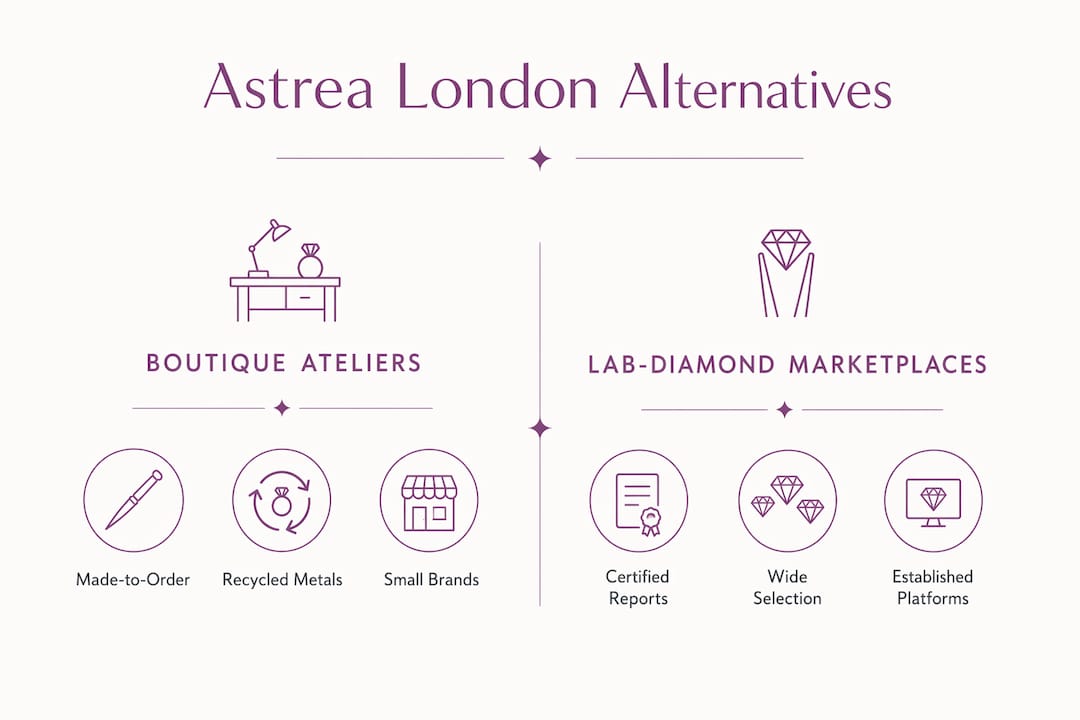
The strongest alternatives to Astrea London fall into three categories: boutique moissanite ateliers (best for brilliance and value), certified lab-grown diamond marketplaces (best for buyers who need GIA or IGI documentation), and made-to-order artisan studios (best for bespoke, traceable pieces). For US shoppers who want all three qualities in one place, Merijaan is the clearest starting point.
- Value-first buyers: Boutique moissanite ateliers offer comparable sparkle at a fraction of lab-grown diamond pricing, with recycled-metal options increasingly standard.
- Certification-focused buyers: National lab-grown diamond marketplaces carry GIA, IGI, or GCAL reports on every stone and typically ship across the US with free returns.
- Bespoke buyers: Made-to-order artisan studios document sourcing per piece, reduce inventory waste, and give you a traceable provenance trail from metal to setting.
Trust signals to check across all three: third-party lab reports, recycled or Fairmined metal certification, and a clear made-to-order or small-batch disclosure.
Table of Contents
- How do the best Astrea London alternatives compare at a glance?
- What does each alternative category actually offer?
- Six questions to ask before you choose an alternative to Astrea London
- Lab-grown diamonds vs. lab-grown moissanite: which suits you?
- Practical buying checklist for US shoppers before you click buy
- Credible US-available alternatives to Astrea London
- Key Takeaways
- Why transparency beats marketing language in ethical jewelry
- Merijaan: a sharper alternative for buyers who want more than a label
- Sources and further reading
How do the best Astrea London alternatives compare at a glance?
| Dimension | Boutique Moissanite Ateliers | Certified Lab-Diamond Marketplaces | Made-to-Order Artisan Studios | Merijaan |
|---|---|---|---|---|
| Gemstone type | Lab-grown moissanite | Lab-grown diamond | Lab-grown diamond or moissanite | Lab-grown moissanite |
| Sustainability credentials | Recycled metals common; RJC varies | Recycled metals; some RJC-certified | Fairmined or recycled metals; per-piece audit possible | Recycled metals; social-mission model |
| Certification / lab report | Maker’s certificate; IGI on request | GIA, IGI, or GCAL standard | IGI or maker’s report | Maker’s certificate |
| Design style | Elegant, contemporary | Classic to modern | Fully bespoke | Elegant, heirloom-quality |
| Price positioning | affordable to moderate price range typical | moderate to higher price range | moderate price range | Accessible luxury |
| Customization | Limited to moderate | Moderate | High; made-to-order standard | Made-to-order options |
| US shipping / returns | Yes; 30-day returns common | Yes; 30–60 day returns | Yes; varies by studio | Yes |
| Carbon / energy disclosure | Rare | Occasional | Occasional | Not publicly listed |
Verifying IGI or GIA grading reports for lab-grown diamonds and checking recycled-metal percentages are the two most important steps when evaluating any seller’s sustainability claims.
Pro Tip: GIA and IGI reports speak only to the stone. Confirm recycled-metal sourcing and supply-chain audits separately — those are two different documents, and a seller who conflates them is waving a red flag.
What does each alternative category actually offer?
Merijaan: ethical moissanite with a social mission
Merijaan builds its entire model around lab-grown moissanite set in recycled metals, with made-to-order production that keeps provenance traceable per piece. Every dollar of profit goes back to the artisans who make the jewelry, which is a structural commitment rather than a marketing line. The design language runs toward heirloom elegance: clean lines, refined settings, pieces that read as fine jewelry without the fine-jewelry markup. For US shoppers who want documented ethics and genuine craftsmanship, it is the most direct Astrea London alternative in the moissanite category.
Boutique moissanite ateliers
These are small-to-mid-size direct-to-consumer brands that specialize in moissanite. Prices typically start in the low hundreds for a solitaire pendant and rarely exceed mid-thousands for an engagement ring. Most offer recycled sterling silver or 14k gold settings. The gap to watch: certification varies widely. Some issue only an in-house grading card; others partner with IGI. Best for buyers who prioritize sparkle and value over diamond-equivalent documentation.
National lab-grown diamond marketplaces
Larger platforms carry thousands of stones with GIA, IGI, or GCAL reports attached to each listing. You can filter by cut grade, color, and clarity, then pair the stone with a setting. Made-to-order production is less common here; most inventory is pre-cut and ready to ship. Returns run 30–60 days, and financing through Affirm or Klarna is standard. Best for buyers who need a graded stone and want to comparison-shop on paper specs.
Made-to-order artisan studios
These studios build each piece after you order, which means near-zero overstock and the ability to document sourcing at the item level. Lead times run 3–6 weeks. Pricing sits in the mid-range, and customization is the main draw. Best for buyers who want a one-of-a-kind piece with a traceable supply chain.
Pro Tip: Ask any artisan studio for the specific recycled-metal percentage in your piece, not just a general “we use recycled metals” statement. Industry benchmarks treat 90%+ recycled content as a meaningful threshold.
Six questions to ask before you choose an alternative to Astrea London
- Does the listing include a third-party lab report? Ask for the GIA, IGI, or GCAL report number and verify it matches the stone or listing directly on the lab’s website. Unverified report numbers are a common gap.
- What percentage of the metal is recycled, and can you document it? A vague “recycled metals” claim without a percentage or supplier audit is not a sustainability credential.
- Does the maker publish energy sourcing details for the growth lab? Some brands disclose whether their stones are grown with renewable energy; this is an emerging but meaningful signal.
- Is the piece made to order or pulled from stock? Made-to-order production allows per-item provenance documentation that stock inventory cannot match.
- What are the exact return and warranty terms? Confirm the return window in days, whether it covers resizing, and whether the warranty covers manufacturing defects separately from accidental damage.
- Does the brand offer after-sales repairs and polishing? A seller who disappears post-purchase is a real risk with smaller online brands. Ask about turnaround time for repairs before you buy.
Red flags: “Ethically sourced” with no certification name attached; recycled-metal claims with no percentage; lab reports that cannot be verified on the issuing lab’s own portal.
Lab-grown diamonds vs. lab-grown moissanite: which suits you?
Moissanite is the better choice for buyers who want maximum brilliance per dollar. Lab-grown diamonds are the better choice for buyers who need parity with traditional diamond grading systems, GIA or IGI documentation, and the cultural weight of “diamond.”
On sparkle, moissanite’s higher fire means smaller stones read visually larger in delicate settings, which is a genuine design advantage for elegant, minimalist pieces. On hardness, both score near the top of the Mohs scale (moissanite at 9.25, lab-grown diamonds at 10), so daily wear is a non-issue for either. On price, moissanite runs significantly less per carat, letting you size up without the cost jump. On certification, lab-grown diamonds come with GIA or IGI reports as standard at most reputable sellers; moissanite typically comes with a maker’s certificate, which covers the stone’s identity but not a full cut-grade analysis.
Pro Tip: If you’re drawn to a delicate halo or pavé setting, moissanite’s extra brilliance can make the design pop in a way a same-size diamond sometimes doesn’t. Factor that into your stone-size decision before you finalize the setting.
For a deeper look at how these two options compare on environmental footprint, the difference in production energy is worth reading before you decide.
Practical buying checklist for US shoppers before you click buy
- Lab report: Request the GIA, IGI, or GCAL report number and verify it on the lab’s website before purchase.
- Recycled-metal documentation: Ask for the percentage recycled content and any supplier audit; 90%+ is a meaningful benchmark per industry disclosure standards.
- Made-to-order confirmation: Confirm whether your piece is built after ordering or shipped from stock, and get the lead time in writing.
- Return policy: Confirm the exact return window, condition requirements, and whether return shipping is covered.
- Warranty terms: Distinguish between a manufacturing-defect warranty and an accidental-damage policy; ask about repair turnaround.
- Shipping insurance: Confirm the shipment is insured and that there is a US-based returns address.
- Payment and financing: Check whether the seller offers Affirm, Klarna, or another installment option, and read the interest terms before selecting a plan.
- After-sales service: Ask one direct question about polishing or prong re-tipping before you buy; the response speed tells you a lot.
Credible US-available alternatives to Astrea London
Several brands ship to the US and cover the ethical lab-grown and moissanite space that Astrea London occupies in the UK.
Merijaan is the most direct moissanite alternative, with recycled metals, made-to-order options, and a profit-sharing model that returns 100% of profits to makers. Brilliant Earth is the largest US-based ethical fine-jewelry retailer, carrying both lab-grown diamonds and moissanite with recycled gold and RJC certification. Clean Origin focuses exclusively on lab-grown diamonds with IGI certification and a 100-day return window. Vrai uses single-origin lab-grown diamonds grown with renewable hydroelectric power and publishes energy sourcing details. James Allen is a high-volume marketplace with GIA and IGI reports on every stone and a 360-degree viewing tool. Charles & Colvard is the original moissanite brand, offering Forever One moissanite with its own grading reports and a wide range of settings.
Each ships to the US, offers some form of third-party documentation, and works with recycled or responsibly sourced metals to varying degrees. The conflict-free fine jewelry guide covers what to verify across these brands before committing.
Key Takeaways
Merijaan is the strongest moissanite-first alternative to Astrea London for US shoppers who want documented ethics, elegant design, and a social mission built into the price.
| Point | Details |
|---|---|
| Verify the stone separately from the metal | GIA/IGI/GCAL reports cover the stone only; request recycled-metal documentation as a separate step. |
| Made-to-order signals traceability | Per-piece provenance is easier to document when a brand builds to order rather than ships from stock. |
| Moissanite suits value and brilliance buyers | Moissanite delivers more fire per dollar and reads larger in delicate settings than a same-size diamond. |
| Merijaan for ethical moissanite | Merijaan combines recycled metals, made-to-order options, and 100% profit return to makers in one brand. |
Why transparency beats marketing language in ethical jewelry
The phrase “ethically sourced” has become almost meaningless without documentation behind it. What actually separates a credible ethical jeweler from one that’s just using the language is a paper trail: a lab report number you can verify, a recycled-metal percentage with a supplier name attached, and a clear answer about where the stone was grown and how.
What strikes me about the Merijaan model specifically is that the social mission is structural, not decorative. Returning profits to makers changes the incentive at the production level, not just the marketing level. That’s the kind of commitment that holds up when you ask hard questions. Buyers who care about traceability should be asking those questions of every brand on this list, including the well-known ones. A brand that answers quickly and specifically is worth your money. One that pivots to vague language about “our commitment to sustainability” probably isn’t.
The ethical luxury trend is real, but it has also created cover for brands that perform ethics without practicing them. The checklist in this article exists precisely because the gap between claim and documentation is where most shoppers get misled.
Merijaan: a sharper alternative for buyers who want more than a label
If you’ve been comparing sites like Astrea London and want something that ships to the US with genuine ethical credentials, Merijaan is worth a direct look. The core offer is lab-grown moissanite in recycled-metal settings, made to order, with 100% of profits returned to the artisans who craft each piece. That’s not a tagline; it’s the business model.

The design sensibility runs toward timeless elegance: pieces that feel heirloom-quality without the heirloom price. The Frauenfeld Necklace is a strong starting point if you want to see what that looks like in practice. Customers consistently highlight the sparkle and the craftsmanship, two things that are hard to fake at this price point. Browse the full Merijaan collection to find a piece that fits your style and your values.
Sources and further reading
- How to choose sustainable jewelry: a step-by-step guide – Eternal Carat: Covers grading report verification, recycled-metal documentation, and made-to-order as a sustainability indicator.
- Is Moissanite Sustainable? Eco-Friendly Gemstone Deep Dive – Merijaan: Explains moissanite’s production process, environmental footprint, and buyer guidance.
- Lab-Grown Diamonds vs. Mined Diamonds – Merijaan: Technical and ethical comparison useful for buyers deciding between stone types.
- Examples of Conflict-Free Fine Jewelry to Buy in 2026 – Merijaan: Curated examples with verification guidance for US shoppers.
- Why Moissanite Is the Future of Ethical Jewelry – Merijaan: Cost, ethics, and design trade-offs explained for buyers comparing moissanite to lab-grown diamonds.
To verify a lab report, go directly to the GIA, IGI, or GCAL portal and enter the report number from the listing. Any seller who cannot provide a verifiable report number should be asked why before you proceed.
Recommended
- Why Moissanite Is the Future of Ethical Jewelry in 2026 – The Meri Jaan
- Eco-Friendly Elegance: Why Moissanite Is the Sustainable Jewelry Choice – The Meri Jaan
- Top 3 Smilingrocks.com Lab-Grown Jewelry Alternatives 2026 – The Meri Jaan
- Why Meri Jaan Uses Moissanite | Ethical, Sustainable Luxury – The Meri Jaan

