

For most buyers, ready-made moissanite is the better choice. You see the exact stone and setting before you pay. You can wear the piece within days, and the return and warranty terms are usually clearer. Custom work makes sense when you want a specific cut, a one-off setting, or an engraving that no catalog piece offers. This guide compares the two on cost, time, design freedom and quality. It also covers the Swiss rules on VAT, customs, returns and warranty, which change the math for buyers in Switzerland.
TL;DR
- Ready-made means you judge the finished piece yourself, ship it quickly, and compare it against other pieces side by side.
- Custom means more design control, but a longer process, more decisions, and stricter terms on changes and returns.
- Moissanite is silicon carbide with a Mohs hardness of about 9¼, so both routes give you a durable stone.
- In Switzerland there is no general right to withdraw from an online purchase. Confirm return and exchange terms in writing before you order, especially for personalized work.
- Check VAT, duties and carrier fees on imported jewelry before you compare final prices.
Table of Contents
- What custom and ready-made actually mean
- Side-by-side comparison
- Cost: what you really pay
- Time: days or weeks
- What you can personalize
- How to judge quality in either option
- Swiss rules to check before you buy
- Our perspective
- Shop ready-made moissanite from Meri Jaan
- How to decide in five minutes
- FAQ
- Sources
What custom and ready-made actually mean
Ready-made jewelry is designed, cast, set and finished before you order. You choose from existing rings, necklaces, bracelets or earrings, often in a few sizes and metal finishes. What you see on the product page is what arrives.
Custom jewelry is made or modified after you order. That ranges from light personalization, such as an engraving, a different band width or a specific ring size, to a full design where you pick the stone shape, the setting and the metal, and approve a sketch or render before production.
There is a middle path that many buyers overlook: semi-custom. You start from an existing design and change one or two details. It keeps most of the predictability of ready-made and gives you some of the personal touch.

In both cases the stone itself is the same kind of material. Moissanite is synthetic silicon carbide with a Mohs hardness of about 9¼, according to a paper from the Swiss Gemmological Institute. That means the stone is not the variable. The setting, the metal, the craftsmanship and the terms of sale are.
Side-by-side comparison
| Factor | Ready-made | Custom |
|---|---|---|
| What you see before paying | The finished piece, in photos and often video | A sketch or render, then the piece after production |
| Design freedom | Choose from the collection | Stone shape, setting, metal, engraving, proportions |
| Waiting time | Shipping time only | Design approval, production, then shipping |
| Price clarity | One listed price | A quote that can change with each decision |
| Returns and exchanges | Usually the seller’s standard policy | Often limited for made-to-order items, so ask first |
| Resizing | Often covered by a published policy | Depends on the design and the maker |
| Best for | Gifts, everyday wear, stacking, first moissanite | Signature rings, unusual shapes, meaningful details |
The pattern is simple: ready-made trades some freedom for certainty, and custom trades certainty for freedom. Neither is better in the abstract. The right one depends on how much you care about a detail a catalog cannot give you.
Cost: what you really pay
Custom work usually costs more than a comparable ready-made piece, because someone has to design, quote, produce and revise it one time only. A catalog piece spreads that effort across many units. Exact figures depend on the maker, the metal and the stone size, so treat any number you see online as a starting point and ask for an itemized quote.
When you compare, look at the whole price and not only the stone:
- The stone: size, cut and color grade.
- The metal: sterling silver, plated silver or solid gold, each with a different price and wear pattern.
- The labor: setting, finishing, engraving and any revisions.
- Shipping, insurance and tracking.
- Swiss import VAT, customs duty and carrier clearance fees if the piece comes from abroad (more on this below).
If you want a sense of typical price ranges for a ring, our guide on what a moissanite ring really costs walks through the factors, and Swiss moissanite value explains how stone size and color affect what you should expect to pay.
The cost advantage of ready-made is not only the sticker price. A custom quote can grow with each change, such as a different shape, extra side stones or a switch of metal. A listed price does not move.
Time: days or weeks
Ready-made pieces ship once you order. Your wait is the carrier’s transit time plus any customs clearance.
Custom pieces add stages before shipping. A typical process looks like this:
- You send a brief, reference photos and a budget.
- The maker proposes a design, often as a sketch or 3D render.
- You request changes and approve the final version.
- The piece is produced, set and finished.
- It is checked, packed and shipped.
Each loop of revisions adds time. We will not quote a standard number of weeks, because it varies from maker to maker. Ask for a written timeline, and ask what happens if you need the piece by a particular occasion. If a deadline matters, such as a proposal, a birthday or a wedding, a ready-made piece removes the risk of a late delivery.
What you can personalize
When buyers say custom, they usually mean one or more of these choices:
- Stone shape and size. Round, oval, pear, emerald or a less common cut. Moissanite is produced in a lab, so cutters can offer a consistent supply of stones in many shapes.
- Setting style. Solitaire, halo, three-stone, bezel or a tension setting. Our article on moissanite tension settings explains how that one works and when it suits you.
- Metal and finish. Silver, gold plating or solid gold, and the color of the metal.
- Band details. Width, profile, texture and engraving.
- Fit. Exact ring size, a half size, or a band shaped to sit flush against another ring.
Before you commit to a full custom design, check whether your idea already exists in a collection. Browsing ready-made options is quick, and you may find that the ring style you imagined is already there. Our moissanite ring style guide helps you work out which shapes and settings suit your hand, and the moissanite engagement ring ideas show how far catalog designs can go.
How to judge quality in either option
A custom ring and a ready-made ring should pass the same checks. Do not let the word “custom” substitute for evidence.
Check the stone. Moissanite has high double refraction, which can make facet edges look doubled when you look through the stone under magnification. That is a normal property of the material, not a flaw. What you should compare is cut quality, symmetry, polish and how clean the stone looks. For a closer look at how it plays with light, see our piece on moissanite brilliance.
Check the metal marks. Under Swiss precious-metal control rules, precious-metal goods must bear a responsibility mark and a fineness mark. Recognized fineness standards include 375, 585, 750, 916 and 999 for gold, and 800, 925 and 999 for silver. If a seller calls a piece 925 silver or 750 gold, ask where the stamp sits and what it says. If a piece is plated, the seller should say so plainly.
Check the finish. Look at prong tips, the inside of the band, the underside of the setting and the clasp or earring back. Clean, even work in those hidden places usually points to careful production.
Ask what is written down. For a custom order, get the stone shape and size, the metal, the approved design, the price, the timeline and the revision rules in writing. For ready-made, read the product page and policy carefully and keep screenshots.
Swiss rules to check before you buy
This is where buyers in Switzerland most often get surprised. The following applies whether the piece is custom or ready-made, but it matters more for custom work because of how returns are handled.
VAT, duties and carrier fees
If the jewelry ships from outside Switzerland, customs rules apply. The Swiss Federal Office for Customs and Border Security states that import VAT is 8.1% of the assessment basis, which generally includes the purchase price, delivery costs to Switzerland and import duties. Foreign VAT shown separately is excluded. The same office notes that jewelry can attract higher customs duties, that duties under CHF 5 and tax amounts up to CHF 5 are not levied, and that you should check the tariff and your carrier’s clearance fee.
For a practical look at how packing and shipping choices affect import charges, see our guide to avoiding VAT surprises when shipping jewelry to Switzerland.
Ask every seller three questions: Is VAT included in the price? Who pays import VAT and duties? Is the shipment insured and tracked?

Withdrawal, returns and exchanges
Switzerland does not give online shoppers a general right to cancel. According to SECO, the Swiss State Secretariat for Economic Affairs, there is no general statutory right of withdrawal for internet purchases. Such a right exists for doorstep sales and certain special contracts, and a seller may offer one voluntarily.
In practice, that means the seller’s written policy is what protects you. This matters most for personalized pieces, where a seller may reasonably refuse to take back something made to your specification. Ready-made pieces are easier to return or exchange, provided the policy says so. If you want a neutral overview of what to consider when handling returns on a purchase, handling returns locally covers the basics from both the buyer’s and the seller’s side.
Warranty and defects
Statutory protection still applies. For defective goods in consumer sales, SECO states that the buyer may seek rescission, a price reduction or replacement, and that the limitation period for consumer warranty claims is two years. That period cannot be shortened in B2C contracts, except for second-hand goods, where it may be reduced to at least one year.
A seller’s own warranty is a separate matter and can go beyond the legal minimum. Read what it covers: stone loss, setting repairs, plating wear, resizing, or exchanges.
Resizing
Ask about resizing before you buy. Some designs, such as full eternity bands or tension settings, are harder to resize than a simple solitaire. Find out whether resizing is free, how many times it is allowed, and who pays for shipping.
Our perspective
We make ready-made moissanite jewelry, and we think it is the smarter starting point for most people. That is not a claim that custom is wrong. It is a claim about risk. When you buy a finished piece, you know what it looks like, what it costs and when it arrives.
Moissanite already gives you a large, bright stone without a diamond-sized bill, and we think the money you save is best spent on pieces you will actually wear. A well-designed ring, necklace or stack you can order today beats a perfect idea that arrives after weeks of revisions.
We also believe in standing behind what we sell. Our jewelry carries a lifetime warranty, and our club members get unlimited exchanges, so a wrong size or a change of mind does not leave you stuck. You can read how that works in our guide to unlimited jewelry exchange for Swiss buyers. And 100% of our profits go back to the people who make our jewelry, so each purchase supports the craftsmanship behind it.
If you want to understand the value and the ethics behind lab-grown stones, we explain both in Is Moissanite Worth It for Engagement Rings? and in our piece on why moissanite is a sustainable choice.
Ammar
Shop ready-made moissanite from Meri Jaan
If you want a statement piece at a fair price, start with our finished collections. You can browse rings for women, including our vintage rings, as well as necklaces, bracelets and earrings. Every piece is lab-grown moissanite, made to be worn and not kept in a drawer.
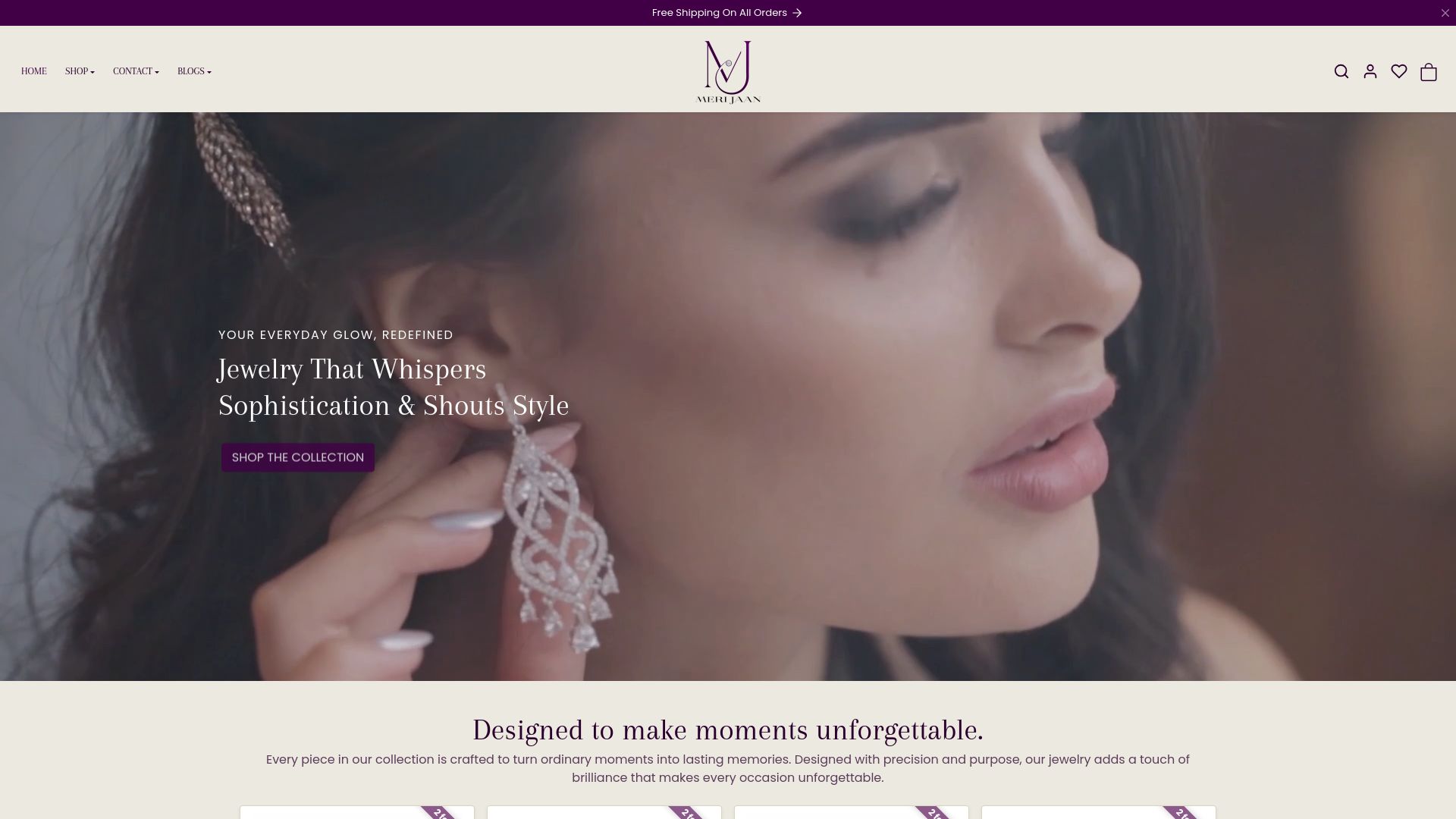
You can see the full range on the Meri Jaan home page, where each product page shows the details, and our lifetime warranty applies to what you buy.
How to decide in five minutes
Answer these questions honestly:
- Do you need it by a certain date? If yes, choose ready-made.
- Is there a detail you cannot find in any collection? If yes, ask a maker about custom or semi-custom work. If no, ready-made.
- Do you want to compare before you pay? Ready-made lets you do that. Custom shows you a render and asks for trust.
- Is flexibility after purchase important? Look for a seller with clear exchange and resizing terms, and be especially careful with made-to-order items.
- Is the total price, including Swiss VAT and duties, within your budget? Ask for a written total before you pay.
If you land on ready-made, you are in good company. Most people who want a bright, durable stone for everyday wear find what they need in a finished design, and they can spend the time they save on enjoying it.
FAQ
Is custom moissanite jewelry worth the extra cost?
It is worth it when you want a detail you cannot find in any collection, such as an unusual cut, a specific setting or a meaningful engraving. If your main goal is a beautiful, durable piece at a fair price, a ready-made design usually delivers the same stone for less money and less waiting. Ask for an itemized quote so you can see what you are paying for.
Can I return a custom piece in Switzerland?
Not automatically. Swiss law has no general right of withdrawal for online purchases, so the seller’s written policy decides. Personalized items are often excluded, so confirm the terms before you pay. Statutory defect remedies still apply if the piece is faulty.
Are custom and ready-made moissanite the same quality?
The stone is the same material in both cases, silicon carbide with a hardness of about 9¼. Quality differences come from cut, setting, metal and finishing. Judge each piece on those points, and check for fineness marks on precious-metal items.
Do I pay import VAT on jewelry ordered from abroad?
Usually yes. Swiss import VAT is 8.1% of the assessment basis, which generally includes the price, shipping and duties, and carriers may add a clearance fee. Amounts of tax up to CHF 5 are not levied. Check whether the seller’s price already includes these costs.
Is ready-made the better choice for a first moissanite piece?
For most buyers, yes. You can see exactly what you are getting, wear it soon, and learn how you like moissanite before you invest in a one-off design. Stacking pieces or a classic solitaire make an easy first step.
Sources
- Swiss Precious Metals Control, Zentralamt für Edelmetallkontrolle
- Update on moissanite identification, Swiss Gemmological Institute
- Courier by post, online shopping, mail-order company, Swiss Federal Office for Customs and Border Security
- Problemi dopo l’acquisto, SECO
